Louis Michel Eilshemius: A Visionary Outsider
Born into affluence in 1864 near Newark, New Jersey, Louis Michel Eilshemius remains a compelling and often perplexing figure in the landscape of American art. His life was a curious blend of rigorous academic training and an utterly untamed artistic spirit—a dichotomy that resulted in works both hauntingly beautiful and deliberately unsettling. Though born into privilege, Eilshemius’s path wasn’t one of easy acceptance within the established art world; instead, he carved out his own unique niche, becoming a celebrated outsider whose vision was truly ahead of its time. He received a comprehensive education, studying in Europe and briefly attending Cornell University before dedicating himself to art at the Art Students League of New York. This formal grounding is evident in his early landscapes, which initially echoed the Barbizon school and artists like Corot, George Inness, and Albert Pinkham Ryder—but even then, a nascent individuality began to glimmer beneath the surface. These initial works, while technically proficient, failed to garner significant attention, setting the stage for a dramatic shift in style that would define his legacy.
- Early Influences & Academic Training
- The Transformation of Style: Cardboard and Dreamlike Visions
- Recognition Amidst Bewilderment: Duchamp’s Patronage
- A Life Marked by Eccentricity & Decline
- Legacy & Enduring Influence: A Pioneer of Naive Art
Early Influences & Academic Training
Eilshemius’s formative years were steeped in European culture. Born to a Dutch father and Swiss mother, he benefited from considerable familial wealth allowing him access to privileged schooling abroad. His artistic inclinations began to blossom during his time at Dresden where he received initial drawing lessons—a grounding that would prove crucial for his later explorations of artistic expression. He continued his studies at Cornell University gaining knowledge in science and humanities before immersing himself fully into the Art Students League of New York, fostering connections with fellow artists and honing his technical skills under Robert Crannell Minor. This early exposure to established artistic traditions—particularly the Barbizon school—influenced his initial landscapes, mirroring the stylistic choices of Corot, George Inness, and Albert Pinkham Ryder. Despite demonstrating considerable talent, these works initially failed to resonate with critics or the public, hinting at the profound divergence that would characterize his subsequent artistic journey.
The Transformation of Style: Cardboard and Dreamlike Visions
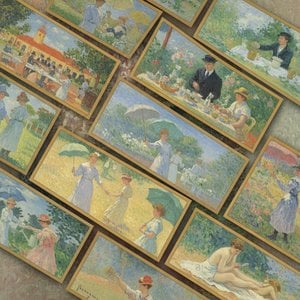
Around 1910, Eilshemius’s artistic voice underwent a seismic shift—a rejection of conventional techniques driven by an unwavering desire for originality. He deliberately abandoned canvas opting instead for cardboard—a decision that profoundly impacted the texture and character of his paintings. This stylistic choice wasn't merely pragmatic; it reflected a deeper impulse to bypass academic constraints and embrace a more visceral approach to artistic creation. The resulting canvases possessed a raw, unrefined quality—a hallmark of his signature style: moonlit landscapes populated by voluptuous nymphs and figures rendered with an almost childlike naiveté. These weren’t idealized depictions of mythological beings; they were dreamlike visions imbued with a strange, unsettling energy. The nudes themselves often sported exaggerated smiles adding to the disconcerting effect—a deliberate departure from classical artistic conventions. His paintings of New York rooftops similarly prioritized visual impact over meticulous detail utilizing sinuous “frames” he painted directly onto the canvas emphasizing their otherworldly aura.
Recognition Amidst Bewilderment: Duchamp’s Patronage
Despite facing widespread critical bewilderment during his lifetime Eilshemius found an unlikely champion in Marcel Duchamp—a figure whose appreciation for Eilshemius's work transcended conventional artistic judgment. Recognizing the unique power of Eilshemius’s vision Duchamp invited him to exhibit in Paris in 1917—a gesture that brought some international attention but also sparked considerable controversy. The Parisian reception was mixed—some critics lauded his originality while others dismissed it as nonsensical—yet Duchamp's endorsement planted a seed for future appreciation. For years Eilshemius remained largely overlooked struggling with financial hardship and experiencing a gradual decline in mental health. He continued to paint write compose music and publish his own eccentric manifestos all whilst battling obscurity.
A Life Marked by Eccentricity & Decline
Throughout his life Eilshemius maintained an unconventional lifestyle—characterized by erratic behavior and a fervent dedication to artistic pursuits alongside intellectual endeavors. He famously signed his paintings “Elshemus”—believing that the length of his name hindered recognition—a gesture reflecting his frustration with societal indifference. His penchant for flamboyant pronouncements and self-promotion fueled speculation about his mental state—further compounded by an automobile accident in 1932 which precipitated a debilitating physical deterioration. Despite these challenges Eilshemius persevered continuing to create art until his death in Bellevue Hospital in 1941—a testament to his unwavering commitment to artistic expression.
Legacy & Enduring Influence: A Pioneer of Naive Art
Today Louis Michel Eilshemius is celebrated as a pivotal figure in American modernism—a precursor to both Naive art and the visionary landscapes that would emerge later in the 20th century. His work can be found in prominent collections such as The Phillips Collection in Washington D.C., and the Neuberger Museum of Art in New York State—houses which showcase a substantial body of his paintings donated by Roy Neuberger. Eilshemius’s influence extends beyond his aesthetic innovations—he embodies the spirit of artistic independence—a refusal to compromise one's vision for acceptance. His story serves as a reminder that true originality often resides on the fringes—and that sometimes it takes time for the world to recognize a visionary artist. He was an artist who dared to be different—leaving an indelible mark on the history of American art.



 Visualizar em escala
 Alternar para Impressão
 Enviar
 Compartilhar
 Ver detalhes
 Guia de Obras do Aluno

 Baixar imagem
 Semelhantes
 Raio X
 Apresentação de slides
 Estatísticas

 Ver mais






































 A opção de vidro está disponível apenas para tamanhos inferiores a 110 cm