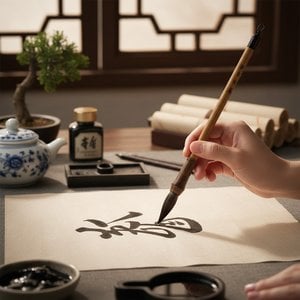
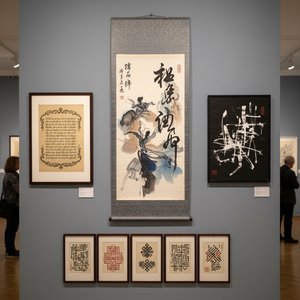
The Elegance of Running Script and Poetic Reflection
Liang Tongshu (1723–1815) stands as a luminous figure within the storied annals of Qing Dynasty calligraphy, a master whose brush captured the very pulse of an era. Recognized as one of the “Four Great Calligraphers” during the Qianjia reign, his artistry represents a pinnacle of intellectual and aesthetic refinement. His legacy is not merely found in the technical precision of his strokes, but in the profound emotional resonance and literary depth embedded within every character. To study Liang’s work is to witness a seamless marriage between the rhythmic vitality of Running Script (Xingshu) and the contemplative grace of classical Chinese poetry.
The foundations of Liang’s distinctive style were laid in his native Shandong Province, where he underwent rigorous artistic training under the guidance of the renowned calligrapher Zhu Daqi. This mentorship was transformative; Zhu Daqi championed the principles of simplicity and naturalness, values that would become the heartbeat of Liang’s creative vision. From this early instruction, Liang inherited an unwavering dedication to capturing the essence of the natural world through the medium of ink. He learned to prioritize harmony and balance over mere ornamentation, a philosophy that allowed his later works to breathe with an organic, unforced vitality.
The Mastery of Fluidity and Form
While many calligraphers of his era sought prestige through the rigid structures of Seal or Clerical scripts, Liang Tongshu found his true voice in the more expressive realms of Running Script and Cursive Script (Caoshu). These styles, characterized by their spontaneity and dynamism, provided him with the perfect vessel to convey subtle nuances of human emotion. His approach was deeply rooted in a meticulous observation of nature—the winding path of a river, the rugged silhouette of a mountain, or the swaying of bamboo. He possessed the rare ability to translate these visual rhythms into graceful curves and flowing lines that mirrored the movement of life itself.
In his most celebrated works, such as his various poems and couplets, one can observe a rhythmic composition that feels almost musical. His brushwork often exhibits:
- Dynamic Energy: A sense of motion where characters seem to dance across the paper, connected by invisible threads of momentum.
- Structural Balance: An expert command over the weight and density of ink, ensuring that even the most free-flowing strokes maintain a sense of structural integrity.
- Literary Symbiosis: A profound connection between the written word and the visual form, where the aesthetic beauty of the calligraphy enhances the poetic meaning of the text.
Historical Significance and Lasting Legacy
The historical importance of Liang Tongshu extends far beyond his technical achievements. As a scholar-artist, he embodied the ideal of the literati, for whom calligraphy was an extension of moral character and intellectual cultivation. His ability to infuse Xingshu with such profound poetic reflection helped define the aesthetic standards of the late Qing period. Even today, his works are held in high esteem by global institutions, such as the Tokyo National Museum, serving as vital touchstones for understanding the evolution of Asian calligraphy.
Liang’s contribution to the art world lies in his ability to bridge the gap between the disciplined tradition of his predecessors and a more personal, expressive form of artistry. By embracing the fluidity of the cursive styles, he ensured that the art of calligraphy remained a living, breathing medium capable of expressing the deepest complexities of the human spirit. His life’s work remains a testament to the enduring power of the brush to capture both the permanence of history and the fleeting beauty of a single, perfect moment.


 Visualizar na parede
 Compartilhar
 Compartilhar
 Detalhes
 Guia
Guia

 Baixar imagem
 Semelhantes
 Raio X
 Ver diaporama
 Perguntas e Respostas
 Estatísticas
 Ler mais
 Alternar para Impressão





































 A opção de vidro está disponível apenas para tamanhos inferiores a 110 cm