Visualizar na parede Visualizar em RA Alternar para Impressão Alternar para Imagem Digital Compartilhar
Detalhes Guia Adicionar aos favoritos Baixar imagem Semelhantes Raio X Ver diaporama Estatísticas

Untitled

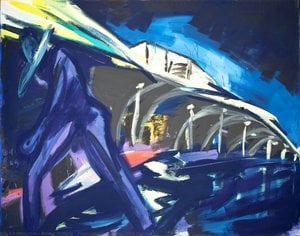
A man in visible distress lies amidst scattered birds in this evocative 1979 painting by Jörg Immendorff, offering a profound glimpse into the artist's provocative vision that you can bring to your collection.

Explore the provocative art of jörg immendorff – a German painter & sculptor known for 'Lidl,' political cycles, & experimental stage design. Discover his unique vision.

A obra de arte exibida nesta página é protegida por leis de direitos autorais, o que significa que não podemos criar ou vender legalmente uma reprodução idêntica. Esta proteção é aplicada por meio de acordos internacionais, tais como a Convenção de Berna e pelas leis nacionais, incluindo as estabelecidas por Lei de Direitos Autorais dos EUA - Título 17.

Como uma alternativa respeitosa e legal, oferecemos obras de arte personalizadas e pintadas à mão, inspiradas na obra original. Nossos artistas profissionais e experientes estudam cuidadosamente o estilo, a atmosfera e a essência artística da obra original para criar uma peça nova e única que evoque a mesma sensação — permanecendo como uma criação original por direito próprio.

Este método cumpre plenamente as regulamentações de direitos autorais, pois não envolve a cópia ou duplicação da obra protegida. Em vez disso, trata-se de uma reinterpretação criativa — uma nova pintura que é influenciada pela original, mas não idêntica a ela.

Reprodução em Óleo Feita à Mão

Óleo sobre tela pintado à mão no tamanho e moldura de sua escolha, feito sob encomenda pelos nossos artistas. ( Alternar para Impressão Alternar para Imagem Digital)

Corner sample of the P118B picture frame: poliestireno moldado, 5 cm wide and 3 cm thick
P118B €10
Corner sample of the P118H picture frame: poliestireno moldado, 5 cm wide and 3 cm thick
P118H €10
Corner sample of the P118W picture frame: poliestireno moldado, 5 cm wide and 3 cm thick
P118W €10
Corner sample of the P438Z picture frame: poliestireno moldado, 5.5 cm wide and 3.5 cm thick
P438Z €10
Corner sample of the P508JH picture frame: poliestireno moldado, 7 cm wide and 3.5 cm thick
P508JH €12
Corner sample of the P508YH picture frame: poliestireno moldado, 7 cm wide and 3.5 cm thick
P508YH €12
Corner sample of the P805H picture frame: poliestireno moldado, 5 cm wide and 3.5 cm thick
P805H €10
Corner sample of the P805Z picture frame: poliestireno moldado, 5 cm wide and 3.5 cm thick
P805Z €10
Corner sample of the P919BZ picture frame: poliestireno moldado, 7 cm wide and 3.5 cm thick
P919BZ €10
Corner sample of the P919G picture frame: poliestireno moldado, 7 cm wide and 3.5 cm thick
P919G €10
Corner sample of the P919XJ picture frame: poliestireno moldado, 7 cm wide and 3.5 cm thick
P919XJ €10
Corner sample of the P959ZH picture frame: poliestireno moldado, 5 cm wide and 3 cm thick
P959ZH €10
Corner sample of the P968JZ picture frame: poliestireno moldado, 6 cm wide and 4 cm thick
P968JZ €12
Corner sample of the W106C picture frame: madeira maciça, 5 cm wide and 3 cm thick
W106C €8
Corner sample of the W218G picture frame: madeira maciça, 5 cm wide and 3 cm thick
W218G €10
Corner sample of the W218JH picture frame: madeira maciça, 5 cm wide and 3 cm thick
W218JH €8
Corner sample of the W218Y picture frame: madeira maciça, 5 cm wide and 3 cm thick
W218Y €10
Corner sample of the W307PJ picture frame: madeira maciça, 6 cm wide and 3 cm thick
W307PJ €10
Corner sample of the W316G picture frame: madeira maciça, 6 cm wide and 3 cm thick
W316G €10
Corner sample of the W316PJ picture frame: madeira maciça, 6 cm wide and 3 cm thick
W316PJ €8
Corner sample of the W316Y picture frame: madeira maciça, 6 cm wide and 3 cm thick
W316Y €10
Corner sample of the W398PJ picture frame: madeira maciça, 5 cm wide and 3 cm thick
W398PJ €8
Corner sample of the W4111J picture frame: madeira maciça, 6.5 cm wide and 3.5 cm thick
W4111J €10
Corner sample of the W500HY picture frame: madeira maciça, 7 cm wide and 5 cm thick
W500HY €15
Corner sample of the W500JH picture frame: madeira maciça, 7 cm wide and 5 cm thick
W500JH €15
Corner sample of the W692G picture frame: madeira maciça, 8 cm wide and 4 cm thick
W692G €12
Corner sample of the W849H picture frame: madeira maciça, 5 cm wide and 3 cm thick
W849H €8
Corner sample of the W940BG picture frame: madeira maciça, 7.5 cm wide and 4.5 cm thick
W940BG €15
Corner sample of the W953PJ picture frame: madeira maciça, 6 cm wide and 3.5 cm thick
W953PJ €8

Tamanho padrão
personalizado
CM
INCH

Escolha entre os nossos tamanhos pré-definidos que respeitam as proporções originais da obra de arte.

largura
altura

Insira a largura e a altura desejadas para se ajustarem à sua moldura ou parede. Como esta obra é pintada à mão, para um tamanho com proporções diferentes, o artista poderá pintar um pouco mais ao redor da imagem ou reduzir ligeiramente a composição — você escolhe. Enviamos uma maquete digital para sua aprovação antes de iniciar a pintura. A imagem exibida nesta página não representa o resultado real — apenas a maquete mostra o resultado final.

Exemplos do que pode ser personalizado: Substituir o rosto pela foto do cliente; Adicionar um animal de estimação (ex: substituir gato por cão); Incluir uma mensagem oculta no fundo; Alterar a paisagem ou elementos do fundo.
Após o pedido, a equipa WahooArt.com enviará um e-mail ao cliente para solicitar instruções e fornecer uma prévia do esboço.

Entrega mundial () em 3 a 4 semanas, em vez das 5 semanas padrão. (26 Outubro). Sem comprometer a qualidade.

Envio expresso gratuito para todo o mundo
Tela de Linho de Alta Qualidade
Seguro de transporte completo
Garantia de Reembolso de Impostos Alfandegários
Garantia de Fidelidade Cromática
Política de Devolução em 100 Dias (Apenas para Defeitos)
Garantia de reembolso de 100%
Oferta de desconto por quantidade

Preço Total

€ 239

Untitled

Técnica de Reprodução

Tamanho da Reprodução

-

Preço Total

€ 239

Informações Rápidas

  • Year: 1979
  • Artist: Jörg Immendorff
  • Subject or theme: Distress, birds, and nature

A Vision of Disquiet: Decoding Immendorff’s Untitled

In the vast, evocative landscape of late 20th-century German painting, few voices resonate with as much raw, psychological intensity as that of Jörg Immendorff. His 1979 work, Untitled, serves as a profound window into a mind grappling with the complexities of existence, identity, and the fractured reality of post-war Europe. At first glance, the canvas presents a striking, almost surreal tableau: a solitary figure lies prone upon the earth, hands clasped behind him in a posture that oscillates between weary resignation and acute physical distress. This central subject, rendered with a visceral sense of weight, anchors the composition, drawing the viewer into a silent dialogue regarding human vulnerability and the heavy burden of being.

The painting’s atmosphere is thick with a sense of restless movement, achieved through a masterful orchestration of symbolic elements. Scattered throughout the scene, birds act as ethereal messengers—some perched in quiet contemplation, others caught in mid-flight, slicing through the composition. These avian figures introduce a layer of kinetic energy that contrasts sharply with the stillness of the man on the ground. The presence of a solitary potted plant to the right adds a touch of domesticity or perhaps a symbol of cultivated life amidst a wilder, more chaotic environment. Through this interplay of the grounded and the airborne, Immendorff creates a visual tension that keeps the eye wandering, searching for meaning within the layers of the scene.

Technique and the Language of Expressionism

Immendorff’s technique in this piece is a testament to his ability to blend expressive freedom with structural intent. The brushwork, though appearing spontaneous, possesses a deliberate rhythm that guides the viewer's emotional response. There is a palpable texture to the work, where the application of pigment feels as much like an emotional outburst as it does a formal application of paint. This approach, deeply rooted in the traditions of Neo-Expressionism, allows the artist to bypass mere representation and instead tap into a more primal, symbolic language. The scale of the 145 x 145 cm canvas demands attention, enveloping the viewer in its large-format presence and making the psychological landscape feel immersive and inescapable.

For the discerning collector or interior designer, this artwork offers more than just aesthetic beauty; it provides a profound intellectual anchor. The piece functions as a conversation starter, inviting scrutiny of its historical context—a period marked by political upheaval and the search for a new German identity. Its ability to command a room through its sheer emotional gravity makes it an ideal centerpiece for spaces dedicated to contemplation, modern curation, or avant-garde design. To possess a high-quality reproduction of this work is to bring a piece of art history’s most provocative era into one's personal sanctuary, offering a permanent connection to the turbulent, beautiful spirit of Jörg Immendorff.

Perguntas e Respostas

O que "Untitled", de Jörg Immendorff retrata e qual é a sua atmosfera?

"Untitled", de Jörg Immendorff combina man in distress, birds, potted plant, distress, figures, composition com uma atmosfera Dramatic.

Qual é a saturação e a intensidade de "Untitled", de Jörg Immendorff?

As cores de "Untitled", de Jörg Immendorff apresentam uma saturação Clear Color Presence com uma intensidade Vivid.

Para que tipo de uso se recomenda uma impressão de "Untitled"?

A recomendação de uso para uma impressão de "Untitled" é Conversation.


Biografia do Artista

Early Life and Artistic Awakening

Jörg Immendorff, born in 1945 in Bleckede, Lower Saxony, emerged from the fractured landscape of post-World War II Germany—a context that would indelibly shape his artistic vision. The early departure of his father cast a long shadow, fostering a sense of emotional distance and inadequacy that resonated throughout his life and work. This personal trauma became a catalyst for exploring themes of identity, belonging, and the weight of history. Immendorff’s initial foray into the art world began at sixteen with an exhibition in a Bonn jazz cellar, a modest beginning hinting at the provocative path ahead. His formal training commenced in 1963 at the prestigious Kunstakademie Düsseldorf, initially under the tutelage of theater designer Teo Otto. However, Immendorff’s rebellious spirit and refusal to compromise his artistic integrity led to a swift expulsion from Otto's class—a pivotal moment that propelled him towards the mentorship of the iconoclastic Joseph Beuys.

The Radical Years: Expulsion and the Birth of LIDL

Immendorff’s time with Beuys was transformative, yet his inherent contrarianism and fervent political activism ultimately led to another expulsion from the academy. This rejection fueled a period of intense experimentation and defiance. From 1969 to 1980, he navigated a dual existence as an art teacher and a free artist, accepting visiting professorships across Europe while simultaneously challenging conventional artistic boundaries. It was during this time that Immendorff founded the “LIDL Academy,” a deliberately provocative gesture mocking the elitism of established art institutions. The name itself—inspired by the sound of a child’s rattle—underscored his fascination with new beginnings and innocence, contrasting sharply with the complexities of postwar German society. The LIDL project wasn't a formal group but rather a constellation of artists – including James Lee Byars, Marcel Broodthaers, and Nam June Paik – engaging in actions that ridiculed artistic pretension. His early work incorporated sculptures, performances, and documents alongside paintings, all imbued with a playful yet subversive energy.

Café Deutschland: A Stage for National Identity

The late 1970s marked a turning point in Immendorff’s career with the creation of his renowned *Café Deutschland* series. Inspired by Renato Guttuso’s *Caffè Greco*, these sixteen large-scale paintings transformed nightclubs into vibrant stages for exploring Germany's fractured cultural and political landscape. These weren’t mere depictions of scenes; they were elaborate tableaux vivants populated with a cast of historical figures—from Adolf Hitler to Otto Dix—engaged in chaotic, often unsettling interactions. The series served as a poignant reflection on the division between East and West Germany, grappling with themes of guilt, memory, and national identity. The paintings are characterized by expressive realism, caricature, and symbolic imagery, creating a visually arresting and emotionally charged experience for the viewer. Immendorff’s masterful use of color and composition draws the eye into these complex narratives, inviting contemplation on the enduring legacy of Germany's past.

Grand Cycles and Political Engagement

Immendorff consistently worked in what he termed “grand cycles of paintings,” ambitious projects that spanned years and were deeply rooted in political commentary. Beyond *LIDL* and *Café Deutschland*, notable series included the *Maoist Paintings* and *The Rake’s Progress*. These weren't simply artistic statements; they were attempts to engage directly with the pressing social and ideological issues of his time. His work often reflected a profound inner conflict—a tension between his desire for artistic expression and his commitment to political activism. He questioned the efficacy of art as a tool for change, famously asking in one painting, “Can one change anything with these?” Despite this skepticism, Immendorff continued to use his art as a platform for challenging established norms and provoking critical dialogue.

Legacy and Historical Significance

Jörg Immendorff’s return to the Düsseldorf Art Academy—the institution that had once dismissed him—in 1996 solidified his position as a leading figure in contemporary German art. He mentored a new generation of artists, including Oda Jaune and Renata Jaworska, passing on his rebellious spirit and commitment to artistic innovation. Immendorff’s work remains profoundly relevant today, offering a powerful commentary on the complexities of identity, memory, and political engagement. His willingness to confront difficult truths and challenge conventional boundaries continues to inspire artists and viewers alike. He left behind a body of work that is not only visually striking but also intellectually stimulating—a testament to his enduring legacy as one of Germany’s most provocative and important painters.

Jörg Immendorff

Jörg Immendorff

1945 - 2007

Dados Rápidos

  • Artistic Movement Or Style: Neue Wilde
  • Artists Who Influenced This Artist:
    • Joseph Beuys
    • Renato Guttuso
  • Date Of Birth: 1945
  • Date Of Death: 2007
  • Full Name: Jörg Immendorff
  • Nationality: German
  • Notable Artworks:
    • Lidl paintings
    • Café Deutschland
    • The Rake's Progress
  • Place Of Birth: Bleckede, Germany