A Moment Frozen in Color: Joan Miró’s “Still Life with Rose”
Joan Miró’s “Still Life with Rose,” painted in 1916, isn't merely a depiction of objects; it’s an invitation into the artist’s subconscious. Emerging from the vibrant crucible of early 20th-century Barcelona, this oil on cardboard work embodies the revolutionary spirit of Fauvism and foreshadows the playful abstraction that would define Miró’s entire career. The painting immediately captivates with its bold palette – a symphony of greens, reds, and yellows—a deliberate departure from the muted tones favored by earlier generations. It's a visual declaration of emotion, prioritizing feeling over strict representation.
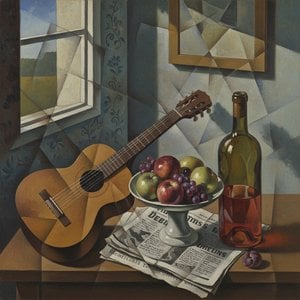
At first glance, the composition appears deceptively simple: a bottle of wine dominates the left foreground, its dark hue contrasting sharply with the luminous rose positioned centrally. Scattered amongst these key elements are several leaves, their delicate forms adding a touch of organic grace to the otherwise geometric arrangement. However, closer inspection reveals a deliberate distortion of reality. The bottle isn’t rendered realistically; instead, it's fragmented and simplified, echoing the Cubist exploration of form that was gaining momentum at the time. Similarly, the rose—a symbol of love, beauty, and fleeting life—is presented with an almost childlike directness, its petals boldly outlined against a vibrant background.
The Fauvist Spark and Catalan Roots
Miró’s “Still Life with Rose” is firmly rooted in the tenets of Fauvism, a movement that prioritized color as the primary means of expression. Artists like Henri Matisse and André Derain had shattered traditional artistic conventions by using pure, unmixed colors—often applied with loose, expressive brushstrokes—to evoke emotion rather than accurately depict reality. Miró embraced this approach wholeheartedly, injecting his Catalan heritage into the painting’s vibrant energy. The use of intense hues and simplified forms can be seen as a reflection of Barcelona's bustling street life and its rich artistic traditions, particularly the work of Antoni Gaudí, whose organic architecture profoundly influenced Miró’s visual vocabulary.
The influence of Cubism is also undeniable. Like Pablo Picasso and Georges Braque, Miró experimented with breaking down objects into geometric shapes and presenting them from multiple viewpoints simultaneously. This technique creates a sense of dynamism and movement within the painting, inviting the viewer to actively engage with the artwork and reconstruct its meaning.
Decoding Symbolism: Beyond the Still Life
While superficially resembling a traditional still life, “Still Life with Rose” is laden with symbolic weight. The wine bottle, often associated with celebration and indulgence, hints at themes of pleasure and perhaps even excess. The rose, as previously mentioned, represents love and beauty but also carries connotations of mortality—a poignant reminder of the ephemeral nature of existence. The scattered leaves suggest a connection to nature and the cyclical rhythms of life and death.
Miró himself often described his work as an attempt to capture “the dream,” drawing inspiration from memories, emotions, and subconscious imagery. In this painting, he seems to be inviting us into that dreamlike realm, where familiar objects are transformed and imbued with new meaning. The overall effect is one of both serenity and mystery—a testament to Miró’s ability to distill complex emotions into a deceptively simple composition.
A Legacy in Color: Miró's Enduring Influence
“Still Life with Rose” stands as a pivotal work in Joan Miró’s artistic development, marking a crucial transition from his early figurative paintings to the more abstract and symbolic works that would define his later career. Its bold colors, fragmented forms, and evocative symbolism paved the way for subsequent art movements, including Expressionism and Surrealism. The painting's influence can be seen in countless contemporary artists who continue to explore the expressive potential of color and form.
Today, “Still Life with Rose” is held within a private collection, offering rare glimpses into Miró’s creative process. Reproductions of this captivating artwork are available through platforms like WahooArt.com, allowing art enthusiasts worldwide to experience the power and beauty of Miró's vision. For those seeking a deeper understanding of this remarkable painting and the artist behind it, resources such as Wikipedia and the Fundació Joan Miró in Barcelona offer invaluable insights.



 Visualizar na parede
 Comprar pintura feita à mão
 Compartilhar
 Compartilhar
 Detalhes

 Baixar imagem
 Semelhantes
 Raio X
 Slideshow
 Stats
Stats


 Ler mais






































 A opção de vidro está disponível apenas para tamanhos inferiores a 110 cm