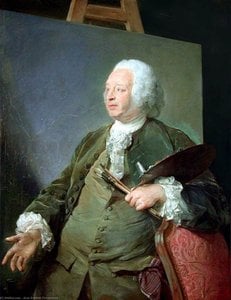
Frederik de Moucheron: A Master of Baroque Still Life
Born in 1633 and passing away in 1686, Frederik de Moucheron was a prominent figure within the Dutch Baroque art scene. While not as widely celebrated as some of his contemporaries, his contributions to still life painting are significant, offering a unique blend of meticulous detail, religious devotion, and a subtle, almost melancholic beauty. De Moucheron’s work reflects the prevailing trends of his time – a fascination with light, shadow, and the textures of everyday objects – but also possesses a distinct personality that sets him apart.
De Moucheron's early life remains somewhat shrouded in mystery, lacking extensive biographical details. He was trained as a landscape painter, a common path for aspiring artists during his era. However, he quickly gravitated towards still life, finding within this genre the opportunity to explore themes of faith and mortality with remarkable sensitivity. His paintings frequently depict arrangements of fruits, flowers, and other objects – often accompanied by religious symbols – creating layered narratives that invite contemplation. The influence of Carlo Dolci, a Florentine painter known for his devotional still lifes, is readily apparent in de Moucheron’s style; both artists shared a penchant for luminous color palettes and a focus on the spiritual significance of their subjects.
- Key Characteristics: De Moucheron's paintings are characterized by an extraordinary level of detail. He meticulously rendered every surface, capturing the sheen of fruit skins, the delicate veins of leaves, and the subtle variations in color. His compositions often feature a carefully arranged pyramid structure, drawing the viewer’s eye to the central focal point.
- Religious Symbolism: De Moucheron frequently incorporated religious symbols into his still lifes – skulls representing mortality, grapes symbolizing the blood of Christ, and lilies signifying purity. These elements elevate the seemingly simple arrangements to profound meditations on life, death, and redemption.
- Color Palette: His use of color is remarkably restrained yet evocative. He favored muted tones—ochres, browns, and greens—creating a sense of quiet solemnity and drawing attention to the textures and forms within each composition.
The Influence of Carlo Dolci and the Florentine Tradition
As noted in research from Art UK, Carlo Dolci’s work served as a significant influence on de Moucheron's artistic development. Dolci, who painted during the same period, was renowned for his intensely devotional still lifes, often depicting scenes of religious contemplation within intimate domestic settings. De Moucheron adopted many of Dolci’s techniques – particularly his masterful use of light and shadow to create a sense of atmosphere—but he developed a more refined and polished style.
The Florentine tradition, with its emphasis on naturalism and the depiction of everyday objects imbued with spiritual meaning, provided a crucial foundation for de Moucheron’s artistic vision. Sir John Finch, a British physician who collected Dolci's works, recognized the value of this connection, highlighting the appeal of these paintings to contemporary European audiences. De Moucheron’s work can be seen as a continuation and evolution of this rich artistic heritage.
Technique and Materials
De Moucheron was known for his meticulous approach to painting, employing a technique characterized by smooth brushwork and an almost photographic level of detail. He utilized oil paints on panel, carefully layering glazes to achieve the desired luminosity and depth. His dedication to realism is evident in every aspect of his work – from the precise rendering of textures to the subtle variations in color.
He was a master of capturing the fleeting effects of light, creating an illusion of three-dimensionality that draws the viewer into the scene. His paintings are not merely representations of objects; they are carefully constructed visual narratives designed to evoke contemplation and spiritual reflection. The influence of Jean-Baptiste Oudry, who focused on animal still lifes and experimented with various media, is also noticeable in de Moucheron’s attention to detail and his ability to capture the essence of natural forms.
Legacy and Historical Significance
Despite not achieving widespread fame during his lifetime, Frederik de Moucheron's work has gained renewed appreciation in recent decades. His paintings are now recognized as important examples of Dutch Baroque still life painting, offering a unique perspective on themes of faith, mortality, and the beauty of the natural world. His meticulous technique and subtle symbolism continue to resonate with viewers today.
De Moucheron’s legacy lies not only in his individual paintings but also in his contribution to the broader artistic landscape of 17th-century Holland. His work serves as a reminder that even within established traditions, artists can develop distinctive voices and create works of enduring beauty and significance.



 Visualizar na parede
 Alternar para Impressão
 Compartilhar
 Compartilhar
 Detalhes

 Baixar imagem
 Semelhantes
 Raio X
 Slideshow
 Estatísticas
 Ler mais