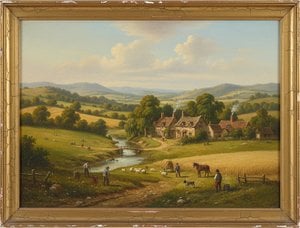
The Spirit of the Hermannsburg School: The Life and Art of Janie Nungala
Born in the heart of Alice Springs, Australia, Janie Nungala (also known as Janie Karpa) carries within her the profound echoes of the Hermannsburg School. Her artistry is not merely a collection of landscapes but a vibrant testament to Aboriginal resilience and an enduring connection to Country. Growing up amidst the arid, breathtaking expanses of Central Australia, Nungala’s creative identity was nurtured by the very soil she depicts. Her journey is deeply intertwined with the legacy of Albert Namatjira, the legendary figure who revolutionized Australian art by bringing the ethereal beauty of the desert vistas to the global stage. Through her work, Nungala continues this lineage, translating the ancient stories of her ancestors into a contemporary visual language that resonates with both local and international audiences.
The foundations of Nungala’s technique were laid organically within the Hermannsburg Lutheran Mission. Rather than seeking formal academic training in distant urban centers, her education was an immersion in the ancestral lands and the wisdom of her elders. This method of learning—rooted in storytelling and a deep observation of the natural world—imbued her work with an authenticity that distinguishes it from more detached explorations of landscape. She absorbed the aesthetic sensibilities championed by Namatjira, specifically the mastery of delicate watercolor washes used to capture the shifting light and atmospheric depth of the Outback. By adopting the use of simplified forms and bold, evocative color palettes, she honors a tradition that rejects European oil painting conventions in favor of a medium that breathes with the fluidity of the Australian landscape.
A Canvas of Resilience and Connection
Nungala’s work serves as a bridge between the physical beauty of the Northern Territory and the urgent socio-political realities facing Aboriginal communities. Her participation in significant cultural exhibitions, such as the 22nd Biennale of Sydney, highlights her role as an artist who uses the landscape to raise awareness about contemporary struggles. Through her art, she explores themes of:
- The enduring connection to Country: Representing the spiritual and physical bond between the people and their ancestral lands.
- Social advocacy: Using the beauty of the landscape to draw attention to critical issues such as housing insecurity and the lack of consultation with traditional owners regarding mining on sacred lands.
- Cultural preservation: Maintaining the watercolor traditions of the Hermannsburg School while asserting messages of self-determination.
In her contributions to collective projects, such as those with the Iltja Ntjarra Many Hands Art Centre, Nungala’s work becomes part of a larger narrative of survival and strength. Her paintings do more than capture scenery; they act as witnesses to the cycles of dispossession and the powerful assertion of identity. By painting the landscapes of the Northern Territory for those in urban environments, she invites the viewer into a world where the beauty of the earth is inseparable from the struggles and triumphs of its traditional custodians. Through her brush, the desert is not just a place of sand and stone, but a living, breathing entity of immense historical and spiritual significance.



 Visualizar em escala
 Encomendar reprodução pintada à mão
 Enviar
 Compartilhar
 Ver detalhes

 Baixar imagem
 Semelhantes
 Raio X
 Apresentação de slides
 Estatísticas


 Ver mais






































 A opção de vidro está disponível apenas para tamanhos inferiores a 110 cm