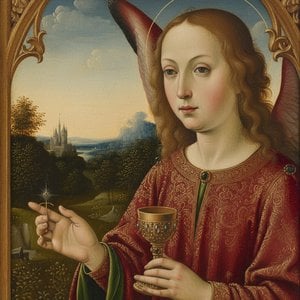
A Radiance of Faith: Unveiling Jan van Eyck’s “Suckling Madonna Enthroned”
Within the hallowed halls of the Städelsches Kunstinstitut in Frankfurt, resides a painting that transcends mere representation—it is an immersion into the heart of Early Netherlandish art and a profound meditation on faith, motherhood, and divine grace: Jan van Eyck’s “Suckling Madonna Enthroned.” Completed in 1436, this monumental oil-on-canvas work isn't simply a depiction of Mary and Christ; it is a meticulously crafted testament to Van Eyck’s revolutionary techniques and his deep understanding of symbolism. The painting immediately captivates with its luminous colors, astonishing detail, and the palpable sense of serenity that emanates from the figures within.
Van Eyck's genius lay not only in his artistic skill but also in his pioneering use of oil paint—a medium previously relegated to sketches and tempera. This innovation allowed him to achieve a level of realism and luminosity unprecedented at the time, capturing the subtle textures of velvet drapery, the delicate sheen of Mary’s robes, and the tender warmth of Christ's skin with breathtaking accuracy. The canvas itself, stretched taut and treated with gesso, provided an ideal surface for this revolutionary technique, allowing for layering and blending in a way that was impossible with traditional methods. The meticulous application of each brushstroke—visible even today— speaks to Van Eyck’s obsessive attention to detail and his unwavering commitment to capturing the essence of his subjects.
A Throne of Majesty: Symbolism and Composition
At the heart of the composition lies a magnificent throne, crafted from gilded brass and adorned with four imposing lion statues. This isn't merely decorative; it’s a deliberate reference to Solomon’s throne, symbolizing divine authority and regal power—a visual declaration of Mary’s elevated status as the Mother of God. Beneath her gaze rests Jesus Christ, nestled securely in his mother’s arms, nursing from her breast. This iconic pose, known as “Suckling Madonna,” immediately evokes a sense of nurturing love, compassion, and foreshadowing of the Eucharist—the central sacrament of Christianity. The carefully arranged background, featuring an architectural space reminiscent of a Gothic church, adds depth and context to the scene, guiding the viewer’s eye across the composition with subtle yet powerful gestures.
Beyond the immediate figures, every element within the painting is laden with symbolic meaning. The mirror image window—a recurring motif in Van Eyck's work—represents divine omniscience, suggesting that God sees and knows everything. The bowl at the base of the throne symbolizes the womb of creation, emphasizing Mary’s role as the vessel through which Christ was born. Even the positioning of the figures—Mary seated on a raised platform, Jesus nestled within her embrace—contributes to the overall sense of reverence and devotion.
A Masterpiece in Context: Influences and Comparisons
Van Eyck’s “Suckling Madonna Enthroned” stands as a pivotal work in the history of art, profoundly influencing generations of painters who followed. To appreciate its significance, it's helpful to consider comparable works from the same period. Fra Angelico’s “Virgin and Child Enthroned with Twelve Angels,” for example, shares Van Eyck’s meticulous attention to detail and his use of vibrant colors to convey a sense of spiritual beauty. Similarly, Hubert van Eyck’s “The Madonna of Canon van der Paele” demonstrates a similar dedication to capturing the likeness of the subjects with remarkable realism. However, while these works share certain stylistic similarities, Van Eyck's painting possesses a unique intensity and emotional depth—a testament to his exceptional artistic vision.
Furthermore, the influence of earlier Italian Renaissance art is evident in Van Eyck’s work, particularly in his use of perspective and his emphasis on naturalism. Yet, unlike many of his contemporaries, Van Eyck seamlessly integrated these influences with a distinctly Northern European sensibility—a focus on detail, symbolism, and religious devotion that would become hallmarks of the Early Netherlandish school.
A Legacy of Light: The Enduring Power of “Suckling Madonna Enthroned”
Jan van Eyck’s “Suckling Madonna Enthroned” remains an enduring symbol of artistic excellence—a captivating fusion of observation and imagination that continues to inspire awe and contemplation. It is more than just a painting; it's a window into the spiritual world, a testament to the power of faith, and a celebration of motherhood. To delve deeper into Van Eyck’s oeuvre, we invite you to explore Painting by 'Jan Van Eyck' | Jan Van Eyck:Suckling Madonna Enthroned on WahooArt, where you can discover a wealth of information about this extraordinary artist and his remarkable creations. The painting’s size is 65 x 49 cm, dating back to 1436.
- The painting embodies profound religious devotion through meticulous detail.
- It’s housed at the Städelsches Kunstinstitut museum in Frankfurt.
- Van Eyck’s innovative use of oil paint revolutionized artistic expression.
- Other notable works include The Madonna of Canon van der Paele and The Madonna with Canon van der Paele (detail).
Key Points:
- The painting’s composition incorporates symbolism rooted in biblical tradition and royal iconography.
- It’s a testament to Van Eyck’s unparalleled artistic vision.
- Its meticulous detail and luminous colors create an immersive experience for the viewer.
For more information on Jan van Eyck: Painting by 'Jan Van Eyck' | Jan Van Eyck:Suckling Madonna Enthroned on WahooArt.



 Visualizar em escala
 Encomendar reprodução pintada à mão
 Enviar
 Compartilhar
 Ver detalhes
 Guia
Guia

 Baixar imagem
 Semelhantes
 Raio X
 Apresentação de slides
 Estatísticas


 Ver mais






































 A opção de vidro está disponível apenas para tamanhos inferiores a 110 cm