
Cubist Abstraction · 1930
Figure is a work by Jacques Lipchitz (1891–1973). It dates from 1930. It belongs to the Cubist Abstraction movement. It is made in Bronze. It is kept at MoMA - Museu de Arte Moderna in Nova York, Estados Unidos da América.

Jacques Lipchitz's "Figure," sculpted in 1930, stands as a profound testament to the transformative power of Cubism and its enduring fascination with exploring the fundamental concepts of form and perception. This bronze masterpiece transcends mere representation; it invites a deep, meditative contemplation on the very essence of human existence through a deliberately abstracted aesthetic. In an era defined by rapid societal shifts, Lipchitz utilized a fragmented language to capture the complexity of the modern soul. The sculpture presents a captivating interplay of geometric precision and organic fluidity, where the human form is not merely depicted but reconstructed through a lens of intellectual rigor and emotional depth.
The composition is a masterclass in the Cubist approach, pioneered by luminaries such as Picasso and Braque. Rather than striving for a realistic or anatomical depiction, Lipchitz dismantles the human figure into interlocking planes, presenting multiple viewpoints simultaneously. The head is rendered with striking simplicity—two oval eyes positioned above a small, triangular nose—which disrupts traditional notions of facial harmony to create a sense of enigmatic presence. Below this stylized visage, undulating vertical forms intersect with curved openings, creating a rhythmic tension between movement and stillness. This structural complexity ensures that the viewer's eye is constantly traveling across the surface, discovering new contours and depths within the bronze.
The materiality of the piece is essential to its enduring impact. The choice of bronze allows for an exquisite level of detail and a rich, tactile quality that stone or wood could not achieve. Through the intricate process of bronze casting, Lipchitz was able to capture subtle variations in surface texture, from the sharp, clean edges of his geometric planes to the softer, more rounded contours of the figure's limbs. The rough, uneven patina resulting from natural oxidation lends the sculpture an ancient, weathered character, suggesting a sense of permanence and historical weight. This textured surface catches the light in a way that emphasizes the sculpture's three-dimensionality, making it a dynamic object that changes appearance depending on the surrounding illumination.
For the discerning collector or interior designer, "Figure" offers an unparalleled opportunity to introduce a piece of art history into a contemporary space. The sculpture’s neutral, earthy tones and sophisticated silhouette allow it to integrate seamlessly into various high-end environments, from minimalist modern galleries to richly textured classical studies. It serves as a powerful focal point, commanding attention through its structural integrity and the quiet strength of its presence. Owning a high-quality reproduction of this work is not merely about acquiring an object; it is about bringing a piece of the avant-garde revolution into one's personal sanctuary, fostering an atmosphere of intellectual curiosity and timeless elegance.
Nova York, Estados Unidos da América
Origens e História do MoMA - Museu de Arte Moderna As fundações do MoMA - Museu de Arte Moderna foram lançadas em 1929. Concebida por Abby Aldrich Rockefeller, Lillie P. Bliss e Mary Quinn Sullivan, a instituição emergiu durante um período de profunda transição global.
Jacques Lipchitz, Figure (1930), MoMA - Museu de Arte Moderna.
"Figure", de Jacques Lipchitz foi criado em 1930.
Com sua atmosfera Modern, "Figure" é sugerida para um(a) Living Room.
A intensidade de cor de "Figure" é Monochromatic. A intensidade descreve o quão vibrantes as cores parecem ser.
"Figure" é classificada como Recognized.
"Figure", de Jacques Lipchitz retrata: sculpture, abstraction, bronze, geometric form, cubism style, human figure, texture, modern art.
A análise cromática de "Figure", de Jacques Lipchitz revela um contraste Statement e uma harmonia Unified Palette.
"Figure", de Jacques Lipchitz apresenta uma saturação de Muted.
Historicamente, "Figure" é uma obra Cubist Abstraction da mais ampla era Modern.
A data de 1930 situa "Figure" no Mature Period do desenvolvimento de Jacques Lipchitz.

1891–1973, Lituânia
Uma Vida Esculpida pela Mudança: A Jornada de Jacques Lipchitz Nascido como Chaim Jacob Lipschitz em 1891, na cidade lituana de Druskininkai, o caminho artístico de Jacques Lipchitz foi dramaticamente moldado pelo deslocamento e pela inovação. Sua vida inicial, enraizada em uma família judaica Litvak onde seu pai trabalhava como empreiteiro, inicialmente o direcionou para estudos de engenharia. No entanto, um espírito criativo florescente, nutrido pelo apoio de sua mãe, impulsionou-o em direção a Paris em 1909 – uma cidade que, na época, pulsava com revolução artística. Ele matriculou-se na École des Beaux-Arts e na Académie Julian, imergindo nas vibrantes comunidades de Montmartre e Montparnasse.
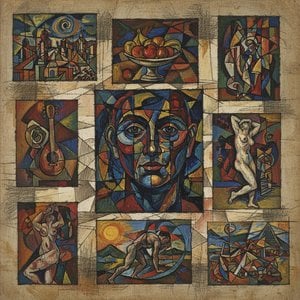 Cubismo Expressionista: 10 Obras-Primas que Moldaram a Arte Moderna | WahooArtDescubra as 10 obras-primas do Cubismo Expressionista que revolucionaram a arte moderna! Explore Picasso, Braque e outros mestres. Reproduç…
 Breaking the Frame: A Collector's Guide to Cubist Fragmentation and the Evolution of Modern ArtMaster the complexities of Cubism with our expert guide. Explore the revolutionary fragmentation of Picasso and Braque, from Analytic to Sy…
 Unlocking the Cubist Portrait: A Revolution of Perspective, Form, and Modernist VisionExplore the revolutionary world of Cubist portraiture. From Picasso's fragmented forms to Malevich's geometric abstraction, discover how th…
 Impressão
 Compartilhar
 Compartilhar
 Guia


 Baixar imagem
 Semelhantes
 Ver diaporama
 Perguntas e Respostas

 Estatísticas


 Seated Figure1917
 Seated Man with Guitar1918
 Seated Woman1918
 Bellerophon Taming Pegasus: Large Version1964