A Singular Vision Amidst Tradition: The Life and Art of Ito Jakuchu
Ito Jakuchu (1716 – 1800) stands as one of Japan’s most distinctive artistic figures, a painter who defied convention while simultaneously embracing the profound spirit of his era. Unlike many of his contemporaries who adhered to established lineages within the Kano school—a dominant force in Edo period art—Jakuchu forged an independent path, marked by meticulous observation and a daring willingness to challenge accepted aesthetic norms. His legacy resides not merely in his technical prowess but in his singular vision: a refusal to depict human figures alongside a deep reverence for the natural world, particularly birds and flowers, which became central to his oeuvre.
- Early Life and Family Background
- Zen Influence and Artistic Training
- Style and Technique: The Pursuit of Detail
- Notable Works and Recognition
- Jakuchu's Enduring Legacy
Early Life and Family Background
Ito Jakuchu was born in Kyoto’s Nishiki market district, a vibrant hub of commerce and culture—a location that would profoundly shape his artistic sensibility. His father, Ito Genzaemon, operated Masuya, a sizable wholesaler specializing in vegetables, providing young Jakuchu with a comfortable upbringing rooted in the practical realities of Edo society. This familial environment instilled in him an awareness of societal shifts and the growing influence of Kyoto’s merchant class—a perspective that subtly permeated his artistic explorations. While expected to inherit the family business, Jakuchu possessed an innate passion for painting—a fascination nurtured from childhood by a father who recognized and encouraged his talent.
Zen Influence and Artistic Training
Jakuchu’s artistic journey took an unexpected turn when he embraced Zen Buddhism at Kyoto’s Shokoku-ji temple. This formative experience instilled in him a contemplative mindset—a detachment from worldly concerns—and profoundly impacted his artistic approach. He studied under Ōoka Shunboku, a Kano school artist renowned for his bird and flower paintings, absorbing centuries of artistic tradition while simultaneously cultivating his own distinctive style. Notably, Jakuchu received permission to study classic Chinese paintings within the temple’s collection, furthering his understanding of artistic principles beyond Japanese conventions.
Style and Technique: The Pursuit of Detail
Jakuchu's artistic style distinguishes itself through meticulous realism combined with a playful disregard for established norms. He achieved remarkable precision in capturing the essence of nature—particularly birds—employing techniques that would become synonymous with his legacy. His paintings are characterized by vibrant colors, dynamic compositions, and an unwavering focus on detail—a hallmark evident in works like “Rooster In The Snow,” where he painstakingly rendered individual feathers to convey a sense of palpable vitality. Unlike many artists of his time who prioritized idealized representations, Jakuchu sought to depict subjects as they appeared in reality, elevating observation and meticulous rendering to the highest artistic standards.
Notable Works and Recognition
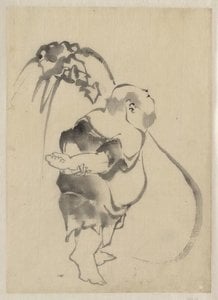
Among Jakuchu’s most celebrated creations are “Five Hundred Arhats,” a monumental undertaking demonstrating his extraordinary skill and dedication—a testament to his unwavering commitment to artistic excellence. Also noteworthy is “Hanshan and Shide,” which captures the spirit of Japanese folklore with remarkable sensitivity. His masterful polychrome renderings— *doshoku sai-e* —are particularly admired, showcasing an unparalleled attention to detail and a palette that defied prevailing stylistic trends. Despite remaining relatively unknown during his lifetime, Jakuchu’s work gained posthumous recognition thanks to the scholarship of Nobuo Tsuji, who championed him as a pivotal figure within the “Lineage of Eccentrics”—a movement that revolutionized perceptions of Edo period painting.
Jakuchu's Enduring Legacy
Ito Jakuchu’s influence extends far beyond his own lifetime. His willingness to challenge artistic conventions paved the way for subsequent generations of artists—most notably Hakuin Ekaku and Suzuki Kiitsu—who embraced the “Lineage of Eccentrics” aesthetic. Today, Jakuchu is revered not only for his technical mastery but also for his singular vision—a testament to an artist who dared to forge his own path and capture the spirit of his time with unparalleled originality. His legacy continues to inspire artists and scholars alike, cementing his place as one of Japan’s most enduring cultural icons.



 Visualizar em escala
 Encomendar reprodução pintada à mão
 Enviar
 Compartilhar
 Ver detalhes
 Guia de Obras do Aluno

 Baixar imagem
 Semelhantes
 Raio X
 Apresentação de slides
 Estatísticas


 Ver mais






































 A opção de vidro está disponível apenas para tamanhos inferiores a 110 cm