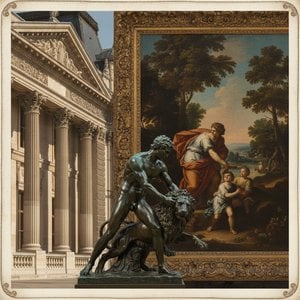
A Divine Encounter in Baroque Grandeur
In the heart of the High Baroque era, few works capture the intersection of celestial grace and earthly majesty as profoundly as Hyacinthe Rigaud’s La Présentation au Temple. Painted between 1724 and 1743, this monumental masterpiece serves as a breathtaking window into a moment of sacred significance: the presentation of the infant Jesus at the Temple. Rigaud, a master renowned for his ability to immortalize the dignity of the French nobility, pivots here from the halls of Versailles to the hallowed architecture of the divine. The scene is not merely a depiction of a biblical event but an immersive experience of spiritual awe, where every brushstroke conspires to elevate the viewer into a state of reverence.
The composition is anchored by a masterful pyramidal structure, a hallmark of Baroque brilliance that guides the eye upward toward the heavens. At the apex of this sacred geometry sits the Virgin Mary, radiating a serene and untouchable dignity. Flanked by the infant Christ, she becomes the focal point of a complex, bustling tableau of priests, elders, and onlookers. This arrangement is deeply symbolic; the central positioning of Mary signifies her holiness, while the surrounding crowd represents the collective witness of the Church to the incarnation. The temple itself, with its imposing pillars and grand arches, acts as a visual anchor, grounding the ethereal subject matter within a tangible, architectural reality.
A Symphony of Light, Texture, and Emotion
To behold this work is to witness a symphony of chiaroscuro. Rigaud employs a dramatic interplay between light and shadow to sculpt his figures, pulling them from the deep, velvety darkness of the temple interior into a brilliant, celestial glow. This lighting does more than create depth; it directs the emotional narrative, illuminating the innocence of the Christ child and the luminous skin tones of the holy figures while allowing the peripheral onlookers to recede into a mysterious, atmospheric shadow. The result is a sense of controlled chaos—a crowded, energetic scene that nonetheless feels profoundly ordered and peaceful.
The technical virtuosity on display in this oil on canvas is nothing short of extraordinary. For the discerning collector or interior designer, the painting offers an unparalleled richness of texture. Rigaud’s meticulous brushwork captures the heavy weight of liturgical vestments, the shimmering luster of silk, and the soft, delicate folds of Mary’s blue robe—a color traditionally symbolizing purity and divine status. The warm palette of golds, deep reds, and ochres creates a sense of warmth and opulence, making the piece an ideal centerpiece for spaces that demand a sense of history, luxury, and intellectual depth.
Beyond its technical mastery, La Présentation au Temple resonates with a timeless emotional impact. It is a painting that speaks of legacy, faith, and the enduring power of tradition. Whether gracing a private gallery or serving as a sophisticated focal point in a grand salon, this reproduction invites a contemplative dialogue between the past and the present. It is an invitation to surround oneself with the splendor of the French Baroque, offering not just decoration, but a profound connection to one of the most celebrated eras of art history.



 Visualizar na parede
 Alternar para Impressão
 Compartilhar
 Compartilhar
 Detalhes

 Baixar imagem
 Semelhantes
 Raio X
 Slideshow
 Estatísticas


 Ler mais






































 A opção de vidro está disponível apenas para tamanhos inferiores a 110 cm