Visualizar na paredeVisualizar na parede Ver em RAVer em RA Comprar pintura feita à mão Comprar pintura feita à mãoComprar imagem Comprar imagem CompartilharCompartilhar
DetalhesDetalhes Adicionar aos favoritos Adicionar aos favoritos Baixar imagemBaixar imagem SemelhantesSemelhantes Raio XRaio X SlideshowSlideshow

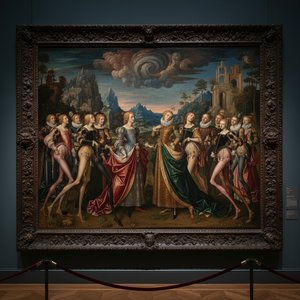
Standard-bearer

Experience Northern Mannerism's drama with Goltzius's masterful 1587 engraving of a standard-bearer; discover this intricate print today.

Hendrik Goltzius (1558-1617) foi um mestre da gravura e pintura do período manierista holandês, conhecido por suas composições dinâmicas e técnicas inovadoras como a 'linha inchada'. Sua obra influenciou a arte barroca e é celebrada em museus internacionais.

Giclée / Impressão de Arte

Impressão giclée ou em tela de qualidade de museu, com produção rápida e opções flexíveis de acabamento. (Comprar pintura feita à mão Comprar pintura feita à mãoComprar imagem Comprar imagem)

P118B $10
P118H $10
P118W $10
P438Z $10
P508JH $12
P508YH $12
P805H $10
P805Z $10
P919BZ $10
P919G $10
P919XJ $10
P959ZH $10
P968JZ $12
W106C $8
W218G $10
W218JH $8
W218Y $10
W307PJ $10
W316G $10
W316PJ $8
W316Y $10
W398PJ $8
W4111J $10
W500HY $15
W500JH $15
W692G $12
W849H $8
W940BG $15
W953PJ $8

Tamanho padrão
personalizado
CM
INCH

Escolha entre os nossos tamanhos pré-definidos que respeitam as proporções originais da obra de arte.

largura
altura

Você pode inserir suas próprias dimensões para se ajustar a uma moldura ou espaço específico. Se o tamanho selecionado não corresponder às proporções da imagem original, iremos recortar a obra de arte ou estender a imagem com uma borda espelhada ou preenchimento sólido. Um mockup digital será enviado para sua aprovação antes do início da produção.
Por favor, observe que a visualização na tela não reflete o recorte ou a extensão real. Apenas o mockup mostrará com precisão a composição final.
Embora tamanhos personalizados estejam disponíveis, recomendamos selecionar uma dimensão da lista predefinida para preservar as proporções originais.

Entrega mundial () em 2 semanas, em vez das 4/5 semanas padrão. (7 Setembro)

why_choose_icon
Envio expresso gratuito para todo o mundo
why_choose_icon
Tela de Linho de Alta Qualidade
why_choose_icon
Seguro de transporte completo
why_choose_icon
Garantia de Reembolso de Impostos Alfandegários
why_choose_icon
Garantia de Fidelidade Cromática
why_choose_icon
Política de Devolução em 100 Dias (Apenas para Defeitos)
why_choose_icon
Garantia de reembolso de 100%
why_choose_icon
Oferta de desconto por quantidade

Preço Total

$ 68

reproduction

Standard-bearer

Giclée / Impressão de Arte

Tamanho da Reprodução

-

Preço Total

$ 68

Informações Rápidas

  • Influences: Albrecht Dürer
  • Medium: Engraving
  • Artist: Hendrik Goltzius
  • Artistic style: Renaissance
  • Year: 1587
  • Movement: Northern Mannerism
  • Dimensions: 286 x 199 cm

Hendrik Goltzius: A Master of Northern Mannerism

Hendrik Goltzius (1558–1617) stands as one of the most influential figures in Dutch art history, a titan whose legacy continues to resonate through centuries. Born in Bracht or Millebrecht near Duisburg, his early life was marked by tragedy – a devastating fire claimed his infant brother’s life and left him with a debilitating deformity in his right hand. Ironically, this physical limitation proved instrumental in shaping his artistic genius; the forceful movements required to manipulate the burin honed a technique that would become synonymous with Goltzius's distinctive style: the “swelling line.” This revolutionary approach, championed by luminaries like Albrecht Dürer, involved subtly thickening and thinning lines to achieve tonal shading from afar—a feat unheard of at the time and one that cemented Goltzius’s reputation as a visionary innovator.
  • Early Training & Influence: Goltzius's formative years were spent under the tutelage of Dirck Volckertszoon Coornhert, a renowned humanist scholar and printmaker who instilled in him a profound appreciation for classical ideals and artistic rigor. This influence would permeate his entire oeuvre, shaping his compositions and informing his meticulous attention to detail.
  • The Haarlem Workshop: Moving to Haarlem in 1577 alongside Coornhert marked the beginning of Goltzius’s prolific artistic career. He established a thriving workshop where he mentored younger artists and collaborated on ambitious projects, notably the engraving set depicting the history of Lucretia commissioned by Philip Galle—a testament to his ability to synthesize humanist scholarship with artistic virtuosity.

The Great Standard Bearer: Symbolism and Technique

“The Great Standard Bearer,” created in 1587, exemplifies Goltzius’s mastery of engraving and embodies the spirit of Northern Mannerism—a stylistic movement characterized by dramatic contrasts of light and dark, stylized figures, and an obsession with anatomical precision. The artwork depicts a military officer holding aloft a flag emblazoned with a lion emblem, symbolizing strength and royalty – potent symbols reflecting the anxieties surrounding Spain’s dominance in Europe during this turbulent period. Goltzius's technique is breathtakingly complex; he employed burins and other engraving tools to create an astonishing level of detail, utilizing hatching and cross-hatching extensively to render the armor, flag, and landscape with unparalleled realism. The swelling line technique—a hallmark of his style—transforms the image into a dynamic interplay of tonal variations, capturing not only the visual appearance but also conveying a palpable sense of movement and urgency.
  • Composition & Perspective: The central figure dominates the foreground, positioned dynamically against a mountainous landscape receding into the distance – a deliberate compositional choice that reinforces the impression of grandeur and conveys a profound respect for classical perspective.
  • Material & Process: The engraving was produced on copper plate using meticulous burin techniques, resulting in an exceptionally durable print with remarkable tonal range and textural richness.

Legacy and Emotional Impact

Goltzius’s influence extended far beyond his own lifetime, shaping the artistic sensibilities of subsequent generations and establishing him as a cornerstone of Dutch Baroque art. His unwavering dedication to anatomical accuracy—evident in portraits like “Self-Portrait”—demonstrates an intellectual curiosity that transcended mere technical skill. More importantly, Goltzius's work speaks to fundamental human concerns: courage, loyalty, and the pursuit of excellence. "The Great Standard Bearer" remains a powerful reminder of the transformative potential of art—its ability to capture not only visual beauty but also the deepest emotions and aspirations of its time. It is a testament to Goltzius’s genius that his engravings continue to inspire awe and admiration centuries after their creation, securing his place as one of the greatest printmakers in European history.

Biografia do Artista

Early Life and Training

Hendrik Goltzius, a figure of immense importance in the history of Dutch art, emerged from the vibrant cultural landscape of Braunschweig, Germany, in 1558. His early years were steeped in artistic tradition; his family’s lineage included painters who had worked in Venlo, and his father, Jan Goltz II, was a skilled glass painter in Duisburg. This familial connection to art provided him with an initial foundation, but it was the guidance of Dirck Volckertszoon Coornhert, a renowned printmaker and polymath residing nearby, who truly shaped his artistic trajectory. Coornhert’s workshop in Xanten became Goltzius's first formal training ground, where he immersed himself in the intricacies of copperplate engraving – a technique that would become synonymous with his name. A defining moment occurred when he was just three years old; an accident involving fire left him with a permanently deformed right hand. Remarkably, this physical challenge didn’t hinder his artistic development but instead fostered a unique dexterity and control over the burin, contributing to the distinctive “swelling line” technique that would characterize his work. His ambition and determination led him to become ambidextrous, mastering both left and right-hand engraving with equal skill.

Artistic Career and Influences

In 1577, Goltzius embarked on a pivotal chapter of his life by relocating to Haarlem, the thriving center of the Dutch Republic, alongside Coornhert. This move marked the beginning of his independent career as an engraver and print publisher. Initially, he worked for established printers like Philips Galle, Maarten de Vos, and Johannes Stradanus, producing prints based on designs from various masters – a period where he meticulously honed his skills by replicating the styles of Albrecht Dürer, Lucas van Leyden, and others. However, his ambition quickly led him to establish his own workshop, allowing him to pursue his own creative vision. His artistic style was profoundly influenced by the Mannerist movement, drawing inspiration from Italian artists like Bartholomeus Spranger and Annibale Carracci, whose dynamic compositions and dramatic use of light and shadow resonated deeply with Goltzius. He wasn’t merely a copyist; he skillfully integrated elements of classicism and archaic styles into his work, creating a unique synthesis that distinguished him within the Dutch art scene. His patronage extended to prominent figures across Europe, including the Holy Roman Emperor Rudolf II, who recognized and championed his talent.

Technique and Innovation

Hendrik Goltzius’s contribution to engraving is marked by several groundbreaking innovations. Perhaps most notably, he developed what became known as the “swelling line” technique – a masterful manipulation of the burin that allowed him to create varying thicknesses of lines, generating a remarkable sense of tonal depth and volume from a distance. This technique, combined with his pioneering use of the "dot and lozenge" method—strategically placed dots within lozenge-shaped spaces created through cross-hatching—further refined his ability to render shading and texture with unparalleled precision. His command of the burin was often compared to that of Albrecht Dürer, a testament to his exceptional skill and artistry. He frequently undertook the challenging task of engraving works by other artists, notably Bartholomeus Spranger’s paintings, significantly elevating their fame and solidifying his own reputation as a leading printmaker.

Legacy and Recognition

Throughout his career, Goltzius produced an astonishing output – approximately 500 drawings and around 50 paintings, alongside over 160 individual prints featuring both original designs and collaborative projects. His works are now housed in major museums worldwide, including the Rijksmuseum in Amsterdam, the British Museum in London, the Metropolitan Museum of Art in New York, and the Los Angeles County Museum of Art. Despite facing periods of relative obscurity following his death in 1617, Goltzius’s legacy has experienced a remarkable resurgence in recent decades. He is now widely recognized as one of the most important printmakers of the Northern Renaissance, celebrated for his technical brilliance, innovative techniques, and profound influence on subsequent generations of artists. His distinctive style continues to captivate art lovers and scholars alike, cementing his place as a pivotal figure in the history of European art.
Hendrik Goltzius

Hendrik Goltzius

1558 - 1617 , Alemanha

Dados Rápidos

  • Artistic Movement Or Style: Manerismo e gravura Barroca
  • Artists Or Movements Influenced By This Artist: ['Jacques Bellange']
  • Artists Who Influenced This Artist: ['Dirck Volckertszoon Coornhert']
  • Date Of Birth: Janeiro/Fevereiro 1558
  • Date Of Death: 1 de Janeiro 1617
  • Full Name: Hendrik Goltzius
  • Nationality: Holandês
  • Notable Artworks:
    • Adoração dos Pastores
    • Paisagem Arcádica
    • Cabeça de Sirene
  • Place Of Birth: Braunschweig, Itália
Explore obras de arte organizadas por temas, estilos e características.