Consultoria de arte gratuita

x
Encomendar pintura Encomendar pinturaComprar imagem em alta resolução Comprar imagem em alta resolução EnviarEnviar
DetalhesDetalhes Adicionar aos favoritos Adicionar aos favoritos BaixarBaixar SemelhantesSemelhantes Raio XRaio X SlideshowSlideshow

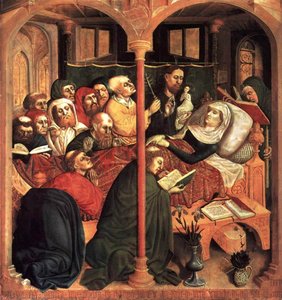
Pentecost

Experience 'Pentecost' by Hans Multscher! This 1437 masterpiece depicts the Holy Spirit’s descent, showcasing vibrant detail and religious fervor. A stunning Renaissance work of art.

Hans Multscher (1400-1467) foi um escultor e pintor alemão crucial na transição do Gótico para o Renascimento. Conhecido por obras como o altar de Wurzach, sua arte realista e influente atelier moldaram a arte alemã, marcando um ponto de virada no estilo e técnica.

Giclê / Impressão de Arte

Impressão giclée ou em tela de qualidade de museu, com produção rápida e opções flexíveis de acabamento.

P118B $10
P118H $10
P118W $10
P438Z $10
P508JH $12
P508YH $12
P805H $10
P805Z $10
P919BZ $10
P919G $10
P919XJ $10
P959ZH $10
P968JZ $12
W106C $8
W218G $10
W218JH $8
W218Y $10
W307PJ $10
W316G $10
W316PJ $8
W316Y $10
W398PJ $8
W4111J $10
W500HY $15
W500JH $15
W692G $12
W849H $8
W940BG $15
W953PJ $8

Standard
custom
CM
INCH

Escolha entre os nossos tamanhos pré-definidos que respeitam as proporções originais da obra de arte.

largura
altura

Você pode inserir suas próprias dimensões para se ajustar a uma moldura ou espaço específico. Se o tamanho selecionado não corresponder às proporções da imagem original, iremos recortar a obra de arte ou estender a imagem com uma borda espelhada ou preenchimento sólido. Um mockup digital será enviado para sua aprovação antes do início da produção.
Por favor, observe que a visualização na tela não reflete o recorte ou a extensão real. Apenas o mockup mostrará com precisão a composição final.
Embora tamanhos personalizados estejam disponíveis, recomendamos selecionar uma dimensão da lista predefinida para preservar as proporções originais.

Entrega mundial () em 2 semanas, em vez das 4/5 semanas padrão. (2 Julho)

why_choose_icon
Envio Expresso Gratuito para todo o Mundo
why_choose_icon
Tela de Linho Premium
why_choose_icon
Seguro de envio completo
why_choose_icon
Garantia de Reembolso de Impostos Alfandegários
why_choose_icon
Garantia de Fidelidade de Cores
why_choose_icon
Política de Devolução de 60 Dias (Apenas para Defeitos)
why_choose_icon
Garantia de 100% de Reembolso
why_choose_icon
Desconto para múltiplas unidades

Preço Total

-

reproduction

Pentecost

Giclê / Impressão de Arte

Dimensões da Reprodução

-

Preço Total Final

-

Dados Rápidos

  • Notable elements: Dove, Apostles
  • Artist: Hans Multscher
  • Title: Pentecost
  • Influences:
    • Gothic
    • Netherlandish
  • Location: State Museums, Berlin
  • Medium: Paint
  • Movement: Early Renaissance

Teste de Arte

Cada pergunta possui apenas uma resposta correta.

Pergunta 1:
What is the primary subject depicted in Hans Multscher’s ‘Pentecost’?
Pergunta 2:
In what year was Hans Multscher’s ‘Pentecost’ painted?
Pergunta 3:
The painting 'Pentecost' is part of which larger artwork?
Pergunta 4:
What artistic movement is Hans Multscher most associated with?
Pergunta 5:
The image description mentions two birds in the painting. What is their significance?

Descrição da Obra

The Divine Descent: An Encounter with Pentecost

To stand before Hans Multscher's depiction of Pentecost is to step directly into the charged atmosphere of early Renaissance spiritual awakening. This 1437 masterpiece does more than merely illustrate a biblical event; it captures a moment of profound, transformative energy. The scene unfolds within an intimate, richly detailed interior space, drawing the viewer immediately into the circle of disciples gathered in anticipation. At the heart of this gathering sits the Virgin Mary, her outstretched hands suggesting both reception and benediction, anchoring the divine mystery for all present. The air itself seems thick with unspoken revelation, a palpable blend of human devotion meeting celestial power.

Bridging Eras: Style and Technique

Multscher, a pivotal figure in German art history, stands as a magnificent bridge between the lingering elegance of the Gothic period and the burgeoning naturalism of the Renaissance. His technique is marked by an astonishing commitment to realism, evident in the drapery of the medieval garments worn by every figure surrounding Mary. Observe the meticulous rendering of texture—the folds of cloth, the subtle gestures of the hands, even the inclusion of life through the two visible birds that seem to observe the sacred drama from above and within the composition. This attention to minute detail speaks to an artist deeply influenced by the burgeoning Netherlandish tradition, allowing the divine narrative to be grounded in tangible, observable reality.

Symbolism Woven into the Scene

The subject matter itself—the descent of the Holy Spirit at Pentecost—is steeped in potent symbolism. The gathering represents the nascent Church receiving the gifts necessary for its mission. Every figure, from the central maternal presence to the surrounding apostles, participates in this moment of illumination. The objects within the room, such as the simple bench and chair, serve not merely as props but as anchors grounding the miraculous event within a recognizable human setting. These elements invite contemplation: how does the divine intersect with the mundane? It is a meditation on revelation itself.

An Echo for the Modern Collector

For the discerning collector or those seeking to infuse a space with historical gravitas and spiritual depth, this work offers unparalleled resonance. While its original scale of 148 x 140 cm commands attention, acquiring a high-quality reproduction allows one to bring Multscher’s masterful narrative into contemporary living spaces. The emotional impact of the piece is one of awe mixed with profound intimacy; it whispers tales of divine guidance and human potential all at once. It remains a powerful focal point, inviting quiet reflection and elevating any room from mere decoration to a space imbued with enduring artistic and spiritual meaning.


Biografia do Artista

A Pioneer of German Realism: The Life and Art of Hans Multscher

Born around 1400 in the small Bavarian town of Reichenhofen, now part of Leutkirch im Allgäu, Hans Multscher emerged as a pivotal figure bridging the stylistic transition from the late Gothic period to the burgeoning Renaissance in Germany. While precise details surrounding his early life remain somewhat elusive, it’s clear that Multscher possessed an inquisitive spirit and a keen eye for artistic innovation – a desire to move beyond mere imitation, seeking out new influences and shaping a distinctly personal vision. These travels likely took him to the vibrant artistic centers of northern France and the Netherlands, exposing him to the burgeoning realism and meticulous detail characteristic of Early Netherlandish painting – a style that would become inextricably linked with his own unique approach.

In 1427, Multscher established himself as a free citizen of Ulm, a thriving commercial hub on the Danube River. This pivotal move marked not just a change of residence but a significant turning point in his career. There, he married Adelheid Kitzin and, alongside his brother Heinrich, founded a workshop that quickly gained renown for its innovative sculptures and paintings. The Multscher workshop wasn’t simply a production line; it was a dynamic environment fostering experimentation and the gradual infusion of naturalism into traditional Gothic forms. Records indicate as many as sixteen assistants at times were employed within its walls, creating a fertile ground for artistic exchange and the development of new techniques.

The Workshop and Artistic Development

Within the Multscher workshop, Hans oversaw a remarkable transformation in artistic style. While retaining elements of Gothic tradition – particularly in decorative details – his work increasingly embraced naturalism, mirroring the influences he’d absorbed during his travels. This shift is most strikingly evident in his sculptural output. Gone were the elongated figures and stylized drapery characteristic of late Gothic sculpture; instead, Multscher sculpted with a newfound anatomical accuracy and a heightened sensitivity to emotional expression. His paintings, though fewer in number than his sculptures, demonstrate an equally compelling evolution. The *Wurzacher Altar*, begun in 1437, stands as a particularly potent testament to this evolving style. This ambitious project, intended for the church of St. James in Wurzach, showcases Multscher’s mastery of oil painting – a relatively new medium at the time – and his ability to render textures, light, and shadow with remarkable precision. The altar's panels depict scenes from the life of Christ and the Virgin Mary, each imbued with a palpable sense of humanity that set it apart from earlier devotional art.

The *Wurzacher Altar* wasn’t merely a technical achievement; it represented a bold departure from established conventions. Multscher sought to capture not just the outward appearance of his subjects but also their inner lives, imbuing them with psychological depth and emotional resonance. This focus on human experience would become a defining characteristic of his work throughout his career.

Key Works and Lasting Legacy

Beyond the *Wurzacher Altar*, several other works cemented Multscher’s reputation as one of Germany’s most important artists. The sculpture of *Holy Mary Magdalen*, now housed in Frankfurt's Liebieghaus, is a particularly poignant example of his ability to convey profound emotion through sculpted form. Her sorrowful expression and the delicate rendering of her hair and clothing reveal a deep understanding of human psychology. Another notable work is the *Man of Sorrows* – copies of which can be found at Ulm Minster – a powerful depiction of Christ’s suffering that reflects the devotional fervor of the era. These pieces, along with his contributions to the Ulm city hall, demonstrate Multscher's skill in both sculpture and painting, as well as his ability to adapt his style to different contexts and patrons.

Multscher’s influence extended far beyond his own lifetime. The workshop he established continued to thrive after his death in 1467, disseminating his artistic principles throughout Swabia and beyond. He is considered a foundational figure in the development of German art, bridging the gap between the stylized conventions of the Gothic period and the burgeoning realism of the Renaissance.

A Bridge Between Eras

Hans Multscher’s significance lies not only in the beauty and technical skill of his art but also in his role as a catalyst for change. He was among the first German artists to fully embrace the realism and naturalism that were transforming art in northern Europe, paving the way for subsequent generations of Renaissance masters. His work represents a crucial moment in the development of German art, marking a departure from the stylized conventions of the Gothic period towards a more humanistic and observational approach. While he didn’t entirely abandon traditional forms – elements of Gothic ornamentation can still be detected in his work – he skillfully integrated them with new techniques and aesthetic sensibilities, creating a unique artistic language that resonated deeply with his contemporaries and continues to captivate audiences today.

He stands as a testament to the power of artistic exchange and the enduring legacy of those who dare to challenge convention.

Hans Multscher

Hans Multscher

1400 - 1467 , Alemanha

Informações Rápidas

  • Artistic Movement Or Style: Gótico tardio/Renascimento
  • Artists Or Movements Influenced By This Artist: ['Multscher influenciou artistas posteriores']
  • Artists Who Influenced This Artist:
    • Estilos franceses do norte
    • Estilos holandeses
  • Date Of Birth: c. 1400
  • Date Of Death: 1467
  • Full Name: Hans Multscher
  • Nationality: Alemão
  • Notable Artworks:
    • Altar de Wurzach
    • Maria Madalena
    • Homem de Sofrimento
  • Place Of Birth: Reichenbach, Alemanha
Explore obras de arte organizadas por temas, estilos e características.