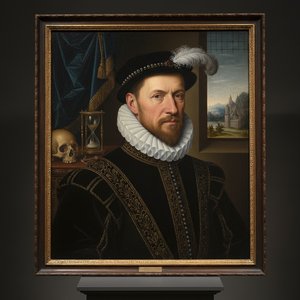
A Window into Tudor Power: Sir Brian Tuke by Hans Holbein the Younger
Hans Holbein the Younger’s ‘Sir Brian Tuke’, painted in 1534, is more than simply a portrait; it's a meticulously crafted window into the heart of 16th-century England – a society grappling with religious upheaval and the burgeoning power of King Henry VIII. This remarkable work, now housed at The Museum Oskar Reinhart in Winterthur, Switzerland, offers a rare glimpse into the life of Sir Brian Tuke, an English courtier and diplomat who served as a key advisor to the king, revealing not just his outward appearance but also the complex political landscape he navigated.
The painting itself is dominated by its subject’s presence – a man rendered with astonishing realism and psychological depth. Holbein's mastery of detail is immediately apparent; from the subtle texture of the fur-lined cloak to the intricate folds of the white paper bearing Latin inscriptions, every element speaks to his unparalleled skill. The muted palette—a blend of rust browns, steely grays, and the vibrant crimson of the ledge—creates a sense of understated formality, reflecting the gravity of Tuke’s position and the era in which he lived. The composition is carefully balanced; the figure occupies a significant portion of the canvas, yet the background, though mottled, doesn't distract from his commanding presence.
Deconstructing the Portrait: Symbolism and Technique
Holbein’s technique is a testament to his dedication to observation and anatomical accuracy. Note the precise rendering of Tuke’s hands – one resting confidently on the crimson ledge, holding gloves that subtly suggest wealth and status, while the other is clenched in a loose fist, a gesture open to interpretation: perhaps a sign of cautiousness, or even restrained power. The folded piece of parchment with Latin inscriptions adds another layer of meaning; these texts likely served as a subtle reminder of Tuke’s education and his role within the royal court – a connection to classical learning and religious authority.
The choice of clothing is equally significant. The black cap, a symbol of respectability and status, combined with the voluminous fur-lined cloak speaks volumes about Tuke's position and wealth. The gold chain bearing a cross adorned with black pearls further emphasizes his importance, linking him to both earthly power and spiritual devotion – a common motif in Tudor portraiture. The background, deliberately kept simple and somewhat indistinct, serves to highlight the subject, reinforcing his central role within the scene.
A Courtier in Context: Sir Brian Tuke’s Life and Times
Understanding ‘Sir Brian Tuke’ requires placing it within its historical context. Tuke was a prominent figure during the reign of Henry VIII, a period marked by dramatic political and religious change. He served as secretary to Cardinal Wolsey before becoming a trusted advisor to the king himself, navigating the treacherous currents of courtly intrigue and royal ambition. The painting is therefore not merely a likeness; it’s a symbolic representation of Tuke's status within this complex system – a man of influence, responsibility, and perhaps even some measure of caution.
Holbein’s skill in capturing the essence of his subjects is unparalleled. He wasn’t simply painting a face; he was revealing character, conveying personality, and hinting at inner thoughts. ‘Sir Brian Tuke’ stands as a prime example of this talent, offering a compelling portrait not just of an individual but also of an era.
Bringing ‘Sir Brian Tuke’ to Life: Reproduction Options
WahooArt offers meticulously hand-painted reproductions of ‘Sir Brian Tuke’, capturing the painting's rich detail and atmospheric depth with exceptional accuracy. Whether you are a discerning collector, an art enthusiast, or seeking a unique piece of décor, our reproductions provide a beautiful and authentic way to experience this masterpiece. Each reproduction is created by skilled artists using traditional techniques, ensuring that it faithfully reflects Holbein’s original vision. Explore the available sizes and canvas options on our website to find the perfect addition to your collection or home.
For further exploration of Hans Holbein the Younger's work, we encourage you to visit Hans Holbein The Younger: Sir Brian Tuke at WahooArt.
Additional Resources:
Relevant Artists:
Relevant Museums:



 Visualizar na parede
 Comprar pintura feita à mão
 Compartilhar
 Compartilhar
 Detalhes

 Baixar imagem
 Semelhantes
 Raio X
 Slideshow
 Stats
Stats


 Ler mais






































 A opção de vidro está disponível apenas para tamanhos inferiores a 110 cm