Visualizar na paredeVisualizar na parede Ver em RAVer em RA Comprar pintura feita à mão Comprar pintura feita à mãoSwitch to Digital Image Switch to Digital Image CompartilharCompartilhar
DetalhesDetalhes Adicionar aos favoritos Adicionar aos favoritos Baixar imagemBaixar imagem SemelhantesSemelhantes Raio XRaio X SlideshowSlideshow StatsStats

Henry howard

Admire Hans Holbein the Younger’s "Portrait of Thomas Howard." A stunning Renaissance masterpiece showcasing intricate detail & historical significance. Explore this iconic artwork today!

Descubra "Os Embaixadores" de Holbein: uma obra-prima renascentista repleta de simbolismo, poder e mistério. Explore a história e os detalhes fascinantes desta icônica pintura.

Giclée / Impressão de Arte

Impressão giclée ou em tela de qualidade de museu, com produção rápida e opções flexíveis de acabamento. (Comprar pintura feita à mão Comprar pintura feita à mãoSwitch to Digital Image Switch to Digital Image)

P118B $10
P118H $10
P118W $10
P438Z $10
P508JH $12
P508YH $12
P805H $10
P805Z $10
P919BZ $10
P919G $10
P919XJ $10
P959ZH $10
P968JZ $12
W106C $8
W218G $10
W218JH $8
W218Y $10
W307PJ $10
W316G $10
W316PJ $8
W316Y $10
W398PJ $8
W4111J $10
W500HY $15
W500JH $15
W692G $12
W849H $8
W940BG $15
W953PJ $8

Tamanho padrão
personalizado
CM
INCH

Escolha entre os nossos tamanhos pré-definidos que respeitam as proporções originais da obra de arte.

largura
altura

Você pode inserir suas próprias dimensões para se ajustar a uma moldura ou espaço específico. Se o tamanho selecionado não corresponder às proporções da imagem original, iremos recortar a obra de arte ou estender a imagem com uma borda espelhada ou preenchimento sólido. Um mockup digital será enviado para sua aprovação antes do início da produção.
Por favor, observe que a visualização na tela não reflete o recorte ou a extensão real. Apenas o mockup mostrará com precisão a composição final.
Embora tamanhos personalizados estejam disponíveis, recomendamos selecionar uma dimensão da lista predefinida para preservar as proporções originais.

Entrega mundial () em 2 semanas, em vez das 4/5 semanas padrão. (7 Setembro)

why_choose_icon
Envio expresso gratuito para todo o mundo
why_choose_icon
Tela de Linho de Alta Qualidade
why_choose_icon
Seguro de transporte completo
why_choose_icon
Garantia de Reembolso de Impostos Alfandegários
why_choose_icon
Garantia de Fidelidade Cromática
why_choose_icon
Política de Devolução de 100 Dias (Apenas Defeitos)
why_choose_icon
Garantia de reembolso de 100%
why_choose_icon
Oferta de desconto por quantidade

Preço Total

$ 68

reproduction

Henry howard

Giclée / Impressão de Arte

Tamanho da Reprodução

-

Preço Total

$ 68

Informações Rápidas

  • medium: oil paint on panel
  • movement: Northern Renaissance
  • artist: Hans Holbein the Younger
  • location: Musée Thomas-Henry, Cherbourg, Normandy
  • subject: Portrait of a man (likely Henry Howard)
  • title: Henry Howard

Quiz de Arte

Cada pergunta possui apenas uma resposta correta.

Pergunta 1:
Who painted the portrait of Henry Howard?
Pergunta 2:
To which artistic movement does this portrait primarily belong?
Pergunta 3:
What is a notable characteristic of Holbein's technique as demonstrated in this portrait?
Pergunta 4:
Where is the painting currently housed?
Pergunta 5:
What does the description suggest about Henry Howard's social standing?

A Window into Tudor Nobility: Hans Holbein the Younger’s Portrait of Henry Howard

This captivating portrait by Hans Holbein the Younger (c. 1497 – 1543) offers a compelling glimpse into the world of Renaissance England and its powerful figures. The subject, identified as Henry Howard, likely a member of the prominent English Howard family, is rendered with an extraordinary level of detail and psychological insight characteristic of Holbein’s masterful style.

Subject & Composition: Presence and Power

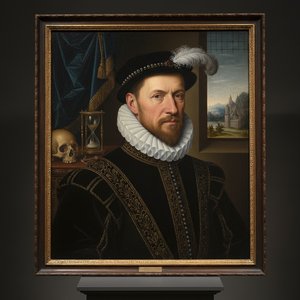
The portrait presents Henry Howard from the head and shoulders up, a compositional choice frequently employed by Holbein to focus attention on the sitter's face and character. He is dressed in an elegant black robe, richly trimmed with intricate white lace – symbols of his status and wealth. Howard’s direct gaze engages the viewer, creating a sense of intimacy despite his obvious social standing. A neatly maintained beard adds to his dignified appearance, suggesting maturity and wisdom. The tightly focused composition emphasizes the subject's intellectual presence.

Style & Technique: Northern Renaissance Realism

Holbein was renowned for his exceptional realism, going beyond mere physical likeness to capture a sense of personality. This portrait exemplifies that skill. He meticulously rendered every detail – from the delicate texture of the lace and subtle gradations in skin tone to the individual hairs of Howard’s beard. This precision was achieved through layering translucent glazes of oil paint over a carefully prepared panel, creating an image that feels remarkably lifelike even centuries later. His technique wasn't simply about replication; it was about revelation.

Historical Context: At the Heart of the Tudor Court

Hans Holbein the Younger spent significant time in England, serving as a court painter to King Henry VIII. This position placed him at the center of English society and made him highly sought-after for his portraiture. The Howard family were key figures within the Tudor court, frequently holding positions of power and influence. Therefore, this portrait likely served not only as a record of Henry Howard’s appearance but also as a statement of his social standing and political connections. Holbein's portraits from this period are invaluable historical documents, providing insights into the fashion, customs, and personalities of the era.

Symbolism & Interpretation: Layers of Meaning

The portrait evokes a sense of quiet authority and intellectual depth. Howard’s gaze is both penetrating and reserved, suggesting a man accustomed to power but perhaps burdened by responsibility. The dark color palette contributes to the painting's somber mood, while the luxurious fabrics hint at wealth and privilege. Holbein often embedded subtle symbolism within his portraits; further research into Henry Howard’s life might reveal hidden meanings within this composition – perhaps allusions to his political allegiances or personal beliefs.

Emotional Impact: A Portrait of Reserved Strength

The overall impression is one of dignified restraint. Howard doesn't offer a warm smile or an inviting gesture; instead, he presents himself with a controlled composure that speaks to his position and the expectations placed upon him. The painting invites contemplation – prompting viewers to consider the complexities of power, ambition, and the weight of responsibility in Tudor England.

Display & Styling Recommendations

  • Traditional Study: Its historical gravitas and rich color palette complement dark wood furnishings and leather accents.
  • Formal Dining Room: The portrait’s elegance adds sophistication to a dining space, sparking conversation among guests.
  • Gallery Wall: Paired with other Renaissance portraits or works depicting Tudor history, it creates a compelling narrative.

To best preserve the painting's integrity, display it away from direct sunlight and fluctuating temperatures. Consider museum-quality lighting to highlight its details without causing damage.

Provenance & Further Exploration

Currently housed at the Musée Thomas-Henry in Cherbourg, Normandy, this portrait stands as a testament to Holbein’s enduring legacy. Further research into Henry Howard and the Holbein family can be found through resources like Wikipedia and art databases such as this database of Holbein's work.


Biografia do Artista

A Life Etched in Detail: The World of Hans Holbein the Younger

Born around 1497 in Augsburg, Germany, Hans Holbein the Younger emerged as a defining figure of the Northern Renaissance—a master portraitist whose work continues to resonate with breathtaking realism and psychological depth. His upbringing within an artistically gifted family laid the foundation for his exceptional talent; his father, Hans Holbein the Elder, was a respected painter and printmaker who instilled in young Hans a meticulous approach to observation and technique. This early training wasn’t merely about mastering brushstrokes or mixing pigments—it was about learning to *see*, to capture not just likeness but the very essence of a subject. Holbein's initial artistic explorations occurred within his father’s workshop, where he honed his skills before embarking on a journey that would lead him through Switzerland and ultimately to the heart of the English court.

From Basel to the Tudor Court: A Rising Star

After completing his apprenticeship, Holbein traveled extensively throughout Switzerland, establishing himself as an independent artist with a growing reputation. He spent several formative years in Basel, creating not only striking portraits but also religious works and intricate woodcut designs—most notably the haunting series depicting the *Dance of Death*. These early pieces reveal a burgeoning mastery of composition and a developing fascination with capturing the complexities of human emotion. His father’s influence was paramount; Holbein inherited his meticulous attention to detail and unwavering dedication to artistic excellence. The Basel workshop fostered an environment where observation reigned supreme—a crucial element in Holbein's future success as a portraitist. He skillfully blended artistic traditions from Germany with those emerging from Italy, absorbing techniques that would enrich his distinctive style. It was in 1526 that fate intervened, drawing Holbein towards England, an event that would irrevocably alter his artistic trajectory. He arrived bearing a letter of introduction from Erasmus, the renowned humanist scholar, which opened doors to the influential circles of English society. His talent quickly captivated prominent figures like Sir Thomas More, who became both a patron and a subject for several compelling portraits. This connection proved pivotal, leading to Holbein’s appointment as a court painter to King Henry VIII in 1536—a position he held, with some interruptions, until his untimely death in 1543. During this period, Holbein documented the grandeur of Tudor England and immortalized its rulers, solidifying his place in history as one of the most celebrated artists of the era.

The Art of Perception: Style and Masterpieces

Holbein's artistic style is characterized by an extraordinary commitment to realism, achieved through painstaking attention to detail in rendering textures, fabrics, and the subtle nuances of facial features. He didn’t simply *paint* portraits; he meticulously constructed them, layer upon layer, capturing not just physical appearances but also the personality and inner life of his sitters. His innovative compositions further enhanced the impact of his work, often employing symbolic objects or backgrounds to convey deeper meaning. The Ambassadors (1533) stands as a testament to this approach—a complex and symbolically rich double portrait showcasing both Holbein’s technical brilliance and intellectual depth. The anamorphic skull subtly embedded within the painting serves as a stark *memento mori*, reminding viewers of the inevitability of death. He skillfully utilized perspective and shading techniques, mirroring advancements in scientific observation during his time. His numerous portraits of Henry VIII established a lasting image of royal power, while his depiction of Erasmus of Rotterdam captures the scholar's profound intellectual gravitas. Other notable works include the stunning *Portrait of Nikolaus Kratzer* (1528), a masterpiece of realism and scientific detail—a reflection of Holbein’s fascination with anatomical accuracy. He didn't merely record appearances—he captured moments in time, preserving them for posterity. His work serves as a powerful testament to the enduring power of art to document, interpret, and illuminate the past.

Legacy and Influence: A Lasting Impression

Holbein’s artistic journey was shaped by a confluence of influences, blending the precision of German artistic traditions with the compositional principles of the Italian Renaissance. He admired the work of Albrecht Dürer and other German masters while also studying Italian art during his travels, absorbing their techniques and incorporating them into his own unique style. His legacy is profound; Holbein’s portraits set a new standard for realism and psychological insight in portraiture, influencing generations of artists who followed. His depictions of key figures during the Tudor period provide invaluable insights into the lives and personalities of those who shaped English history. He remains one of the most admired and studied painters of the Renaissance—a master whose work continues to inspire and enthrall.
Hans Holbein o Jovem

Hans Holbein o Jovem

1497 - 1543 , Alemanha

Dados Rápidos

  • Artistic Movement Or Style: Renascimento Norte
  • Artists Who Influenced This Artist: ['Albrecht Dürer']
  • Date Of Birth: c. 1497
  • Date Of Death: October or November 1543
  • Full Name: Hans Holbein der Jüngere
  • Nationality: Deutsch-Schweiz
  • Notable Artworks:
    • Os Embaixadores
    • Retrato de Henrique VIII
    • Retrato de Erasmo
  • Place Of Birth: Augsburg, Alemanha
Explore obras de arte organizadas por temas, estilos e características.