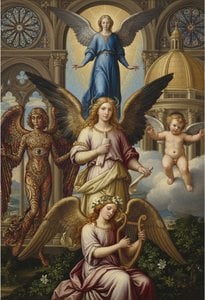
A Vision of Humanity’s Journey: Exploring Moreau's "Vie de l'Humanité"
Gustave Moreau’s “Vie de l’Humanité” (Life of Humanity) is not merely a painting; it’s an immersion into a realm of profound symbolism and spiritual yearning. Completed in the latter half of the 19th century, this monumental work embodies the core tenets of Symbolism – a movement that sought to transcend representational accuracy in favor of conveying subjective emotions and philosophical ideas through evocative imagery. Moreau, a key figure in Parisian artistic circles, deliberately distanced himself from the burgeoning Realist and Impressionist movements, choosing instead to delve into the rich tapestry of mythology, religion, and the subconscious mind. The painting’s power resides not in its depiction of a tangible scene, but in its ability to evoke a deeply felt sense of humanity's eternal quest for meaning and connection.
Subject and Composition: A Central Figure Amidst Celestial Guardians
At the heart of “Vie de l’Humanité” stands a woman, presented as the embodiment of humankind. Her gaze is directed upwards, suggesting an aspiration towards something beyond the earthly realm – perhaps divine grace or enlightenment. Surrounding her are four figures, each representing one of the classical seasons: Spring, Summer, Autumn, and Winter. These seasonal deities aren’t rendered with naturalistic detail; instead, they possess a distinctly angelic quality, their forms imbued with a dreamlike luminescence. The architectural backdrop, an ornate building adorned with arches, elevates the scene to a monumental scale, reinforcing the painting's themes of grandeur and spiritual significance. This carefully constructed composition immediately draws the viewer into a narrative that transcends simple portraiture.
Symbolism and Influences: Echoes of Myth and Religion
Moreau’s work is saturated with symbolism, drawing heavily from classical mythology and religious iconography. The four seasons themselves are potent symbols – Spring representing rebirth and renewal, Summer embodying passion and abundance, Autumn signifying maturity and reflection, and Winter symbolizing dormancy and spiritual contemplation. The woman's upward gaze aligns with the Christian concept of ascending to heaven, while the angelic figures evoke a sense of divine protection and guidance. Moreau’s artistic influences extend beyond these readily apparent sources; he was deeply affected by the writings of Plato and other philosophical thinkers who explored themes of duality, the soul, and the nature of reality. The painting reflects a desire to capture not just outward appearances but also the inner spiritual landscape of humanity.
Technique and Style: A Masterclass in Dreamlike Atmosphere
Moreau’s technique is characterized by meticulous detail combined with an almost otherworldly atmosphere. He employed rich, saturated colors – deep blues, purples, and golds – to create a sense of opulence and mystery. His brushwork is often layered and textured, contributing to the painting's dreamlike quality. Moreau was a master of creating depth and perspective through subtle gradations of light and shadow, further enhancing the illusion of three-dimensionality. The use of gold leaf, particularly in highlighting the angelic figures and architectural details, adds to the overall sense of sacredness and elevates the work beyond mere representation. This meticulous approach reflects his commitment to crafting a visual experience that transcends simple observation.
Emotional Impact and Legacy: A Timeless Exploration of the Human Condition
"Vie de l’Humanité" continues to resonate with viewers today because it taps into fundamental human concerns – our desire for meaning, our yearning for connection with something greater than ourselves, and our struggle to reconcile the earthly and the spiritual. Moreau's painting is a testament to the power of Symbolist art to evoke profound emotions and stimulate intellectual reflection. Its enduring appeal lies in its ability to transport us to a realm of beauty, mystery, and timeless significance. WahooArt.com offers meticulously crafted hand-painted reproductions that faithfully capture the essence of this extraordinary masterpiece, allowing you to bring its captivating vision into your own space.


 Visualizar em escala
 Encomendar reprodução pintada à mão
 Enviar
 Compartilhar
 Ver detalhes
 Guia
Guia

 Baixar imagem
 Semelhantes
 Raio X
 Apresentação de slides
 Estatísticas

 Ver mais






































 A opção de vidro está disponível apenas para tamanhos inferiores a 110 cm