Visualizar na paredeVisualizar na parede Ver em RAVer em RA Comprar pintura feita à mão Comprar pintura feita à mãoAlternar para Imagem Digital Alternar para Imagem Digital CompartilharCompartilhar
DetalhesDetalhes Adicionar aos favoritos Adicionar aos favoritos Baixar imagemBaixar imagem SemelhantesSemelhantes Raio XRaio X SlideshowSlideshow EstatísticasEstatísticas

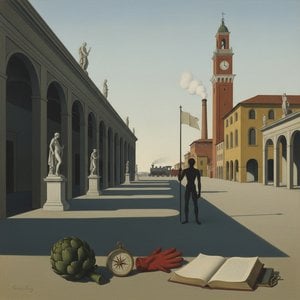
Self Portrait (8)

Experience Giorgio de Chirico's 'Self Portrait (8)' – a hauntingly beautiful and enigmatic masterpiece from 1967. Explore the surreal world of Neo-Baroque art with this hand-painted replica.

Explore o universo surreal de Giorgio de Chirico (1888-1978), fundador da arte metafísica. Descubra paisagens urbanas oníricas, temas filosóficos e manequins icônicos. Influenciou o Surrealismo.

Giclée / Impressão de Arte

Impressão giclée ou em tela de qualidade de museu, com produção rápida e opções flexíveis de acabamento. (Comprar pintura feita à mão Comprar pintura feita à mãoAlternar para Imagem Digital Alternar para Imagem Digital)

P118B $10
P118H $10
P118W $10
P438Z $10
P508JH $12
P508YH $12
P805H $10
P805Z $10
P919BZ $10
P919G $10
P919XJ $10
P959ZH $10
P968JZ $12
W106C $8
W218G $10
W218JH $8
W218Y $10
W307PJ $10
W316G $10
W316PJ $8
W316Y $10
W398PJ $8
W4111J $10
W500HY $15
W500JH $15
W692G $12
W849H $8
W940BG $15
W953PJ $8

Tamanho padrão
personalizado
CM
INCH

Escolha entre os nossos tamanhos pré-definidos que respeitam as proporções originais da obra de arte.

largura
altura

Você pode inserir suas próprias dimensões para se ajustar a uma moldura ou espaço específico. Se o tamanho selecionado não corresponder às proporções da imagem original, iremos recortar a obra de arte ou estender a imagem com uma borda espelhada ou preenchimento sólido. Um mockup digital será enviado para sua aprovação antes do início da produção.
Por favor, observe que a visualização na tela não reflete o recorte ou a extensão real. Apenas o mockup mostrará com precisão a composição final.
Embora tamanhos personalizados estejam disponíveis, recomendamos selecionar uma dimensão da lista predefinida para preservar as proporções originais.

Entrega mundial () em 2 semanas, em vez das 4/5 semanas padrão. (8 Setembro)

why_choose_icon
Envio expresso gratuito para todo o mundo
why_choose_icon
Tela de Linho de Alta Qualidade
why_choose_icon
Seguro de transporte completo
why_choose_icon
Garantia de Reembolso de Impostos Alfandegários
why_choose_icon
Garantia de Fidelidade Cromática
why_choose_icon
Política de Devolução de 100 Dias (Apenas Defeitos)
why_choose_icon
Garantia de reembolso de 100%
why_choose_icon
Oferta de desconto por quantidade

Preço Total

$ 68

reproduction

Self Portrait (8)

Giclée / Impressão de Arte

Tamanho da Reprodução

-

Preço Total

$ 68

Informações Rápidas

  • Artistic style: Neo-Baroque
  • Medium: Painting
  • Movement: Metafisica
  • Influences:
    • Schopenhauer
    • Nietzsche
  • Year: 1967
  • Notable elements: Arcades, shadows

Quiz de Arte

Cada pergunta possui apenas uma resposta correta.

Pergunta 1:
What is the primary artistic movement associated with Giorgio de Chirico’s ‘Self Portrait (8)’?
Pergunta 2:
The image description mentions a building in the background. What architectural style is most strongly suggested by this element?
Pergunta 3:
Based on the image description, what is a prominent feature of the man’s attire?
Pergunta 4:
Giorgio de Chirico is known for his exploration of what philosophical themes in his art?
Pergunta 5:
The image description indicates the man is holding his hand on his chin. What does this gesture typically symbolize in de Chirico’s work?

Giorgio de Chirico’s “Self Portrait (8)” – A Dreamscape of Isolation

Giorgio de Chirico's "Self Portrait (8)," painted in 1967, isn’t merely a depiction of an artist; it’s a meticulously constructed fragment of the subconscious, a distilled essence of the anxieties and intellectual currents that defined his entire oeuvre. This particular iteration, created later in his career, leans heavily into the neo-baroque style he embraced during this period, offering a glimpse into a mind grappling with memory, alienation, and the unsettling beauty of the familiar transformed. The painting immediately draws the viewer in with its stark simplicity – a solitary figure, rendered in muted tones against a backdrop that simultaneously evokes classical Roman architecture and an unnerving sense of emptiness. It’s a portrait not just of a man, but of a state of being.

The Anatomy of Disquiet: Style and Technique

De Chirico's technique in this self-portrait is deliberately restrained, almost austere. The brushwork is visible, lending the painting a tactile quality that contrasts sharply with the dreamlike atmosphere. He employs a flattened perspective, reminiscent of Byzantine icons, creating an illusion of depth that simultaneously draws the eye inward and reinforces the feeling of confinement. Notice the careful attention to detail in the figure’s face – the slightly furrowed brow, the intense gaze directed squarely at the viewer—a direct challenge to the observer's presence within this carefully constructed space. The use of dark clothing against a lighter background further emphasizes the figure’s isolation and creates a dramatic interplay of light and shadow that contributes significantly to the painting’s overall mood.

Philosophical Echoes: Schopenhauer, Nietzsche, and the Uncanny

To understand “Self Portrait (8),” one must delve into the philosophical landscape that profoundly shaped de Chirico's artistic vision. Heavily influenced by Arthur Schopenhauer’s philosophy of pessimism and Friedrich Nietzsche’s exploration of nihilism and the will to power, de Chirico sought to capture the unsettling feeling of reality as a deceptive illusion—a “veil” concealing an underlying chaos. The painting embodies this concept perfectly. The Roman-inspired background, with its echoing arches and distant water, is not a genuine place but rather a construct of memory and imagination, imbued with a sense of longing and loss. The mannequins, often present in his earlier works, subtly hint at the artificiality of human relationships and the inherent loneliness of existence—a recurring motif reflecting his engagement with Schopenhauer’s ideas about the will as a relentless striving for satisfaction ultimately leading to suffering.

Symbolism and Emotional Resonance: Birds, Perspective, and the Viewer

Beyond the philosophical influences, several symbolic elements contribute to the painting's layered meaning. The two birds—one perched near the top left corner, another in the lower right—represent fleeting moments of beauty or perhaps even a sense of escape within an otherwise desolate landscape. The illogical perspective, a hallmark of de Chirico’s metaphysical style, further destabilizes our perception and creates a feeling of disorientation. Most importantly, the direct gaze of the self-portrait is profoundly unsettling. It forces the viewer to confront their own reflection in this strange, dreamlike world—a silent acknowledgment of shared isolation and the inherent mystery of human consciousness. “Self Portrait (8)” isn’t simply a portrait; it's an invitation to contemplate the complexities of the inner life and the enduring power of art to capture the elusive nature of reality.

A Reproduction for the Soul: Bringing De Chirico Home

WahooArt offers meticulously hand-painted reproductions of “Self Portrait (8),” allowing you to bring this iconic work into your own space. Our artists recreate de Chirico’s distinctive style and evocative atmosphere with exceptional skill, ensuring that every detail—from the subtle brushstrokes to the nuanced color palette—is faithfully reproduced. This is more than just a print; it's an authentic artistic experience, a window into the mind of one of the 20th century’s most enigmatic artists. Consider this reproduction not as a mere decoration, but as a conversation starter, a meditation on themes of isolation, memory, and the enduring power of art to illuminate the human condition.


Biografia do Artista

A Jornada de um Sonhador: A Vida e a Arte de Giorgio de Chirico

Nascido em 1888 na pitoresca cidade de Volos, Grécia, filho de pais italianos – uma mãe proveniente de Gênova e um pai oriundo da Sicília – o percurso artístico de Giorgio de Chirico foi marcado por uma profunda ligação com a herança clássica e uma crescente sensação de alienação moderna. Sua educação inicial no Politécnico de Atenas forneceu-lhe uma base sólida em técnicas tradicionais, mas foram seus estudos subsequentes em Munique que realmente acenderam sua chama criativa. Ali, imerso na fermentação intelectual da Europa pré-guerra, encontrou obras de Arnold Böcklin e Max Klinger, artistas cujas paisagens simbólicas e imagens fantasmagóricas ressoariam profundamente com sua própria visão artística em desenvolvimento. Igualmente influentes eram as correntes filosóficas da época – os escritos de Friedrich Nietzsche, Arthur Schopenhauer e Otto Weininger – que exploravam temas de existencialismo, a irracionalidade do desejo humano e a natureza subjetiva da realidade. Essas ideias se tornariam centrais na visão artística inovadora de de Chirico.

O Nascimento da Pintura Metafísica

Por volta de 1909, um estilo único começou a emergir das explorações de de Chirico – um estilo que ele próprio denominou “Pintura Metafísica”. Não se tratava apenas de uma inovação estilística; era um esforço profundo para capturar as realidades ocultas por baixo da superfície da vida cotidiana, revelar a poesia inquietante escondida em espaços familiares. Um momento crucial ocorreu durante uma visita a Florença e uma experiência na Piazza Santa Croce, que inspirou sua icônica série “Praças Metáfisicas”. Essas pinturas são caracterizadas por seu silêncio enigmático, longas sombras dramáticas, perspectivas ilógicas e a presença de arquitetura clássica juxtapositada com elementos perturbadores como manequins sem rosto e estátuas imponentes. O efeito é profundamente desconcertante, evocando uma sensação de nostalgia, isolamento e um anseio quase insuportável por algo perdido ou inatingível. De Chirico fundou a *Scuola Metafisica*, impactando profundamente o Surrealismo, embora mais tarde se afastasse das interpretações de sua obra. Suas pinturas não pretendiam ser ilustrações de sonhos, mas sim tentativas de representar uma realidade além do mundo visível – um reino onde tempo e espaço são fluidos e os limites entre a consciência e o inconsciente se desfazem. Obras notáveis como “Os Perturbações do Pensador”, “O Enigma da Tarde Outonal” e “A Canção do Amor” exemplificam essa estética inquietante, convidando os espectadores a contemplar os mistérios da existência e a fragilidade da percepção humana.

Influências e a Evolução de um Estilo Único

A influência de Böcklin e Klinger se manifesta na atmosfera melancólica e no simbolismo presente em suas obras, elementos que de Chirico absorveu profundamente. A filosofia de Nietzsche e Schopenhauer forneceu-lhe uma estrutura para explorar temas de angústia existencial, alienação e a busca por significado em um mundo aparentemente sem sentido. No entanto, a visão artística de de Chirico transcendia essas influências, buscando criar uma linguagem visual própria que desafiasse as convenções artísticas da época. Aos poucos, ele começou a experimentar com a perspectiva, distorcendo-a para criar espaços irrealistas e ambíguos, e a introduzir objetos aparentemente desconectados em cenários familiares. Essa combinação de elementos resultou em uma estética única que se tornaria conhecida como “Metafísica”.

A Transição para um Novo Caminho Artístico

Após a Primeira Guerra Mundial, por volta de 1919, o caminho artístico de de Chirico tomou um rumo inesperado. Ele rejeitou sua abordagem metafísica anterior, abraçando em vez disso um estilo mais tradicional neoclássico ou neo-barroco. Essa mudança foi recebida com grande controvérsia; muitos críticos lamentaram a suposta perda de qualidade e o acusaram de abandonar o espírito inovador que havia definido seu trabalho inicial. No entanto, de Chirico permaneceu firme em suas escolhas artísticas, revisitando temas de seu passado, mas renderizando-os com uma sensibilidade diferente. Continuou a pintar e expor abundantemente ao longo de sua vida, explorando vários estilos e assuntos, mantendo um compromisso constante com o artesanato e a habilidade técnica. Apesar das críticas, sua influência sobre as gerações posteriores de artistas é inegável. Sua utilização inovadora do espaço, da perspectiva e do simbolismo desafiou as normas artísticas convencionais e abriu caminho para novas formas de expressão.

Um Legado Duradouro

De Chirico deixou um legado duradouro na história da arte, abrindo novos caminhos para a representação da realidade interior e da experiência humana. Sua obra continua a inspirar artistas e intelectuais em todo o mundo, convidando-os a explorar os mistérios do inconsciente e a questionar as fronteiras entre o real e o imaginário. Ele não apenas deixou um corpo de obras de arte, mas também uma nova maneira de ver – uma forma de perceber o mundo como um lugar de significados ocultos, beleza inquietante e mistério duradouro.

Principais Influências & Linha do Desenvolvimento Artístico

  • Influenciado Por: Arnold Böcklin, Max Klinger, Friedrich Nietzsche, Arthur Schopenhauer.
  • Influenciou: Surrealismo, particularmente artistas como René Magritte e Salvador Dalí. Sua obra também impactou movimentos posteriores como o Realismo Mágico.

Giorgio de Chirico

Giorgio de Chirico

1888 - 1978 , Grécia

Dados Rápidos

  • Artistic Movement Or Style: Metafísica
  • Artists Or Movements Influenced By This Artist: ['Surrealismo']
  • Artists Who Influenced This Artist:
    • Böcklin
    • Klinger
  • Date Of Birth: 10 Jul 1888
  • Date Of Death: 20 Nov 1978
  • Full Name: Giorgio de Chirico
  • Nationality: Italiano
  • Notable Artworks:
    • O Retorno do Poeta
    • A Enigma da Tarde de Outono
  • Place Of Birth: Volos, Grécia
Explore obras de arte organizadas por temas, estilos e características.