A Life Dedicated to Zen: The World of Gesshū Sōko
Gesshū Sōko, born in Hizen Province, Japan, in 1618 and passing away in 1696, was far more than simply a calligrapher or poet. He embodied the spirit of Zen Buddhism as both a dedicated teacher within the Sōtō school and a pivotal figure in its reformation during the Edo period. His life unfolded against a backdrop of evolving religious practices and societal shifts, and he navigated these complexities with a profound commitment to his faith and artistic expression. While many artists leave behind a tangible body of work—paintings, sculptures, or architectural marvels—Sōko’s legacy is largely found in the revitalization of monastic codes and the deeply personal reflections captured within his calligraphy and poetry.
Early Life and Zen Training
Details surrounding Sōko's early life remain somewhat elusive. However, it is known that he embarked on a rigorous path of Zen training, initially under teachers associated with the lesser-known ōbaku school—a branch of Zen originating from China. This exposure to a more strictly monastic approach would profoundly shape his later efforts within the Sōtō tradition. The ōbaku school’s emphasis on disciplined practice and direct experience likely instilled in him a desire for clarity and authenticity, qualities that permeate both his teachings and artistic endeavors. He wasn't content with merely preserving existing traditions; he sought to refine them, stripping away perceived excesses and returning to the core principles of Zen.
The Revitalizer of Sōtō Monasticism
Sōko’s most significant contribution lay in his reformation of the Sōtō monastic codes. By the 17th century, some aspects of the Sōtō school had become diluted or overly ritualized. Recognizing this, he undertook a systematic effort to restore the original spirit of *zazen* (seated meditation) and emphasize the importance of direct personal realization. This wasn’t a revolutionary upheaval but rather a careful recalibration—a return to foundational principles. For his dedication to this cause, Sōko earned the fitting title “The Revitalizer.” He believed that true understanding arose not from intellectual study alone, but from immersive practice and unwavering self-reflection.
Calligraphy as Spiritual Practice
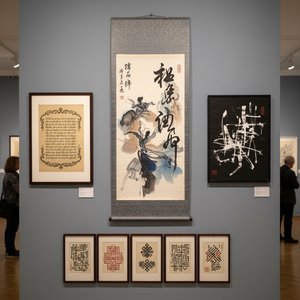
Central to understanding Gesshū Sōko is recognizing his calligraphy not merely as an artistic skill, but as a direct extension of his Zen practice. Each brushstroke was imbued with intention, each character a manifestation of his meditative state. His works are characterized by their simplicity and elegance—a deliberate rejection of ostentation in favor of profound clarity. He frequently employed Chinese verses alongside Japanese script, reflecting the deep historical connections between Zen Buddhism and Chinese culture. A particularly striking example is his piece titled ‘Poem,’ which showcases aged paper and gold leaf, creating a timeless work that invites contemplation on life’s impermanence and the beauty found within transience.
Poetry and Reflections on Life and Death
Beyond calligraphy, Sōko was a gifted poet whose verses offer poignant insights into the Zen worldview. His most famous poem, often referred to as his death poem, encapsulates the essence of his teachings:
Inhale, exhale
Forward, back
Living, dying:
Arrows, let flown each to each
Meet midway and slice
The void in aimless flight—
Thus I return to the source.
This poem is not a lament for mortality, but rather an acceptance of it as an integral part of existence. The imagery of arrows meeting and slicing through the void speaks to the fleeting nature of life and the ultimate liberation found in surrendering to the present moment. It’s a testament to his ability to distill complex philosophical concepts into concise, evocative language. His passing of Dharma transmission to Manzan Dōhaku further solidified his legacy, ensuring the continuation of Sōtō Zen's revitalized spirit for generations to come.



 Visualizar na parede
 Switch to Print
 Compartilhar
 Compartilhar
 Detalhes

 Baixar imagem
 Semelhantes
 Raio X
 Slideshow
 Stats
Stats

 Ler mais






































 A opção de vidro está disponível apenas para tamanhos inferiores a 110 cm