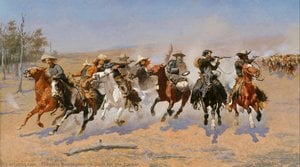
A Chronicler of the Vanishing West: The Life and Art of Frederic Remington
Frederic Sackrider Remington, nascido em Canton, Nova York, em 4 de outubro de 1861, não era um produto do Velho Oeste que tão vívidamente retratava; ao contrário, ele era um oriental que forjou sua identidade artística através da fascinação e estudo dedicado. Sua linhagem sugeria uma vida distante das trilhas poeirentas e cargas de cavalaria – ancestralidade francesa basca misturada com raízes republicanas do Novo Inglês, um pai que era coronel e editor de jornais da Guerra Civil, e conexões com a famosa Remington Arms Dynasty através de parentes distantes. No entanto, uma exposição precoce a temas militares, combinada com um espírito inquieto e um olhar aguçado para a narrativa, o levaram a trilhar um caminho em direção a se tornar, sem dúvida, o artista mais reconhecível do Oeste americano. Sua infância mudou para Bloomington, Illinois, depois de volta a Canton e finalmente Ogdensburg, Nova York, mas sua imaginação permaneceu cativada por contos de vida na fronteira. Embora inicialmente direcionado a uma educação militar no Vermont Episcopal Institute, o chamado real de Remington não estava em seguir ordens, mas em observar e interpretar o mundo ao seu redor através da arte. Um breve período na Universidade de Yale confirmou isso; futebol e esboço tinham muito mais apelo do que empreendimentos acadêmicos formais.
Do Ilustrador ao Pintor: Forjando uma Visão Artística
A jornada artística de Remington não começou com telas grandiosas, mas sim com tinta e papel. Seu primeiro trabalho publicado, um desenho para o *Yale Courant*, sinalizou uma aptidão precoce para capturar ação e narrativa. Uma viagem crucial a Montana em 1881 acendeu sua obsessão vitalícia pelo Oeste. Isso não era apenas um olhar de turista; Remington buscou se imergir na cultura, observando cowboys, nativos americanos e o próprio cenário. Inicialmente tentou empreendimentos de pecuária e mineração, mas estes se mostraram infrutíferos, liberando-o para se dedicar totalmente à arte. Retornando ao Leste, ele rapidamente se estabeleceu como um ilustrador para revistas como *Harper’s Weekly* e *Collier’s*, suas representações dinâmicas de cenas do Oeste cativaram um público nacional ávido por histórias da fronteira. Esses desenhos não eram simplesmente reportagens; eles estavam imbuídos de drama, energia e uma visão romântica do Oeste que ressoou profundamente na imaginação pública. Foi através deste trabalho que Remington aprimorou suas habilidades em composição, capturando movimento e transmitindo emoção – qualidades que mais tarde definiriam seus quadros. Ele recebeu treinamento artístico limitado além de algumas aulas de desenho na Yale e um breve período na Art Students League, desenvolvendo em vez disso um estilo distinto caracterizado por pinceladas enérgicas, cores ousadas e foco no realismo combinado com o charme dramático.
Capturando um Mundo Desaparecendo: Temas e Estilo
A arte de Remington está inextricavelmente ligada a um momento específico na história americana – o crepúsculo do Velho Oeste. Seus quadros são povoados por figuras icônicas: cowboys robustos dirigindo gado, nativos americanos estoicos confrontando a deslocação e soldados da cavalaria dos EUA envolvidos tanto em batalhas heroicas quanto em trágicas disputas. Ele não hesitou em retratar as duras realidades da vida na fronteira, mas sua obra muitas vezes inclina-se para uma representação romântica, enfatizando coragem, aventura e o choque de culturas.
Sua arte não é simplesmente um documento histórico; são narrativas evocativas que exploram temas de heroísmo, perda e a marcha inevitável do progresso. O estilo de Remington evoluiu ao longo do tempo, movendo-se de representações mais apertadas e acadêmicas para pinceladas mais soltas e expressivas. Ele era um mestre em capturar movimento – cavalos galopando pelos campos, cowboys lutando com bois, soldados avançando em batalha. *Ele frequentemente empregava esboços rápidos e fotografias como material de referência, mas sua arte sempre transcendia a mera imitação, imbuída de sua própria visão única e intensidade emocional.* Quadros notáveis como “My Ranch”, “Waiting in the Moonlight”, “Ridden Down” (1905) e “The Long-Horn Cattle Sign” (1908) exemplificam sua capacidade de capturar tanto a grandiosidade quanto a vulnerabilidade do Oeste americano.
Influências e Legado
Frederic Remington morreu inesperadamente em 1909, aos 48 anos, deixando para trás uma vasta obra que continua a cativar o público hoje. Seu impacto na arte ocidental é inegável; ele não apenas retratou o Oeste, mas *definiu*-o para gerações de americanos. Ele estabeleceu uma linguagem visual para a fronteira – uma iconografia de cowboys, nativos americanos e soldados da cavalaria que se tornou profundamente enraizada na imaginação popular.
- Sua obra inspirou inúmeros outros artistas, incluindo N.C. Wyeth e Zane Grey.
- O Museu de Arte Remington em Ogdensburg, Nova York, é um testemunho de sua herança duradoura, preservando uma extensa coleção de suas pinturas, esculturas e materiais arquivais.
- Sua arte continua a ser exibida em importantes museus nos Estados Unidos, incluindo o Metropolitan Museum of Art e o Amon Carter Museum of American Art.
As representações dele, embora às vezes criticadas por sua visão romântica do Oeste, oferecem um vislumbre valioso de uma era crucial na história americana. Ele capturou não apenas o que *era*, mas também o que as pessoas *acreditavam* sobre o Oeste – seus mitos, suas lendas e seu apelo duradouro. Ele permanece um símbolo poderoso do espírito americano - um cronista de um mundo desaparecendo que transformou-o em uma herança artística duradoura.



 Visualizar em escala
 Alternar para Impressão
 Enviar
 Compartilhar
 Ver detalhes
 Guia
Guia

 Baixar imagem
 Semelhantes
 Raio X
 Apresentação de slides
 Estatísticas


 Ver mais