Dreaming Horse
Franz Marc was a prominent figure in the German Expressionist movement, and his painting Dreaming Horse is a quintessential example of this style. Created in 1912, this oil on canvas artwork showcases Marc’s unique blend of vibrant colors and emotive subjects.
Style and Media
The Dreaming Horse painting exemplifies the characteristics of Expressionism, with its bold brushstrokes and vivid colors. Marc's use of oil paint allowed him to achieve a thick, textured surface that adds depth and volume to the horse’s form. The artist’s simplified, almost abstracted style focuses on the essential elements of the subject matter, creating a dynamic energy that brings the horse to life.
Meaning and Interpretation
The Dreaming Horse can be seen as a representation of Marc’s deep connection with nature and his belief in the spiritual power of animals. The horse's serene expression and dreamlike state suggest a sense of mysticism and otherworldliness, inviting viewers to contemplate the deeper meanings of the work. As an Expressionist artist, Marc sought to convey his emotional responses to the world around him, and this painting is no exception.
Relevant Works by Franz Marc
Some of Marc's other notable works include The Red Deer, which can be found on WahooArt.com. This painting, created in 1912, is a testament to Marc’s unique style and his ability to blend vibrant colors with emotive subjects. Another notable work is Sleeping Deer, which showcases Marc’s use of cubist techniques and his fascination with the natural world.
- Visit WahooArt.com to discover more masterpieces by Franz Marc
- Learn more about the Museum Collection Hugo Fischer on WahooArt.com
- Read about the life and work of Franz Marc on Wikipedia
Dreaming Horse is a powerful example of Expressionist art that showcases Marc’s unique style and vision. Through its simplified form, bold colors, and emotional intensity, the painting invites viewers to explore the deeper meanings of the work and connect with the spiritual power of nature. As a handmade oil painting reproduction, this artwork can be appreciated in a new light, allowing viewers to experience the vibrant colors and textures that Marc so masterfully created.
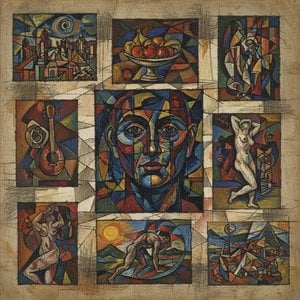
Photo Description: The painting is a colorful and abstract piece of artwork featuring various animals and objects. The main focus is on two blue birds, one located in the top left corner and another towards the bottom right side of the painting. There are also several other birds scattered throughout the image, some closer to the center while others are positioned near the edges. In addition to the birds, there are three people visible within the painting. One person is situated on the left side, another in the middle, and a third one towards the right side of the artwork. The people appear to be interacting with or observing the animals in the scene. The painting also includes various objects such as a guitar located near the top center, a bowl positioned at the bottom left corner, and two apples placed on the right side of the image. These elements contribute to the overall vibrant and dynamic nature of the artwork.
Size: Unknown
Date: Unknown
Artist Information:
A Life Immersed in Color and Spirit
Franz Moritz Wilhelm Marc, born in Munich in 1880, was a painter whose brief but intensely focused career irrevocably altered the course of German Expressionism. His story is one of profound spiritual seeking translated into a vibrant visual language, a quest to understand the essence of life through the purity he found in the natural world—particularly within the animal kingdom. Initially influenced by his father, Wilhelm Marc, a landscape painter; young Franz’s artistic path wasn't immediately certain. He briefly considered theology, grappling with questions of faith and existence before ultimately dedicating himself to art at the Academy of Fine Arts in Munich. These early explorations into religious thought would remain deeply embedded within his work, shaping his belief that art could be a conduit for spiritual experience. His academic training provided him with technical foundations, but it was encounters with the works of Vincent van Gogh that truly ignited his artistic passion. He immediately recognized Van Gogh’s expressive use of color and brushstrokes as kindred spirits, mirroring his own yearning to capture emotion and feeling on canvas. This fascination would permeate his entire oeuvre, influencing his stylistic choices and thematic concerns for decades to come. Marc's artistic journey wasn't without its challenges; he wrestled with personal demons and struggled to reconcile his intellectual pursuits with his emotional impulses. Yet, amidst these difficulties, he persevered, honing his craft and developing a distinctive visual language that would solidify his place as one of the foremost artists of his generation. He continued to refine his technique, experimenting with various mediums and styles—from landscapes imbued with symbolic resonance to portraits capturing fleeting expressions of human emotion—always striving for an authentic portrayal of the inner world. His unwavering commitment to artistic integrity ensured that his legacy endured beyond his lifetime, inspiring countless artists who followed in his footsteps. Marc’s exploration into spirituality was not merely a philosophical preoccupation but a fundamental element shaping his creative process. He believed that art possessed the capacity to transcend rational thought and communicate directly with the soul, seeking to evoke feelings of awe and wonder—a conviction that underpinned his entire artistic vision. His work stands as a testament to this belief, inviting viewers to contemplate profound questions about existence and beauty.
Notable Achievements
Marc’s career spanned several decades, during which he produced an impressive body of artwork that garnered critical acclaim and cemented his reputation as a visionary artist. He achieved considerable success in the art world, establishing himself as a leading figure within Der Blaue Reiter—a journal founded by Macke and Kandinsky—and collaborating with fellow Expressionist artists on numerous projects. His paintings were exhibited extensively throughout Europe, attracting audiences eager to experience his distinctive style and emotive themes. Furthermore, Marc’s influence extended beyond the realm of painting; he actively engaged in artistic discourse and championed innovative approaches to visual expression. He served as a professor at Munich University, nurturing the talents of aspiring artists and fostering a spirit of experimentation and creativity. His dedication to teaching instilled in his students a profound appreciation for art's transformative power—a legacy that continues to resonate today.
Legacy
Franz Marc’s artistic contributions have had an enduring impact on the history of modern art. He is remembered as one of the pioneers of Expressionism, shaping its aesthetic principles and thematic concerns. His paintings continue to inspire artists and viewers alike, captivating audiences with their vibrant colors, evocative imagery, and profound spiritual depth. Marc's work remains a cornerstone of artistic heritage, demonstrating the transformative potential of art—a testament to his unwavering belief in its ability to communicate emotion and illuminate the human condition. He is honored as an artist who dared to challenge conventions and forge new paths toward artistic expression—a figure whose legacy continues to inspire creativity and contemplation."
Perguntas e Respostas
Como posso visualizar uma reprodução de "Sonhando com Cavalos" de Franz Marc?
Para visualizar uma reprodução de "Sonhando com Cavalos" de Franz Marc, acesse a página de Visualização da obra.
As cores de "Sonhando com Cavalos" de Franz Marc são saturadas ou suaves?
As cores de "Sonhando com Cavalos" de Franz Marc possuem uma saturação Presença de cor nítida. A saturação descreve o quão vívidas ou suaves são as cores.
"Sonhando com Cavalos" é mais claro ou mais escuro no geral?
"Sonhando com Cavalos" possui brilhante de brilho geral, e sua luminância é Luminosidade Suave.



 Visualizar em escala
 Encomendar reprodução pintada à mão
 Enviar
 Compartilhar
 Ver detalhes
 Guia de Obras do Aluno

 Baixar imagem
 Semelhantes
 Raio X
 Apresentação de slides
 Estatísticas

 Ver mais






































 A opção de vidro está disponível apenas para tamanhos inferiores a 110 cm