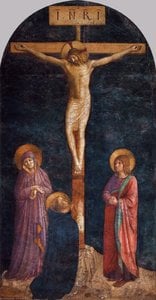
A Vision of Divine Judgment: Fra Angelico’s Masterpiece
Fra Angelico's “Christ the Judge,” painted in 1447 for the Chapel of San Brizio within the Orvieto Cathedral, is not merely a depiction of religious iconography; it is a profound statement of faith rendered with the delicate hand and spiritual intensity that define the Early Renaissance. The fresco presents a majestic Christ enthroned amidst celestial glory, his gaze commanding yet imbued with compassion. He raises his hands in gesture of both blessing and judgment, holding a sphere—a symbol of the cosmos over which he reigns. The composition is striking in its formality and vibrant use of gold and deep blues, colors traditionally associated with divinity and heavenly realms. This wasn’t simply decoration; it was an integral part of a larger program intended to inspire awe and contemplation within the sacred space.
The Artistic Landscape of 15th-Century Italy
To understand “Christ the Judge,” one must consider the artistic climate of mid-15th century Italy. Fra Angelico, born Giovanni da Fiesole, was a Dominican friar whose religious devotion permeated every aspect of his art. He moved within a world increasingly influenced by humanist ideals and a renewed interest in classical antiquity, yet remained steadfastly committed to expressing spiritual truths. While he absorbed lessons from contemporaries like Lorenzo Monaco – evident in the elegant lines and decorative patterns – and likely studied the groundbreaking perspective techniques pioneered by Masaccio, Fra Angelico never abandoned his distinctly devotional style. His work stands as a bridge between the Gothic past and the burgeoning Renaissance, retaining a sense of ethereal beauty and spiritual depth that sets it apart. The commission itself reflects the power and patronage of the Church during this period; cathedrals were not only places of worship but also showcases for artistic achievement, intended to reinforce religious authority and inspire piety.
Symbolism and Spiritual Resonance
Every element within “Christ the Judge” carries symbolic weight. The golden background isn’t merely decorative; it represents the divine light emanating from God himself. The sphere held by Christ signifies his dominion over all creation, while his raised hand is a gesture of both authority and mercy. Flanking Christ are figures – angels or perhaps saints – who bear witness to the final judgment. Their presence underscores the universality of this event and the importance of faith in securing salvation. The fresco’s placement within the Chapel of San Brizio further amplifies its meaning; it was intended as a visual sermon, reminding worshippers of their mortality and the ultimate accountability before God. The very act of creating such an image was considered a pious undertaking, a form of prayer translated into paint and plaster. Fra Angelico’s intention wasn’t simply to depict a scene but to create a space for spiritual encounter.
Technique and Artistic Innovation
Fra Angelico’s mastery of fresco technique exemplifies the artistic advancements of his era. He skillfully employed tempera pigments mixed with lime, creating durable colors that adhered seamlessly to the plaster surface—a method perfected by Masaccio and Giotto before him. The meticulous layering of glaze over underpainting ensured luminosity and depth, capturing the subtle nuances of light and shadow. Notably, Angelico eschewed traditional perspective, opting for a flattened pictorial space characteristic of Gothic art, yet simultaneously incorporating elements of humanist observation to convey a sense of grandeur and solemnity. This deliberate stylistic choice distinguishes his work from earlier predecessors while maintaining an unwavering focus on conveying spiritual truth.
A Legacy of Beauty and Faith
Fra Angelico's “Christ the Judge” continues to resonate with viewers today, not only as a masterpiece of Renaissance art but also as a testament to the enduring power of faith. Its serene beauty, meticulous detail, and profound symbolism invite contemplation on themes of judgment, redemption, and the divine order. The fresco’s influence can be seen in countless subsequent depictions of Christ in Majesty, solidifying its place within the canon of Western art. For those seeking to bring a touch of spiritual grace and historical significance into their homes or collections, a hand-painted reproduction of this iconic work offers an opportunity to connect with a legacy of beauty and faith that transcends time.
Photo Description: The image is a painting of Jesus Christ sitting on a chair with his arms raised in the air. He appears to be holding a sphere or ball in his hands. The painting is done in a fresco style, which gives it an old and historical appearance. The colors used are predominantly gold and blue, adding to the richness of the artwork. In addition to Jesus, there are two other figures present in the painting. One figure can be seen on the left side of the image, while the other is located towards the right side. These figures appear to be part of a larger scene or possibly represent additional characters from religious history.
Size: Unknown
Date: 1447
ARTIST INFORMATION:
==================
Artist: Fra Angelico
Birth Year: 1395
Death Year: 1455
Birth City: Rupesana
Birth Country: Italy
Biography:
Early Life and Spiritual Formation
Born Guido di Pietro around 1395 in the hamlet of Rupecanina in the Tuscan area of Mugello near Fiesole, not far from Florence, towards the end of the 14th century. Little is known of his parents. He was baptised Guido. The earliest recorded document concerning Fra Angelico dates from 17 October 1417, when he joined the Dominican Order at Fiesole, embracing a life of religious contemplation and service. It was within the walls of the monastery that he received the name Fra (Brother) Angelico, a moniker that would soon reflect not only his monastic vows but also the angelic quality inherent in his art. Initially tasked with illuminating manuscripts – a meticulous craft demanding precision and vibrant color – he honed skills that would later blossom into breathtaking frescoes and



 Visualizar em escala
 Encomendar reprodução pintada à mão
 Enviar
 Compartilhar
 Ver detalhes

 Baixar imagem
 Semelhantes
 Raio X
 Apresentação de slides
 Estatísticas

 Ver mais






































 A opção de vidro está disponível apenas para tamanhos inferiores a 110 cm