Obtenha um arquivo pronto para impressão que vai muito além da visualização na web. Cada imagem digital que vendemos provém de um arquivo mestre de alta resolução em nosso banco de dados — geralmente entre 5.000 e 15.000 pixels de largura — para que você possa imprimir em grandes formatos, realizar cortes precisos ou reproduzir detalhes minuciosos com total confiança.
Nenhum arquivo sai do nosso estúdio sem passar por um cuidadoso processo de revisão. Um especialista digital verifica as cores em relação à pintura original e as corrige se necessário, aumentando então a clareza e o detalhe com ferramentas profissionais de retoque — sempre mantendo a fidelidade às pinceladas e ao estilo do artista. O resultado é uma imagem que se assemelha à pintura, e não a um scan com filtros.
Aprovação antes da finalização: nosso especialista enviará a imagem por e-mail em até 72 horas para sua revisão. Não ficou satisfeito? Solicite melhorias ou correções, ou peça o reembolso caso a qualidade não atenda às suas expectativas.
Esta é a qualidade em que confiam editoras, estúdios de design, galerias e gráficas.
Baixe um arquivo de alta resolução para exibição pessoal, impressão e projetos criativos. ( Alternar para Impressão Comprar pintura feita à mão)
Ao escolher o WahooArt.com, você não está apenas adquirindo uma imagem — você está recebendo uma obra de arte digital profissionalmente aprimorada, elaborada com precisão e com garantia de satisfação. Aqui está tudo o que acompanha seu pedido, automaticamente:
O seu arquivo de imagem digital em alta resolução será enviado por e-mail em até 72 horas após o pedido — pronto para uso imediato.
Sua obra de arte é otimizada profissionalmente por meio de ferramentas avançadas de IA e edição manual, garantindo o máximo de detalhes, clareza e precisão de cores.
Apagou ou perdeu o seu ficheiro acidentalmente? Não se preocupe – nós reenviamos para si a qualquer momento, gratuitamente.
Desfrute da sua obra de arte instantaneamente, sem taxas alfandegárias, impostos ou custos de entrega — downloads digitais são sempre isentos de taxas.
Garantimos que sua imagem digital reflita as cores originais com a maior fidelidade possível, utilizando ferramentas profissionais e gerenciamento de cores.
Se não estiver satisfeito com a sua imagem digital, nós a revisaremos ou reembolsaremos 100% dentro de 100 dias — sem perguntas.
Não está satisfeito? Receba o reembolso total em até 100 dias após o recebimento do seu arquivo digital — sem perguntas.
Compre 3 imagens, economize 10% - Compre 5, economize 15% - Compre 10+, economize 20%. Ideal para projetos criativos, galerias e agências.
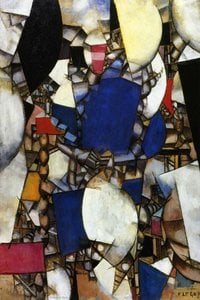
In the quiet tension of Fernand Léger’s 1919 masterpiece, Study for the Card Game, one finds a profound paradox that defines the very essence of early twentieth-century modernism. The canvas presents an arresting stillness, yet beneath its surface, there is a rhythmic, almost mechanical vitality that refuses to be ignored. At first glance, the composition appears deceptively simple, presenting three figures—a man and two women—standing in a shared moment against a muted backdrop of ochre and grey. However, to look closer is to witness a revolution of form. Léger does not merely depict people; he deconstructs them into an intricate orchestration of interlocking cubes, cylinders, and planes. This is the birth of a visual language where the human silhouette begins to merge with the structural precision of the machine age.
The technique employed in this study reveals Léger’s obsessive dedication to volume and light. Utilizing a meticulous process he termed multiplication, the artist layered thin washes of color to establish a foundational tonal structure before applying heavy, opaque pigments. This method allowed him to build up forms with a sculptural weight, capturing the internal volume of each figure without relying on traditional, soft-focus shading. Instead, Léger embraced bold contrasts and sharp outlines, creating a sense of depth through geometric intersection rather than atmospheric perspective. For the discerning collector or interior designer, this technique offers a striking visual texture that commands attention, providing a sophisticated focal point that feels both structurally grounded and vibrantly alive.
To understand the emotional resonance of Study for the Card Game, one must look to the era from which it emerged. Painted in the immediate aftermath of World War I, the work is steeped in the burgeoning anxieties and technological triumphs of a changing Europe. As industrialization accelerated, Léger found inspiration in the rhythmic, metallic hum of the modern city. The card game itself serves as a poignant symbol; much like the deterministic forces of the machine age, the game suggests a world governed by patterns, chance, and structural logic. There is a certain muscular energy in his use of primary colors and bold shapes that mirrors the strength and resilience of a society rebuilding itself through innovation.
For those seeking to infuse a contemporary space with historical depth, this piece offers an unparalleled opportunity. It bridges the gap between the organic human experience and the disciplined beauty of Constructivism. The painting does not merely decorate a wall; it invites a dialogue about how we perceive reality in an increasingly mechanized world. Whether placed in a minimalist gallery setting or as a bold statement in a curated residential collection, Léger’s work brings a sense of intellectual rigor and aesthetic dynamism. It is an invitation to embrace the beauty of the essential form—a timeless tribute to the era when art first learned to speak the language of the future.
Com sua atmosfera Elegant, "Study for the card game" é sugerida para um(a) Living Room.
Em "Study for the card game", de Fernand Léger, o movimento Cubism encontra a era Modernismo.
O movimento associado a "Study for the card game", de Fernand Léger é Cubism. Esta classificação situa a obra entre artistas e obras de arte relacionados.


1881 - 1955 , França
 Visualizar na parede
 Compartilhar
 Compartilhar
 Detalhes
 Guia
Guia

 Baixar imagem
 Semelhantes
 Raio X
 Ver diaporama
 Perguntas e Respostas
 Estatísticas

 Ler mais