Biografia do Artista
Elioth Gruner: The Texture of Light
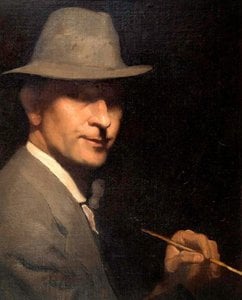
Elioth Lauritz Leganyer Gruner (1882-1939) stands as one of Australia’s most revered landscape painters, a true heir to the Heidelberg School tradition and celebrated for his serene depictions of rural New South Wales. His artistic journey began in Gisborne, New Zealand, where he was born December 16th, 1882 – son of Elliott Grüner, a Norwegian-born bailiff, and Mary Ann Brennan, whose Irish heritage instilled within him a profound connection to the land—a connection that would become central to his artistic vision. Shortly after his birth, the family relocated to Sydney, immersing young Elioth in an environment brimming with burgeoning artistic expression. Already demonstrating an innate aptitude for drawing at a tender age, he received invaluable instruction from Julian Ashton around twelve years old, marking the genesis of his formal artistic education. However, fate dealt him a cruel blow when both his father and older brother succumbed to illness, thrusting him into considerable responsibilities at just fourteen—a formative experience that fueled his determination to pursue his passion for painting alongside his duties as caregiver.
Gruner’s artistic style is undeniably Impressionistic, though it evolved over time, absorbing influences from diverse sources. He possessed an extraordinary talent for capturing the ephemeral effects of light and atmosphere in the Australian landscape, imbuing his canvases with a palpable sense of serenity and poetic beauty. The encouragement he received from Norman Lindsay proved instrumental in shaping his artistic trajectory, bolstering his confidence and refining his perception of artistic excellence. A pivotal moment arrived between 1923 and 1925 when Gruner embarked on an extended sojourn to Europe—a transformative experience that profoundly impacted his creative sensibilities. During this period, he deliberately simplified his compositions, prioritizing pattern and brushwork, and honing his technique under the guidance of Sir William Orpen – a deliberate effort to elevate his artistic craft. This newfound focus on light and color harmony would become a defining characteristic of his later works.
His breakthrough came in 1907 when he began submitting paintings to exhibitions organized by the Society of Artists in Sydney, attracting considerable attention from fellow artists—particularly Norman Lindsay, who famously declared Gruner “painted the purest light that ever has been seen on a bit of canvas.” This accolade underscored Gruner’s unwavering commitment to capturing the essence of natural illumination and translating it onto his canvases. In 1916, he achieved recognition as a master when he secured the prestigious Wynne Prize for landscape painting with "Morning Light"—a luminous depiction of Jim Innes Farm at Emu Plains—purchased by the Art Gallery of New South Wales (AGNSW) and cementing his legacy as Australia’s most prolific Wynne Prize winner. Subsequent victories continued to affirm Gruner's artistic prowess, culminating in the acquisition of “Spring Frost” (1919), which remains arguably the most beloved Australian landscape painting—a testament to his ability to convey emotion through masterful brushwork and color palettes.
Gruner’s dedication extended beyond mere technical skill; he meticulously considered every element of his subject matter before embarking on a painting project, reflecting a profound respect for the natural world and an unwavering desire to communicate its beauty authentically. He continued his artistic pursuits after Ashton's illness, taking complete charge of classes at Sydney Art School for approximately three months—a testament to his generosity and commitment to nurturing future generations of artists. His final masterpiece, “The Valley of the Tweed” (1921), commissioned by the AGNSW trustees, exemplifies Gruner’s masterful synthesis of technique and emotion—a poignant portrayal of Australian rural life that continues to resonate with viewers today.
Elioth Gruner passed away October 17th, 1939, at his home in Waverley, leaving behind a remarkable body of work that embodies the spirit of Impressionism and celebrates the splendor of the Australian landscape. His paintings are not merely representations of places; they are evocative expressions of light, atmosphere, and emotion—a legacy that secures his place as one of Australia’s greatest artists.