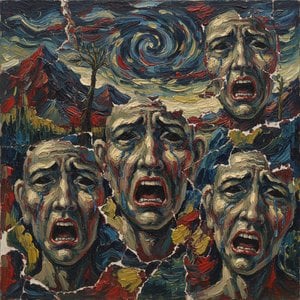
A Life Shrouded in Shadow: The World of Edvard Munch
Edvard Munch, born in 1863 amidst the stark landscapes of Norway, was an artist whose work became synonymous with the anxieties and emotional turmoil of the modern age. His life, deeply marked by loss and a pervasive sense of melancholy, served as the wellspring for his profoundly expressive art. From a childhood shadowed by the early deaths of his mother and sister – both claimed by tuberculosis – Munch developed a haunting preoccupation with mortality, sickness, and the fragility of human existence. These experiences weren’t merely biographical details; they became the very core of his artistic vision, fueling a relentless exploration of the inner landscape of fear, grief, and longing. His father's strict religious beliefs and own struggles with mental illness further contributed to a sense of dread that permeated Munch’s world, shaping not only his personal life but also the symbolic language of his paintings.
Studying at the Royal School of Art and Design in Kristiania (Oslo), Munch began to live a bohemian life under the influence of the nihilist Hans Jæger, who urged him to paint his own emotional and psychological state ('soul painting'); from this emerged his distinctive style. He wasn’t interested in portraying reality objectively; rather, he sought to capture its essence—its feelings—through distorted forms and vibrant colors.
Travel brought new influences and outlets. In Paris, he learned much from Paul Gauguin, Vincent van Gogh and Henri de Toulouse-Lautrec, especially their use of color. In Berlin, he met the Swedish dramatist August Strindberg, whom he painted, as he embarked on a major series of paintings he would later call The Frieze of Life, depicting a series of deeply-felt themes such as love, anxiety, jealousy and betrayal, steeped in atmosphere.
His fame and wealth grew, but his emotional state remained insecure. He briefly considered marriage, but could not commit himself. A mental breakdown in 1908 forced him to give up heavy drinking, and he was cheered by his increasing acceptance by the people of Kristiania and exposure in the city’s museums.
Madonna (Munch) - An Expressionist Masterpiece
Edvard Munch's *Madonna* stands as a cornerstone of Expressionism, encapsulating its core tenets—emotional intensity, subjective perception, and symbolic representation. Created in 1895, this painting transcends mere depiction; it strives to convey the profound psychological state of its subject.
Munch’s stylistic choices are deliberate and impactful. Bold colors dominate the canvas—primarily yellows and reds—creating a jarring contrast that amplifies the emotional tension. The artist employs distorted forms and expressive lines, rejecting academic conventions in favor of conveying raw emotion directly to the viewer. These techniques serve as conduits for Munch's inner turmoil, mirroring his preoccupation with themes of fear, anxiety, and existential dread.
Symbolism: Layers of Meaning
The painting’s symbolism is rich and multifaceted, inviting multiple interpretations. The central figure—a woman lying down—represents not only femininity but also vulnerability and receptiveness to life's transformative forces. Above her head hovers an amorphous form—often interpreted as an angel or demonic influence—symbolizing the omnipresent presence of both divine grace and primal terror.
The color palette itself contributes significantly to the painting’s symbolic resonance. The dominant yellow hue evokes warmth, optimism, yet simultaneously hints at decay and impending doom. Similarly, the red symbolizes passion, desire, but also bloodshed—a reminder of mortality and suffering. Munch skillfully utilizes these colors to heighten the emotional impact of the scene.
The Munch Museum: Experiencing Edvard Munch's Vision
If you wish to immerse yourself in the world of Edvard Munch and witness *Madonna* alongside other iconic works, a visit to The Munch Museum (Oslo, Norway) is indispensable. Located on Bjørvika waterfront, this museum houses an unparalleled collection of Munch’s paintings, prints, and drawings—allowing visitors to appreciate the breadth and depth of his artistic genius.
Furthermore, explore the museum's immersive exhibitions that delve into Munch’s life story and artistic process, providing valuable context for understanding *Madonna*'s profound emotional significance. Don’t miss the opportunity to contemplate this masterpiece in person—a testament to Munch’s enduring legacy as one of Expressionism’s most influential figures.
WahooArt: Bringing Edvard Munch's Art Home
At WahooArt, we offer high-quality reproductions of famous artworks, including *Madonna* by Edvard Munch. Our handmade oil paintings are crafted with meticulous attention to detail—ensuring that every nuance of Munch’s original vision is faithfully reproduced.
Whether you aspire to adorn your home with a stunning piece of art or simply wish to savor the beauty of Expressionist aesthetics, our reproductions provide an accessible pathway to experiencing the timeless allure of Edvard Munch's *Madonna*. Browse our curated collection today—and discover how WahooArt can enrich your artistic appreciation.
Perguntas e Respostas
O que explica a situação dos direitos autorais de "Madonna" de Edvard Munch?
"Madonna" de Edvard Munch está em em domínio público - seus direitos autorais expiraram. Os termos de direitos autorais são calculados a partir do falecimento do artista, e Edvard Munch faleceu em 1944.
"Madonna" é típico do que Edvard Munch costumava criar?
Entre os temas registrados de Edvard Munch — psychological expressionism, fear, anxiety, suffering, religious symbolism, madonna, artist’s emotional journey, iconic representation munch — "Madonna" traz seu próprio foco em madonna, munch, expressionism, woman, symbolism, fear, mortality.
A que fase da carreira de Edvard Munch corresponde a data de 1895 de "Madonna"?
A data de 1895 situa "Madonna" no Mature Period do desenvolvimento de Edvard Munch.
Em que ano e em qual movimento foi feita a obra "Madonna"?
"Madonna" foi criada em 1895 como uma obra do movimento Expressionism. A data e o movimento situam a obra na história da arte.
Como é construída a composição cromática de "Madonna" de Edvard Munch?
Em "Madonna", um Sereno contraste é acompanhado por uma Paleta Unificada harmonia.
Qual era a idade de Edvard Munch ao criar "Madonna" em 1895?
Edvard Munch criou "Madonna" aos 32 anos. O artista nasceu em 1863 e a obra data de 1895.
"Madonna" é mais claro ou mais escuro no geral?
"Madonna" de Edvard Munch está registrado com brilhante, apresentando uma luminância de Luminosidade total da obra.
De qual país é a obra do Expressionism "Madonna"?
A obra do Expressionism "Madonna" foi realizada por um artista nascido em Suécia.



 Visualizar em escala
 Alternar para Impressão
 Enviar
 Compartilhar
 Ver detalhes
 Guia de Obras do Aluno

 Baixar imagem
 Semelhantes
 Raio X
 Apresentação de slides
 Estatísticas

 Ver mais






































 A opção de vidro está disponível apenas para tamanhos inferiores a 110 cm