A Glimpse into Divine Majesty: Duccio’s *La Maestà 1*
Immerse yourself in the profound beauty of *La Maestà 1*, a captivating fragment from the monumental altarpiece by the Sienese master, Duccio di Buoninsegna. Painted around 1308-1311 during a pivotal moment in Italian art history, this piece offers an intimate encounter with religious iconography, seamlessly blending Byzantine grandeur with the nascent naturalism of the burgeoning Renaissance. More than just a painting, it’s a window into the spiritual heart of Siena and a testament to Duccio's innovative spirit – a man who dared to infuse sacred narratives with palpable human emotion.
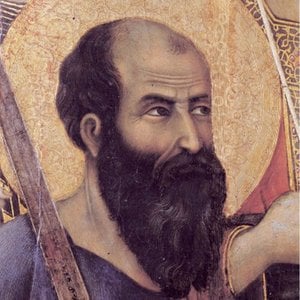
At its core, *La Maestà 1* depicts Saint Mark, identified by the inscription ‘S. MARC.’ He is presented not as an austere figure of divine authority, but rather with a dignified solemnity that invites contemplation. His bearded visage, radiating wisdom and power, is framed by a halo – a subtle yet potent symbol of his connection to the divine. The object held in his hands, partially obscured within the composition, likely represents an attribute associated with his role as Evangelist or relics linked to his life and teachings, adding layers of symbolic richness to the scene. The very act of portraying a saint in this manner was not merely representational; it served as a conduit for prayer and devotion, transforming the image into a focal point for spiritual engagement.
Duccio’s genius lies in his masterful synthesis of Byzantine tradition with emerging Italian Gothic sensibilities. The painting is characterized by its distinctive flattened perspective – a hallmark of Byzantine art – alongside a rich color palette dominated by vibrant reds and deep browns, creating a dramatic contrast against the dark background. Geometric shapes—circles, rectangles, ovals—are employed not for realistic depiction but rather as symbolic elements, contributing to the overall harmony and clarity of the composition. The lines defining Saint Mark’s facial features – his beard, eyes, and mouth – are strong yet refined, imbuing the figure with a remarkable sense of expressiveness. The use of tempera paint on wood panel allows for layering of pigments, resulting in subtle sheens and luminous effects that enhance the painting's ethereal quality. This technique, combined with Duccio’s meticulous attention to detail, elevates *La Maestà 1* beyond mere representation, transforming it into a powerful work of devotional art.
Historical Context: A Turning Point in Artistic Vision
Duccio di Buoninsegna stands as a pivotal figure bridging the artistic worlds of Byzantium and early Renaissance Italy. Siena, during his lifetime, was a vibrant center of commerce and culture, yet also a city deeply rooted in religious tradition. The commission for *La Maestà* by the Siena Cathedral underscores the city’s importance as a cultural and spiritual hub during the Trecento period (14th century). Duccio's work represents a significant departure from earlier artistic conventions, reflecting a growing desire to imbue sacred narratives with greater emotional depth and human connection.
The *Maestà* altarpiece itself was revolutionary for its time, marking a bold step towards a more naturalistic style. It’s believed that Duccio's innovative approach influenced subsequent generations of Italian artists, including Giotto and Simone Martini, shaping the trajectory of Renaissance painting. The work’s creation coincided with a period of intense political and social change in Italy, as city-states vied for power and influence. Duccio’s *La Maestà 1*, therefore, can be seen as both a reflection of these turbulent times and a symbol of Siena's enduring faith and artistic prowess.
Symbolism & Emotional Resonance
Beyond its formal qualities, *La Maestà 1* is rich in symbolic meaning. The halo surrounding Saint Mark’s head signifies his divine connection, while the object he holds likely represents an attribute associated with his role as Evangelist or relics linked to his life and teachings. The overall composition evokes a sense of reverence, contemplation, and spiritual depth – inviting viewers to engage with the sacred narrative on a profound level. The careful arrangement of figures, colors, and geometric shapes creates an atmosphere of otherworldly beauty, transporting the viewer to a realm beyond the earthly.
For interior design enthusiasts, *La Maestà 1*—or a high-quality reproduction thereof—would lend itself beautifully to spaces seeking a touch of historical elegance and contemplative serenity. The bold red hue provides a striking focal point against neutral backgrounds, while its religious symbolism adds layers of meaning and cultural richness. It would be particularly well-suited for libraries, meditation rooms, or as a statement piece in a classically inspired living space, bringing a sense of timeless beauty and spiritual contemplation to any room.
Collecting & Appreciation: A Legacy of Artistic Genius
Owning a reproduction of this artwork connects you to a pivotal moment in art history – the transition from Byzantine formality to the burgeoning naturalism of the Italian Renaissance. Duccio’s *La Maestà* represents the pinnacle of Sienese painting and offers a unique window into medieval religious beliefs. The fragment's intimate scale allows for close study of Duccio’s masterful technique, revealing the subtle nuances of his brushwork and color palette.
The Museo dell’Opera del Duomo in Siena houses the remaining panels of this magnificent altarpiece, offering art lovers the opportunity to witness firsthand the full scope of Duccio's artistic vision. Consider a reproduction as a way to bring this masterpiece into your home, celebrating its enduring beauty and historical significance.



 Visualizar em escala
 Encomendar reprodução pintada à mão
 Enviar
 Compartilhar
 Ver detalhes
 Guia
Guia

 Baixar imagem
 Semelhantes
 Raio X
 Apresentação de slides
 Estatísticas

 Ver mais






































 A opção de vidro está disponível apenas para tamanhos inferiores a 110 cm