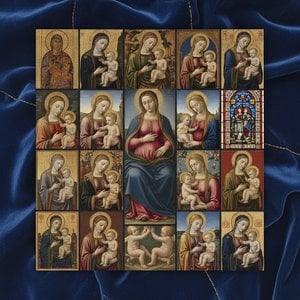
A Glimpse into Divine Majesty: Cimabue’s *Madonna in Majesty* (Detail)
The fragment presented before us – a meticulously detailed section from Cimabue's *Madonna in Majesty*, painted in 1285 – offers an extraordinary portal into the nascent artistic landscape of early Renaissance Italy. Measuring just 48 x 39 centimeters, this panel, currently residing within the hallowed halls of the Galleria degli Uffizi in Florence, belies its modest size with a profound sense of scale and historical weight. It’s not merely a painting; it's a pivotal document, marking a crucial transition from the rigid formality of Byzantine art to the burgeoning naturalism that would define the Italian Renaissance. The work immediately captivates with its serene dignity – a Madonna enthroned as Queen of Heaven, cradling the Christ Child in her arms – yet within this tranquility lies an undeniable sense of movement and nascent humanity.
At first glance, the composition appears rooted firmly in the Italo-Byzantine tradition. The rich, deep red background immediately draws the eye, providing a dramatic contrast to the luminous figures. Cimabue’s masterful use of tempera on panel – a technique demanding both precision and patience – is evident in every brushstroke. Tempera's quick-drying nature necessitated swift execution, layering pigments with deliberate care to build up depth and texture. However, beyond this established framework, subtle yet significant innovations begin to emerge. Notice how the artist skillfully employs shading to suggest volume, a departure from the flatter, more stylized depictions that were commonplace at the time. This nascent understanding of three-dimensionality is a key indicator of Cimabue’s pioneering spirit – he was not simply replicating Byzantine conventions; he was cautiously experimenting with new ways of representing reality.
The Embodiment of Faith and Symbolism
The central figure, the Virgin Mary, dominates the composition. Her posture exudes an almost otherworldly serenity, a testament to her role as intercessor between God and humanity. The Christ Child, nestled in her lap, is rendered with a delicate tenderness that hints at his future destiny. Beyond their immediate representation, these figures are laden with symbolic weight. The throne itself, elevated and richly adorned, reinforces Mary’s divine status – she is presented as Queen of Heaven, the ultimate authority. The gold background, a hallmark of Byzantine art, symbolizes divinity and spiritual illumination, further elevating the scene to a realm beyond earthly concerns. The outstretched hand of the Madonna, a gesture frequently seen in depictions of the Virgin Hodegetria (she who points the way), directs our gaze towards Christ, signifying his importance as the path to salvation.
A Bridge Between Traditions
Cimabue’s *Madonna in Majesty* exists within a period of intense cultural and artistic transformation. The late 13th century witnessed a growing interest in humanism – a renewed focus on earthly concerns and the potential of human achievement. Cimabue, born Cenni di Pepo around 1240 in Florence, was instrumental in this shift. While deeply influenced by Byzantine art, he wasn’t content to simply imitate its established conventions. He subtly introduced elements that foreshadowed the Renaissance – a greater emphasis on naturalistic proportions and a more emotive quality in the faces of his subjects. These subtle changes represent a crucial step towards breaking free from the rigid formalism of the past and embracing a new vision of art as a means of expressing human experience.
A Legacy of Innovation
The *Madonna in Majesty* is not just a beautiful painting; it’s a historical document, a testament to Cimabue's courage and innovation. It represents a pivotal moment where art began to move beyond purely devotional imagery, gradually incorporating elements of humanism and naturalism. Studying this detail allows us to appreciate the delicate balance between tradition and experimentation that characterized early Renaissance Italy – a period marked by both profound continuity and revolutionary change. The work’s enduring appeal lies in its ability to evoke a sense of reverence and spirituality, while simultaneously offering a glimpse into the artistic processes and intellectual currents that shaped Western art history.



 Visualizar na parede
 Comprar impressão
 Compartilhar
 Compartilhar
 Detalhes

 Baixar imagem
 Semelhantes
 Raio X
 Slideshow


 Ler mais






































 A opção de vidro está disponível apenas para tamanhos inferiores a 110 cm