x
Visualizar na paredeVisualizar na parede Ver em RAVer em RA Comprar pintura feita à mão Comprar pintura feita à mãoComprar imagem Comprar imagem CompartilharCompartilhar
DetalhesDetalhes Adicionar aos favoritos Adicionar aos favoritos Baixar imagemBaixar imagem SemelhantesSemelhantes Raio XRaio X SlideshowSlideshow

MIrage

Discover "Mirage" by Charles Conder – a captivating Australian Impressionist painting of a woman and a ball. Explore this iconic work's details & history on WahooArt.

Explore as paisagens e cenas impressionistas de Charles Edward Conder (1868-1909), um personagem chave da Escola Heidelberg na Austrália. Descubra suas vibrantes pinturas de portos, praias e o campo francês em WahooArt.

Giclée / Impressão de Arte

Impressão giclée ou em tela de qualidade de museu, com produção rápida e opções flexíveis de acabamento. (Comprar pintura feita à mão Comprar pintura feita à mãoComprar imagem Comprar imagem)

P118B $10
P118H $10
P118W $10
P438Z $10
P508JH $12
P508YH $12
P805H $10
P805Z $10
P919BZ $10
P919G $10
P919XJ $10
P959ZH $10
P968JZ $12
W106C $8
W218G $10
W218JH $8
W218Y $10
W307PJ $10
W316G $10
W316PJ $8
W316Y $10
W398PJ $8
W4111J $10
W500HY $15
W500JH $15
W692G $12
W849H $8
W940BG $15
W953PJ $8

Tamanho padrão
personalizado
CM
INCH

Escolha entre os nossos tamanhos pré-definidos que respeitam as proporções originais da obra de arte.

largura
altura

Você pode inserir suas próprias dimensões para se ajustar a uma moldura ou espaço específico. Se o tamanho selecionado não corresponder às proporções da imagem original, iremos recortar a obra de arte ou estender a imagem com uma borda espelhada ou preenchimento sólido. Um mockup digital será enviado para sua aprovação antes do início da produção.
Por favor, observe que a visualização na tela não reflete o recorte ou a extensão real. Apenas o mockup mostrará com precisão a composição final.
Embora tamanhos personalizados estejam disponíveis, recomendamos selecionar uma dimensão da lista predefinida para preservar as proporções originais.

Entrega mundial () em 2 semanas, em vez das 4/5 semanas padrão. (3 Setembro)

why_choose_icon
Envio expresso gratuito para todo o mundo
why_choose_icon
Tela de Linho de Alta Qualidade
why_choose_icon
Seguro de transporte completo
why_choose_icon
Garantia de Reembolso de Impostos Alfandegários
why_choose_icon
Garantia de Fidelidade Cromática
why_choose_icon
Política de Devolução em 60 Dias (Apenas para Defeitos)
why_choose_icon
Garantia de reembolso de 100%
why_choose_icon
Oferta de desconto por quantidade

Preço Total

$ 68

reproduction

MIrage

Giclée / Impressão de Arte

Tamanho da Reprodução

-

Preço Total

$ 68

Informações Rápidas

  • Artistic style: Impressionism
  • Movement: Heidelberg School
  • Medium: Watercolor on paper
  • Title: Mirage
  • Location: Private Collection
  • Year: 1889
  • Artist: Charles Conder

Quiz de Arte

Cada pergunta possui apenas uma resposta correta.

Pergunta 1:
What artistic movement is Charles Conder most associated with?
Pergunta 2:
In 'Mirage,' what prominent element is depicted near the center of the painting, suggesting a change in weather conditions?
Pergunta 3:
What year was 'Mirage' painted by Charles Edward Conder?
Pergunta 4:
Charles Conder was born in which city?
Pergunta 5:
The painting 'Mirage' primarily showcases a scene of:

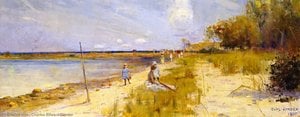
A Mirage of Light and Leisure: Charles Edward Conder’s “Mirage”

Charles Edward Conder's "Mirage," painted in 1889, isn’t merely a depiction of a landscape; it’s an invitation into a realm where reality subtly bends, inviting contemplation on the ephemeral nature of perception and the allure of the Australian outback. Born in Tottenham, London, Conder’s journey led him to Australia, where he became a pivotal figure within the Heidelberg School – a movement that championed a distinctly Australian artistic voice, rejecting European academic traditions in favor of capturing the light, color, and spirit of the continent.

The painting immediately draws the eye with its vibrant palette. Warm ochres dominate the foreground, punctuated by the cool blues and greens of distant trees and sky. Conder masterfully employs an Impressionistic technique, utilizing loose brushstrokes and broken colors to capture the shimmering heat haze that defines the Australian landscape. This isn’t a photographic representation; rather, it's a subjective experience translated onto canvas – a distillation of light, color, and atmosphere. The composition itself is deceptively simple: a woman holding a ball in her hand, positioned beside a solitary tree against a backdrop of rolling hills. Yet, within this apparent stillness lies a subtle dynamism, a sense of movement created by the play of light and shadow.

The Symbolism of Leisure and Illusion

While superficially appearing as a charming pastoral scene, “Mirage” is rich in symbolic meaning. The woman holding the ball evokes a sense of carefree leisure – a quintessential image of Australian summer. It speaks to a time of relaxation, social gatherings, and the simple pleasures of life. However, the presence of the ball itself introduces an element of illusion. Balls are often associated with games, entertainment, and even fleeting moments of joy. In this context, it suggests that these experiences, like the mirage itself, can be deceptive – beautiful but ultimately transient.

The solitary tree further amplifies this theme. Trees represent resilience, strength, and connection to the earth. Yet, its isolation within the vast landscape hints at a sense of loneliness or detachment. The woman’s position beside it suggests a moment of quiet contemplation, perhaps questioning the nature of her own place in this world.

A Window into the Heidelberg School

"Mirage" exemplifies the core tenets of the Heidelberg School – a group of Australian artists who sought to capture the unique character of their homeland. Unlike their European counterparts, they were deeply interested in portraying the light and color of the Australian landscape, often focusing on scenes of rural life and leisure. Conder’s work is characterized by its vibrant colors, loose brushstrokes, and emphasis on capturing the fleeting effects of light and atmosphere. His use of local pigments and his rejection of academic conventions firmly established him as a key figure in shaping Australian art.

Capturing the Essence of an Illusion

Conder’s skill lies not just in depicting a scene, but in conveying its *feeling*. The painting isn't about literal accuracy; it’s about capturing the subjective experience of being immersed in the heat haze of the Australian outback. The shimmering quality of the landscape, the sense of distance and ambiguity, all contribute to a powerful emotional impact. “Mirage” invites us to question our perceptions, to appreciate the beauty of illusion, and to contemplate the transient nature of life itself. It remains a captivating testament to Conder’s artistic vision and his profound connection to the Australian landscape.


Biografia do Artista

early life and artistic journey

Charles Edward Conder (1868 - 1909) foi um pintor, litógrafo e designer inglês nascido em Londres, filho do segundo de seis filhos, James Conder, engenheiro civil e Mary Ann Ayres. Passou anos na Índia como criança antes da morte de sua mãe em 14 maio 1873 em Bombaim, quando ele tinha apenas quatro anos; foi enviado de volta à Inglaterra e frequentou várias escolas incluindo uma escola preparatória em Eastbourne, onde estudou desde 1877. Abandonou a escola aos quinze anos e seu pai religioso, contra suas naturais inclinações artísticas, decidiu que deveria seguir seus passos como engenheiro civil.

artistic career in australia

Em 1884, aos dezesseis anos, foi enviado para Sydney, Austrália, onde trabalhou para seu tio, um topógrafo do governo da Nova Gales do Sul. No entanto, ele não gostou do trabalho, preferindo desenhar o cenário em vez de realizar levantamentos. Em 1886, deixou o emprego e tornou-se artista para o *Illustrated Sydney News*, onde estava na companhia de outros artistas como Albert Henry Fullwood, Frank Mahony e Benjamin Edwin Minns. Também frequentou as aulas de pintura de Alfred James Daplyn e juntou-se à Sociedade Artística da Nova Gales do Sul, participando de excursões pictóricas com Julian Ashton.

the heidelberg school and notable works

Conder tornou-se um pintor australiano importante no início do século XX. Sua obra mais famosa é *Departure of the Orient – Circular Quay* (1888), uma cena portuária que captura o movimento e a luz da hora do pôr do sol em Sydney Cove. Esta pintura foi adquirida pelo Art Gallery of New South Wales, marcando seu primeiro trabalho a entrar em uma coleção pública e consolidando sua posição como um dos principais artistas da Escola Heidelberg.

legacy and later life

Conder passou seus últimos anos na Europa, principalmente Inglaterra, mas visitou França várias vezes. Sua saúde deteriorou-se constantemente devido à sífilis, que o acompanhou até o fim de sua vida e impediu que ele continuasse pintando. Apesar disso, Conder produziu obras significativas que permanecem como testemunhos de uma época e um artista excepcional.

Charles Edward Conder

Charles Edward Conder

1868 - 1909 , Reino Unido

Dados Rápidos

  • Artistic Movement Or Style: Heidelberg School
  • Artists Who Influenced This Artist:
    • Alfred Daplyn
    • Victor Mann
    • Julian Ashton
  • Date Of Birth: October 24, 1868
  • Date Of Death: February 9, 1909
  • Full Name: Charles Edward Conder
  • Nationality: British
  • Notable Artworks:
    • Departure of the Orient – Circular Quay
    • A holiday at Mentone
    • Under The Southern Sun
  • Place Of Birth: Tottenham, United Kingdom
Explore obras de arte organizadas por temas, estilos e características.