Biografia do Artista
A Life Painted in Light: The World of Anton Mauve
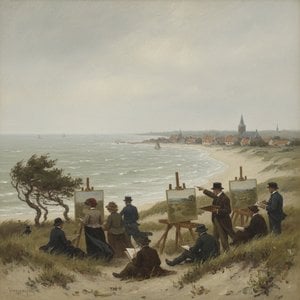
Anton Mauve, a name synonymous with the delicate beauty of Dutch Realism and the burgeoning spirit of Impressionism, occupies a pivotal position in 19th-century art. Born Anthonij Rudolf Mauve in Zaandam, Netherlands, in 1838, his journey was one of artistic evolution, deeply connected to the land and its people. His early life unfolded within a contemplative atmosphere; his father served as a Mennonite chaplain, instilling a quiet observational quality that would permeate his canvases. The family’s relocation to Haarlem provided young Anton with access to formal artistic training, initially under Pieter Frederik van Os and then Wouter Verschuur, laying the foundation for his technical skill. However, it was his association with Paul Gabriël at Oosterbeek – affectionately known as the “Dutch Barbizon” – that truly ignited his passion for painting directly from nature, forging a path toward more liberated artistic expression. This period proved formative, encouraging him to abandon highly finished techniques in favor of freer brushwork and a delicate harmonic palette.
The Hague School and Pastoral Visions
By 1872, Mauve had settled in The Hague, becoming a central figure within the burgeoning Hague School of painters. This collective, dedicated to depicting scenes of everyday life with unflinching realism, provided fertile ground for his artistic growth. He wasn’t merely a participant; he was instrumental in establishing both the Hollandsche Teekenmaatschappij (Dutch Drawing Society) in 1876 and played a vital role in developing Pulchri Studio, The Hague's most influential art society. Mauve’s subject matter consistently revolved around people and animals integrated into outdoor settings – fashionable equestrians enjoying a “Morning Ride,” peasants toiling in the fields, and particularly, his beloved sheep flocks. These pastoral scenes weren’t simply idyllic representations; they were imbued with authenticity, even incorporating details often overlooked by other artists—a testament to his commitment to realism, such as the inclusion of horse droppings in the foreground of “Morning Ride,” grounding the scene in tangible reality. His depictions of sheep proved remarkably popular, especially among American patrons, creating a curious distinction in value between paintings showing them arriving versus departing, perhaps reflecting symbolic resonance with themes of prosperity and transience. He masterfully captured the ‘silver light’ characteristic of the Dutch landscape, imbuing his scenes with a unique atmospheric quality.
A Mentor's Hand: Influencing Vincent van Gogh
Mauve’s legacy extends far beyond his own artistic output; he served as a crucial early influence on Vincent van Gogh. The connection was deeply personal, stemming from the fact that Ariëtte (Jet) Sophia Jeannette Carbentus, Mauve’s wife, was Van Gogh’s cousin. In 1881, Van Gogh sought guidance from Mauve, spending three weeks immersed in his studio, marking the beginning of his serious exploration of oil painting under Mauve's tutelage. Mauve provided not only technical instruction but also a crucial introduction to the art world and its possibilities. However, their relationship was complex and ultimately fractured. A decisive break occurred when Mauve informed Van Gogh that their association was “over and done with,” reportedly due to concerns about Van Gogh’s increasingly intense personality and his relationship with Clasina Maria Hoornik. Despite this painful separation, Van Gogh continued to hold Mauve in high regard, a sentiment powerfully expressed through art. Following Mauve's untimely death in 1888, Van Gogh dedicated one of his iconic paintings—a blossoming fruit tree scene—to him, signing it “Souvenir de mauve vincent & theo,” a poignant tribute to the man who had first guided him on his artistic path. This act underscores the profound impact Mauve had on shaping Van Gogh’s early development as an artist.
The Larense School and Lasting Significance
In the final years of his life, Mauve sought refuge in the tranquil countryside surrounding Laren, part of the Gooi region. This area quickly became known as “Mauve land,” attracting a community of artists including Jozef Israëls and Albert Neuhuys, collectively referred to as the Larense School. Here, he continued to refine his delicate style, capturing the subtle nuances of light and atmosphere in his landscapes and genre scenes. His sudden death in Arnhem on February 5, 1888, at the age of forty-nine, was a shock to the art world. Mauve’s contribution to Dutch Realism is undeniable; he exemplified the principles of depicting life as it was, with honesty and sensitivity. His influence extended beyond his immediate circle, impacting artists like Scottish painter Robert McGregor. But perhaps his most enduring legacy lies in his role as a mentor to Vincent van Gogh, demonstrating the profound impact one artist can have on another, shaping not only individual styles but also the trajectory of art history itself. He remains a vital link between the traditions of 19th-century Dutch painting and the revolutionary innovations of modernism.
A Continuing Legacy
Today, Anton Mauve’s works are celebrated for their evocative beauty and technical mastery. Paintings like “Winter in the Scheveningen Woods” (1870-1888) and “On the Heath near Laren” (1887) continue to captivate audiences with their atmospheric depth and poignant depictions of rural life. His portraits, such as that of Pieter Frederik van Os (1855), reveal a keen eye for character and an impressive command of impasto technique. Mauve’s art serves as a window into a bygone era, offering a glimpse into the lives and landscapes of 19th-century Netherlands while simultaneously resonating with timeless themes of nature, humanity, and the enduring power of artistic expression. His influence continues to be felt by artists and art lovers alike, solidifying his place as a key figure in Dutch art history and a significant precursor to the innovations that would define the modern era. He was truly a master of silver light.



 Visualizar em escala
 Encomendar reprodução pintada à mão
 Enviar
 Compartilhar
 Ver detalhes
 Guia
Guia

 Baixar imagem
 Semelhantes
 Raio X
 Apresentação de slides
 Estatísticas


 Ver mais






































 A opção de vidro está disponível apenas para tamanhos inferiores a 110 cm