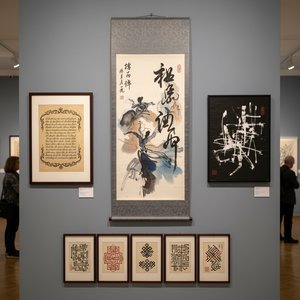
A Life in Ink and Stone
Born in 1766 during the Qing dynasty, Wen Ding lived a life defined by the precision of the brush and the permanence of the seal. He was a man of many disciplines, moving between the fluid grace of a painter, the disciplined structure of a calligrapher, and the meticulous carving required of a seal cutter. His work reflects a deep engagement with the classical traditions of his era, shaped significantly by the stylistic influence of Wen Peng. This lineage provided a foundation for a career that spanned the late eighteenth and mid-nineteenth centuries, ending with his death in 1852.
His technical skill was not limited to a single medium. In the hands of a man so practiced in calligraphy, the act of painting became an extension of the written word. This intersection of disciplines allowed him to approach the landscape and the scholar's study with a singular, cohesive vision. His output was characterized by a commitment to the classicism that defined the aesthetic standards of his time.
The Scholar's Hand
The compositions of Wen Ding often sought to capture moments of quietude and intellectual pursuit. His work frequently placed the scholar at the center of a carefully constructed natural world, where the rhythm of the landscape mirrored the internal state of the subject. One notable example of his ability to translate these themes is seen in his 1833 work, Landscape with Scholar Playing a Lute (Qin), currently held by the Los Angeles County Museum of Art.
His artistic output is characterized by several distinct technical focuses:
- The application of ink and color on paper to create depth and atmosphere.
- The integration of calligraphy and painting to unify composition.
- The use of seals to mark both the artist's identity and the work's provenance.
Historical Presence
The survival of Wen Ding's work through the centuries is evidenced by the layers of history left upon his scrolls. Handscrolls such as the Conversation in the Garden, dated to the sixth month of the wuzi year of the Daoguang reign in 1828, reveal a history of appreciation. These works often carry the marks of various collectors and scholars, including inscriptions and seals that trace their movement through the hands of many over the decades. Such additions, while separate from the artist's original hand, provide a secondary layer of historical context to his legacy.
Pytania i odpowiedzi
Jakie nastroje wyrażają dzieła Wen Ding?
Prace Wen Ding można przeglądać według nastroju na stronie Sztuka według nastroju, która grupuje dzieła artysty według ich przypisanego nastroju.
Pod jakimi innymi nazwiskami znany jest Wen Ding?
Wen Ding jest znany/a również pod pseudonimami: Houweng, Houshan, Xuekuang, 文鼎.
Jakich kolorów Wen Ding używał najczęściej?
Genom Palety artysty Wen Ding to strona prezentująca profil kolorystyczny całego dorobku twórczego tego artysty.
Czy istnieje chronologiczny opis twórczości Wen Ding?
Osiągnięcia artystyczne artysty Wen Ding to interaktywna oś czasu, która prezentuje dzieła w porządku chronologicznym, pogrupowane w rozdziały odpowiadające poszczególnym etapom jego kariery.