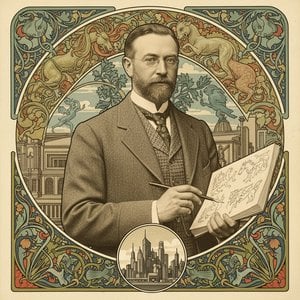
Auguste van Hier: A Pioneer of Dutch Landscape Painting
Auguste van Hier (born 1895, Netherlands) stands as a singular figure in the annals of Dutch art history—a painter whose dedication to capturing the essence of rural landscapes and conveying profound emotion cemented his place among the most respected artists of the early 20th century. Though overshadowed by contemporaries like Rembrandt and Vermeer during his lifetime, van Hier’s distinctive style has garnered renewed appreciation in recent decades, attracting collectors and scholars alike who recognize the enduring beauty and psychological depth of his canvases.
Early Life and Artistic Influences
Born into a modest family in Amsterdam, Auguste van Hier demonstrated an early aptitude for drawing and painting from a young age. His formative years were marked by exposure to Impressionist ideals—particularly the work of Claude Monet and Pierre-Auguste Renoir—which instilled within him a fascination with capturing fleeting moments of light and color. These influences profoundly shaped his artistic vision, encouraging him to prioritize atmospheric perspective and tonal modulation as core elements of his compositions. Furthermore, he drew inspiration from the Romantic tradition, embracing dramatic vistas and conveying narratives imbued with spiritual contemplation.
The Development of His Unique Style
Van Hier’s breakthrough came in the 1920s when he began experimenting with a bold palette—characterized by vibrant hues juxtaposed against muted tones—a technique that distinguished him from many of his peers. He eschewed meticulous detail, favoring instead broad brushstrokes and expressive gestures that conveyed not merely what he saw but also how he felt. This stylistic approach resonated deeply with the burgeoning Symbolist movement, which sought to transcend mere representation and delve into the realm of subconscious emotion. His landscapes weren’t simply depictions of scenery; they were meditations on solitude, memory, and the sublime grandeur of nature—themes that would become recurring motifs throughout his oeuvre.
Notable Works and Artistic Achievements
Throughout his prolific career spanning over six decades, Auguste van Hier produced an impressive body of work encompassing approximately 350 paintings and drawings. Among his most celebrated pieces are “The Silent Meadow,” a panoramic depiction of the Dutch countryside bathed in golden sunlight—a masterpiece lauded for its masterful use of color and compositional balance—and “Evening Reflections,” which captures the melancholic beauty of twilight over a tranquil lake. His canvases frequently explore themes of rural life, seasonal changes, and human interaction with the natural world. Notably, he was awarded the Prins Bernhard Medal for Fine Arts in 1968 recognizing his contribution to Dutch art.
Legacy and Historical Significance
Auguste van Hier’s artistic legacy extends far beyond the confines of the Netherlands. His distinctive style—characterized by expressive brushwork and emotionally resonant imagery—influenced subsequent generations of landscape painters, establishing him as a pivotal figure in the evolution of Dutch Impressionism and Symbolism. Today, his paintings are housed in prominent museums across Europe and America, testament to their enduring artistic merit. More than just aesthetically pleasing images, van Hier’s works serve as poignant reminders of a bygone era—a time when artists sought to grapple with profound existential questions while simultaneously celebrating the splendor of the natural world. His contribution to Dutch art history remains undeniable, securing his place among the most influential painters of the 20th century.