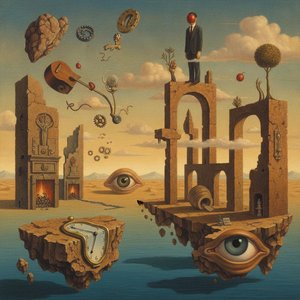
A Tapestry of Cultures and Colors
Olga Nicolaevna Sacharoff was an artist whose very existence embodied a rich, cross-cultural tapestry. Born in Tbilisi, Georgia, within the Russian Empire, her heritage was a profound blend of Russian and Persian origins, a lineage that likely contributed to the multifaceted nature of her creative vision. Her early artistic journey began at the Tbilisi State Academy of Arts, but her spirit was far too expansive to be contained by a single geography. As she traveled through Rome and Munich, she encountered the stirring energy of German Expressionism, an encounter that would leave an indelible mark on her developing aesthetic. It was in Germany that she met Otho Lloyd, a photographer and painter who would become her husband, marking the beginning of a life shared between the avant-garde circles of Europe.
The shifting tides of history eventually redirected her path toward the Mediterranean. The outbreak of World War I necessitated a relocation to Spain, leading her first to Mallorca and subsequently to Barcelona around 1915 or 1916. In these vibrant Spanish landscapes, Sacharoff found a new home that would host her for much of her later life. Her presence in the art scene was deeply intertwined with the pulse of the era's most radical movements. She became an active member of the circle surrounding the Russian émigré artist Marie Vassilieff and contributed to the legendary magazine 391, collaborating with figures such as Francis Picabia during the height of Dadaism.
Evolution of a Visionary Style
The trajectory of Sacharoff’s work is a fascinating study in stylistic metamorphosis. Her early explorations were anchored by the structural lessons of Paul Cézanne, yet she was never one to remain static. Upon her arrival in Paris, she found herself captivated by the complexities of radical or synthetique Cubism, pushing the boundaries of form and perspective. This period of experimentation was followed by a shift toward a more colorful, "naïve" style, heavily influenced by the whimsical and primitive charm of Henri Rousseau. This unique blend allowed her to navigate between the intellectual rigor of Cubism and the emotive, uninhibited joy of Naive art.
Her artistic language was further enriched by various influences, ranging from the fine Impressionist touch to the more structured elements of Noucentisme catala, a movement linked to Neoclassical and Primitivist tendencies. This versatility allowed her to move seamlessly between different modes of expression, whether she was engaging with the provocative spirit of Dadaism or creating intimate, chamber-like family portraits. Her ability to synthesize these diverse influences—from German Expressionism to the avant-garde movements of Paris—resulted in a body of work that felt both deeply personal and cosmopolitain.
Legacy and Recognition
Throughout her career, Sacharoff’s presence was felt in some of the most prestigious art institutions of her time. She was a frequent exhibitor at the Salon d'Automne, the Salon des Tuileries, and the Société des Artistes Indépendants, ensuring her work reached the eyes of the European intelligentsia. Her reach even extended across the Atlantic, with exhibitions in New York City at the Perls Galleries. In Spain, she was a celebrated figure, participating in the Salones de los Once in Madrid and exhibiting in Barcelona at the Laietanes Gallery and Galería Syra.
The significance of her contribution to Catalan art was formally recognized through prestigious honors, including the Medalla d'or de Barcelona and the Silver medal of the city of Barcelona. Her legacy is preserved today in esteemed collections such as the Museu Nacional d'Art de Catalunya in Barcelona and the Museo de Art Nouveau y Art Déco in Salamanca. Beyond the canvas, her literary sensitivity was evident in her beautiful book illustrations for works by Colette and Fyodor Dostoyevsky, proving that her artistry was not merely a visual pursuit, but a profound engagement with the soul of storytelling.
Pytania i odpowiedzi
Czy mogę przeglądać dzieła Olga Nicolaevna Sacharoff według kolorów?
Indeks kolorystyczny artysty Olga Nicolaevna Sacharoff to strona, która porządkuje jego dzieła według kolorów.
Jak popularne są dzieła artysty Olga Nicolaevna Sacharoff?
Strona Statystyki odwiedzin artysty Olga Nicolaevna Sacharoff przedstawia statystyki obliczone na podstawie dzieł tego artysty wymienionych w niniejsza strona.
Gdzie można znaleźć dzieła Olga Nicolaevna Sacharoff pogrupowane według nurtów artystycznych?
Nurty, w których tworzył/a Olga Nicolaevna Sacharoff, można zobaczyć na stronie Wszystkie nurty artystyczne artysty, gdzie dzieła są pogrupowane według nurtów.