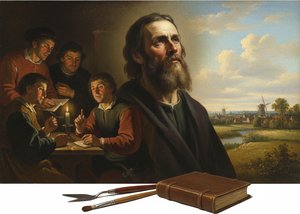
The Verdant Legacy of Michiel Carree
In the golden twilight of the Dutch Golden Age, a period defined by unparalleled mastery of light and landscape, the name Michiel Carree emerges as a significant, if often understated, figure. Born in 1657 in the historic city of The Hague, Carree was a painter whose life traversed the most influential artistic hubs of Europe, from the bustling streets of Amsterdam to the royal courts of Berlin. His journey began under the watchful eye of his elder brother, Hendrik Carré, but his artistic soul was shaped by a complex web of influences and a distinct preference for a specific, evocative style that would define his contribution to the landscape tradition.
Carree’s early training was marked by a connection to some of the era's most formidable masters. He served as a scholar under the renowned Nicolaas Berchem, a giant of the Italianate landscape genre. Yet, in a fascinating departure from the high-classical elegance of his mentor, Carree found himself drawn to the more grounded and perhaps less refined aesthetic of Gabriel van der Leeuw. This choice reveals much about his artistic temperament; rather than chasing the idealized, sun-drenched vistas of the Mediterranean style, Carree embraced a technique characterized by an uncommon facility and a certain "baldness" of pencil—a directness of execution that allowed him to capture the raw, textured essence of the natural world.
A Wanderer’s Canvas: From England to Berlin
The life of Michiel Carree was as much a journey of geography as it was of style. His career was defined by periods of intense international movement, which brought his work before diverse audiences and royal patrons. Records suggest he spent formative years in England during the 1690s, where he moved within circles that included the painter Pieter Gerritsz van Roestraten. While his popularity in England may have been modest, his reputation grew significantly on the continent. The most prestigious chapter of his life arrived when he was invited to Berlin by the King of Prussia, Frederick I. This appointment as a court painter elevated his status, placing him at the heart of European cultural patronage.
This period of royal service allowed Carree to utilize his greatest strength: his ability to decorate large-scale spaces. He was not merely an easel painter but a decorative artist capable of transforming grand halls and expansive apartments with his sweeping vistas. His work often featured:
- Italianate Landscapes: Evocative scenes that blended Dutch sensibility with the light and atmosphere of Southern Europe.
- Pastoral Scenes: Intimate depictions of cattle and animals within wooded settings, showcasing his ability to render texture and life.
- Narrative Grandeur: Large-scale compositions, such as his representation of the History of Jacob and Esau, which demonstrated his capacity for historical storytelling through landscape.
Artistic Significance and Enduring Spirit
As the sun set on his career, Carree returned to the Netherlands, eventually settling in Alkmaar, where he passed away in 1727. Though history sometimes debates the relative merits of his style compared to the masters who preceded him, there is no denying the technical prowess and atmospheric depth present in his oeuvre. His ability to marry the decorative requirements of courtly life with a sincere observation of nature left a lasting mark on the Dutch landscape tradition.
Today, Carree’s works serve as vital windows into the late seventeenth and early eighteenth centuries. Whether it is a river scene with windmills or a quiet wooded landscape, his paintings possess a rhythmic vitality that speaks to the enduring power of the natural world. He remains a testament to the era of the traveling artist—a man whose brush bridged the gap between the intimate Dutch countryside and the opulent halls of European royalty, leaving behind a legacy of light, earth, and movement.