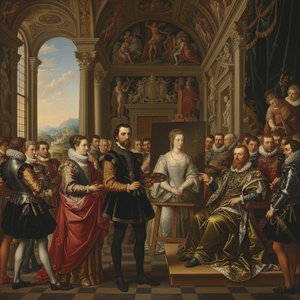
A Life in Color and History
Born in Linz, Austria, Josef Munsch began his professional journey working as a gilder in his father's shop. His artistic talent eventually led him to the Munich Academy, where he was encouraged by Philipp Foltz. After receiving a travel scholarship to Italy, he settled in Munich, where he became a prominent history and genre painter. His work often captured significant historical moments, such as the death of Rudolf of Habsburg or the murder of the Duke of Guise.
Munsch's versatility allowed him to move between grand historical scenes and intimate genre paintings. He contributed to the decoration of several royal residences, including the castles of Ludwig II, such as Neuschwanstein, and the palaces of Herrenchiemsee. His ability to render detailed scenes earned him comparisons to the German Meissonier in his later years, particularly as he turned toward small-scale paintings and shadow pictures.
Artistic Legacy and Works
Throughout his career, Munsch's repertoire expanded from large-scale historical compositions to delicate genre scenes. His notable works include:
His paintings were widely recognized, appearing in contemporary illustrations like Die Gartenlaube and being exhibited in major cities including Munich, Vienna, Berlin, Paris, and London. He was also a member of the Polytechnical Association in Munich and served on the jury for the Munich Annual Exhibition at the Glaspalast.
Pytania i odpowiedzi
Do jakiej epoki należał/a Josef Munsch?
Josef Munsch tworzył w okresie 19th Century. Epoka ta osadza twórczość artysty w kontekście historycznym.
Gdzie i w którym roku urodził(a) się Josef Munsch?
Josef Munsch urodził się w Linz w 1832 roku.
Gdzie można znaleźć dzieła Josef Munsch pogrupowane według słów kluczowych?
Aby znaleźć dzieła artysty Josef Munsch o konkretnej tematyce, skorzystaj ze strony Według słów kluczowych, która grupuje prace według słów kluczowych.
W jakim mieście i kraju urodził(a) się Josef Munsch?
Josef Munsch urodził się w Linz w Austria.