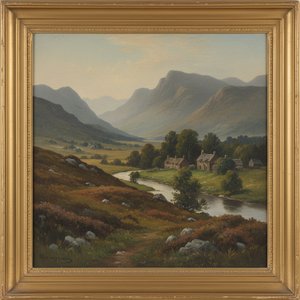
John Henry Lorimer: A Scottish Painter of Domestic Life and Architectural Legacy
Born in Edinburgh in 1856, John Henry Lorimer descended from a family deeply rooted in intellectual pursuits; his father, James Lorimer, held a prestigious professorship at Edinburgh University, profoundly shaping young John's academic foundation. This upbringing instilled within him not merely knowledge but also an appreciation for observation and meticulous detail—qualities that would become hallmarks of his artistic style. Educated at Edinburgh Academy and subsequently Edinburgh University, Lorimer honed his artistic skills further through studies at the Royal Scottish Academy, mentored by influential figures like Frank McTaggart and William Chalmers. This formative period cemented his allegiance to Impressionistic techniques and compositional considerations – a stylistic choice that would define much of his oeuvre. Lorimer’s artistic journey commenced with explorations across Europe between 1877 and 1891. He traveled extensively through Spain, Italy, and Algeria, absorbing the vibrant colors and diverse cultural traditions of these nations. These experiences served as invaluable catalysts for broadening his visual vocabulary and fostering a sensitivity to the nuances of human experience—elements that would permeate his paintings and imbue them with an enduring emotional resonance. Notably, he captured the grandeur of Kellie Castle in stunning detail, documenting its transformation from ruin to Victorian holiday home alongside his brother, Robert Lorimer – a collaborative endeavor reflecting not only familial bonds but also a reciprocal influence on each other’s creative sensibilities. Lorimer's artistic output was prolific during his lifetime, demonstrating unwavering dedication to his craft. He exhibited regularly at both the Royal Scottish Academy and the Royal Academy in London, showcasing approximately 123 works at the former and 43 at the latter—a testament to his commitment to disseminating his vision before a discerning public. His paintings predominantly focused on genre scenes depicting everyday life – intimate domestic interiors bathed in soft light – capturing the quiet beauty of ordinary moments with remarkable precision. Furthermore, Lorimer produced evocative portraits of prominent figures including Lyon Playfair, Joseph Lister, and Peter Hately Waddell—works characterized by astute psychological insight and masterful rendering of facial expressions. Sold at auction in 2000 for £32,900, “A Peaceful Art and Kellie Castle Garden” exemplifies Lorimer’s Romantic aesthetic – a celebration of natural splendor infused with profound emotional depth. Lorimer's artistic style distinguished itself by blending meticulous realism with lyrical sensitivity. He achieved this harmonious balance through careful observation and masterful brushwork—techniques honed during his academic training and reinforced by his travels abroad. His compositions prioritized clarity and harmony, reflecting the influence of Impressionistic principles while simultaneously conveying a palpable sense of atmosphere and emotion. The enduring legacy of John Henry Lorimer resides not only in his artistic achievements but also in his contribution to Scottish architectural heritage – specifically the revitalization of Kellie Castle under the stewardship of Robert Lorimer—a project embodying the spirit of familial collaboration and artistic vision. He resided at 1 Bruntsfield Crescent, Edinburgh until his passing in 1936, leaving behind a remarkable collection of paintings that continue to captivate viewers today.Pytania i odpowiedzi
Gdzie i w którym roku urodził(a) się John Henry Lorimer?
John Henry Lorimer urodził się w Edynburg w 1856.
W jakiej epoce historycznej tworzył/a John Henry Lorimer?
John Henry Lorimer tworzył w okresie – Wiek XIX. Epoka ta osadza twórczość artysty w kontekście historycznym.
Gdzie można znaleźć dzieła John Henry Lorimer pogrupowane według palety barw?
Aby znaleźć prace artysty John Henry Lorimer w konkretnej palecie barw, skorzystaj ze strony Według palet kolorystycznych poświęconej temu artyście.