The Hands of a Craftsman
Hermann Dudley Murphy lived a life shaped by the physical textures of his surroundings. Born in Marlborough, Massachusetts, he spent his early years absorbing the landscapes of New England before seeking formal training at the Boston Museum School. He studied under figures like Emil Otto Grundmann and Edmund C. Tarbell, men who helped shape his early approach to light and form. His path eventually led him to Paris, where he spent five years studying at the Académie Julian. In the studios of Benjamin-Constant and Jean-Paul Laurens, he learned a technical discipline that would later define his work in both paint and wood.
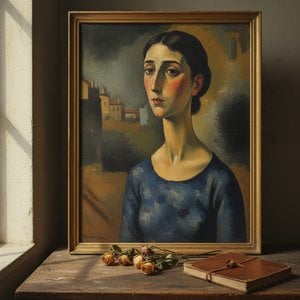
His time in Europe brought him into contact with the aesthetic of James McNeill Whistler. This influence was not merely about brushwork; it changed how he viewed the edges of a painting. Murphy understood that a frame could be an extension of the canvas itself. Along with Charles Prendergast, he established the Carrig-Rohane frame shop in Winchester, Massachusetts. The name, meaning "Red Cliff" in Gaelic, reflected his father's Irish roots. He did not simply sell borders; he carved and gilded them by hand, treating each piece as a singular object of art. He was among the first in the United and States to sign the back of his frames, asserting that the craftsmanship of the border held as much weight as the image within.
Light and Stillness
As his career progressed, Murphy's focus shifted from the broad views of landscapes to the quiet intimacy of the tabletop. While he once captured the atmosphere of places like Venice and the volcanic slopes of Stromboli, his later years were spent observing the way light rests on petals and porcelain. He moved away from the experimental edges of modernism, preferring a more grounded, academic Impressionist style. His compositions often featured flowers arranged in Chinese porcelain vases, set against the patterns of oriental rugs or prints.
His technical skill was evident in the way he handled color and texture. He had a particular knack for juxtaposing strokes of color to create a flickering effect, a technique that drew from his understanding of optics. This knowledge even found a practical use during World War I, when he served as the U.S. Shipping Board’s Chief Inspector for Camouflage. In his studio, this same eye for detail allowed him to compose table arrangements that felt both heavy with substance and light with atmosphere.
A Life of Diverse Disciplines
The work of Murphy was never confined to a single medium or role. He moved between the roles of painter, illustrator, art teacher, and designer with a steady, focused energy. His teaching career took him from the Byrdcliffe Colony in Woodstock, New York, to the Art Department at Harvard University, where he taught from 1931 to 1937. Even as his business interests changed—such as when the management of his frame shop passed to Robert C. Vose—his commitment to the physical reality of art remained constant.
His achievements were recognized by several institutions, including:
- The National Academy of Design, where he became an Academician in 1934.
- The Boston Art Club and the Copley Society.
- The Guild of Boston Artists and the Boston Society of Watercolor Painters.
By the time he passed away in Lexington, Massachusetts, in 1945, he had left behind a body of work that bridged the gap between the fine art of painting and the meticulous craft of the frame maker. His paintings remain in collections such as the Museum of Fine Arts, Boston, and the Metropolitan Museum, preserved as examples of the Boston School's dedication to tonal harmony and technical precision.
Pytania i odpowiedzi
Gdzie mogę zobaczyć profil kolorystyczny twórczości Hermann Dudley Murphy?
Profil kolorystyczny twórczości Hermann Dudley Murphy można zobaczyć na stronie Genom Palety artysty.
Gdzie można znaleźć dzieła Hermann Dudley Murphy pogrupowane według tematów?
Strona Atlas tematów prezentuje dzieła Hermann Dudley Murphy pogrupowane według tematów.
Gdzie mogę zobaczyć dzieła Hermann Dudley Murphy w porządku chronologicznym?
Oś czasu prac Hermann Dudley Murphy jest dostępna na stronie Chronologia dzieł, gdzie dzieła zostały uporządkowane według daty ich powstania.
Gdzie można znaleźć dzieła Hermann Dudley Murphy pogrupowane według nurtów artystycznych?
Strona Wszystkie nurty artystyczne grupuje dzieła Hermann Dudley Murphy według nurtów artystycznych.