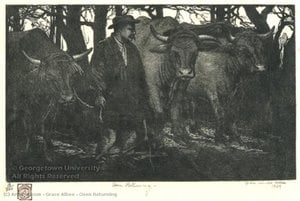
Grace Albee: A Pioneer of American Printmaking
Grace Thurston Arnold Albee (1890-1985) stands as a quietly significant figure in the history of American printmaking, a master of linocut and wood engraving who dedicated sixty years to her craft. Born in Scituate, Rhode Island, into a family that initially resisted her artistic ambitions, Albee’s determination and talent ultimately led her to become one of the first female graphic artists to achieve full membership in the prestigious National Academy of Design – a remarkable testament to her skill and perseverance.
Albee's early life was shaped by a confluence of influences. Her grandfather’s collection of illustrated books ignited a passion for visual storytelling, while her formal training at the Rhode Island School of Design provided a solid foundation in drawing and painting. However, it wasn’t until she married muralist Percy F. Albee in 1913 that her artistic journey truly took shape. Percy's interest in linocut techniques inadvertently opened doors for Grace to explore this medium, initially through the creation of posters for his puppet shows – elaborate productions that toured throughout New England and provided a crucial early platform for her developing skills.
The Rise of Linocut and Early Innovations
The 1920s marked a pivotal decade in Albee’s career, characterized by a shift towards linocut as her primary medium. This period witnessed the emergence of a distinctive style – one defined by meticulous detail, subtle tonal variations, and an understated elegance. Unlike some of her contemporaries who embraced bold, graphic styles, Albee favored a more nuanced approach, capturing the essence of her subjects with remarkable precision. She wasn’t simply reproducing images; she was translating them into tactile prints that invited close examination.
A particularly innovative aspect of Albee's work during this time involved experimenting with colored linoleum blocks and silk screens – a technique rarely explored by American printmakers at the time. Collaborating closely with Percy, she created stunning tapestry-like hangings, layering vibrant colors to evoke scenes from Parisian landscapes and historical events. These ambitious projects required considerable technical skill and demonstrated Albee’s willingness to push the boundaries of traditional printmaking.
Parisian Influence and Artistic Development
In 1928, the Albees embarked on a transformative journey to Paris, seeking artistic inspiration and exposure in the vibrant European art scene. This period proved crucial for Albee's development as an artist. She enrolled at the Institut d’Esthétique Contemporaine, immersing herself in new techniques and perspectives. Her time in Paris was marked by a deepening appreciation for urban and rural landscapes, which she translated into a series of evocative engravings that captured the spirit of both French cities and countryside.
Returning to America in 1932, Albee established her own studio and continued to refine her artistic vision. She exhibited her work independently, showcasing her prints at American libraries in Paris and later in New York City. Her commitment to quality and originality earned her recognition from the Providence Art Club and other prominent art organizations.
Legacy and Recognition
Grace Albee’s contributions to American printmaking are often understated, yet profoundly significant. Over a career spanning six decades, she created more than two hundred and fifty prints – a testament to her dedication and skill. Her works are now held in thirty-three museum collections across the United States and beyond, including the Smithsonian American Art Museum.
Albee’s achievement as the first female graphic artist to receive full membership in the National Academy of Design stands as a powerful symbol of her pioneering spirit and artistic merit. Her meticulous technique, subtle tonal range, and evocative imagery continue to resonate with viewers today, cementing her place as a vital figure in the history of American art.
Further information about Grace Albee can be found on the AWARE Women Artists website: https://awarewomenartists.com/en/artiste/grace-albee/
Pytania i odpowiedzi
Gdzie mogę zobaczyć dzieła Grace Thurston Arnold Albee pogrupowane według nastroju?
Strona Klimat wnętrza artysty prezentuje dzieła Grace Thurston Arnold Albee pogrupowane według ich nastroju.
Gdzie można znaleźć dzieła Grace Thurston Arnold Albee pogrupowane według nurtów artystycznych?
Strona Wszystkie nurty grupuje dzieła Grace Thurston Arnold Albee według nurtów artystycznych.
Gdzie i w którym roku urodził(a) się Grace Thurston Arnold Albee?
Grace Thurston Arnold Albee urodził się w Scituate w 1890.