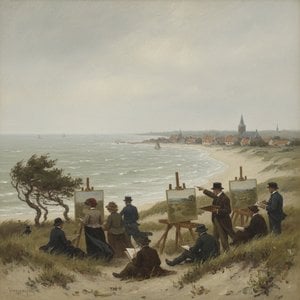
Alfred Clive Gardiner: A Pioneer of British Modernism
Clive Gardiner (1891-1960) wasn’t merely an artist; he was a pivotal figure in the evolution of British art, bridging the gap between traditional illustration and the burgeoning dynamism of modernism. Born into a family steeped in artistic and journalistic heritage – his father, Alfred George Gardiner, was a celebrated editor of The Daily News – Clive inherited a deep appreciation for visual communication and a restless spirit for experimentation. His life’s work wasn't confined to a single medium; he seamlessly transitioned between painting, printmaking, illustration, and design, leaving an indelible mark on the art world through his innovative posters, murals, and teaching.
Gardiner’s early artistic development was profoundly shaped by his time in Paris during the first decade of the 20th century. Immersed in the vibrant Parisian avant-garde, he encountered the revolutionary ideas of Paul Cézanne, Cubism, Futurism, and Surrealism – movements that would dramatically influence his subsequent work. This exposure ignited a passion for abstraction and a desire to break free from conventional representation. Returning to London, he began experimenting with bold colors, fragmented forms, and dynamic compositions, laying the groundwork for his distinctive style.
The Slade School and Goldsmiths’ Influence
Gardiner's formal artistic training commenced at the Slade School of Fine Art in 1909-1912, a renowned institution that nurtured generations of British artists. However, it was his appointment as Acting Warden and Headmaster of the Art School at Goldsmiths’ College in 1929 that truly cemented his legacy. He fundamentally reshaped the school's curriculum, shifting its focus towards higher education in art and championing the principles of modernism. This involved introducing a more rigorous approach to teaching, emphasizing observation, experimentation, and critical engagement with contemporary artistic trends.
Crucially, Gardiner fostered an environment where students were encouraged to explore diverse media and push the boundaries of traditional illustration. He instilled in them a deep respect for Impressionism and Modernist movements, advocating for their inclusion within the curriculum. His influence extended beyond Goldsmiths’; he mentored numerous talented artists, including Carel Weight and Charles Hasler, who went on to become significant figures in British design and illustration.
A Master of Poster Design
Gardiner's career as a poster artist was particularly noteworthy. He secured commissions from major organizations like London Transport and Shell Petroleum, creating visually arresting advertisements that captured the spirit of the era. His posters weren’t simply functional; they were works of art in their own right, employing bold colors, dynamic compositions, and innovative techniques to convey information and evoke emotion. His designs for Kew Gardens and The Tower of London, for example, demonstrate a masterful command of perspective and a keen eye for detail, while his Shell posters reflect the influence of Futurism with their emphasis on speed and movement.
The British Restaurants campaign during World War II showcased Gardiner’s ability to blend artistic vision with social responsibility. He designed a series of murals that adorned these wartime establishments, creating a visually stimulating environment for weary travelers. These murals, often depicting scenes from British life and history, served as a powerful reminder of national identity amidst the challenges of war.
Beyond the Poster: Murals and Illustrations
While his posters are perhaps Gardiner’s most recognizable work, he was also a prolific muralist and illustrator. His large-scale murals for the British Empire Exhibition in 1938 demonstrated his ability to translate complex ideas into visually engaging compositions. These murals, characterized by their vibrant colors and dynamic forms, reflected the spirit of exploration and discovery that defined the exhibition.
Gardiner’s illustrations for books, including his father's works on empire and history, showcased his versatility as an artist. He skillfully combined technical precision with artistic flair, creating images that were both informative and aesthetically pleasing. His work consistently demonstrated a deep understanding of visual storytelling and a commitment to capturing the essence of the subject matter.
Legacy and Influence
Clive Gardiner’s impact on British art is profound and enduring. He played a crucial role in introducing modernism to a wider audience, fostering a generation of talented artists, and shaping the visual landscape of 20th-century Britain. His pioneering spirit, his commitment to innovation, and his unwavering belief in the power of art continue to inspire artists today. Graham Sutherland famously declared that “Everything worthwhile I learnt, I learnt from him,” encapsulating the immense influence Gardiner had on his contemporaries and the trajectory of British art.
Pytania i odpowiedzi
Czy mogę odwiedzić wirtualne muzeum dzieł Clive Gardiner?
Zapraszamy na wirtualny spacer: strona Wirtualna Galeria 3D artysty Clive Gardiner prezentuje jego dzieła w galerii trójwymiarowej.
Ile dzieł Clive Gardiner można przejrzeć w katalogu?
Możesz przeglądać 9 dzieł sztuki dzieł autorstwa Clive Gardiner na stronie Wszystkie dzieła.
Czy mogę przeglądać dzieła Clive Gardiner według techniki wykonania?
Dzieła artysty Clive Gardiner można przeglądać według techniki na stronie Wszystkie techniki artysty.