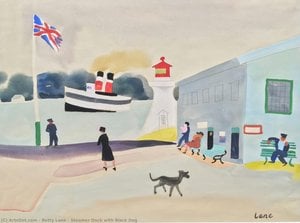
A Life Painted in Light and Shadow
Betty Lane, born Elizabeth Thoburn Lane in Washington D.C. in 1907, was an American artist whose evocative watercolors and oils quietly charted a course through the shifting currents of modernist art. Her life, spanning nearly a century, was one of constant exploration – not just of artistic technique but also of place and perspective. The daughter of a Marine officer and raised amidst a large family, Lane’s early exposure to diverse locales – her father's postings included the Philippines and Santo Domingo – likely instilled in her a lifelong wanderlust and an observant eye for detail. Even as a child, around the age of nine, she demonstrated a natural aptitude for painting, finding solace and expression in watercolor. Though initially enrolled at the Corcoran College of Art and Design, Lane soon realized it didn’t nurture her burgeoning talent; a transfer to the Massachusetts Normal Art School proved pivotal, offering an environment more attuned to her artistic needs. This early search for the right creative space would become a defining characteristic of her career.Parisian Transformations and Early Recognition
The year 1928 marked a turning point with Lane’s journey to Paris. Immersing herself in the vibrant art scene, she studied under the influential Cubist painter André Lhote. This mentorship profoundly impacted her artistic development, instilling a rigorous understanding of form and composition that would underpin her modernist style. Lhote's influence wasn’t about mimicry but rather a foundational training in seeing the world anew – breaking down shapes, exploring spatial relationships, and embracing abstraction as a means to convey deeper truths. Returning to the United States in 1929, Lane settled in Falls Church, Virginia, and Washington D.C., where her work quickly gained attention. A significant milestone arrived in April 1931 with an exhibition at the Phillips Memorial Gallery alongside established artists John Marin and Harold Weston – a testament to Duncan Phillips’s discerning eye and early belief in Lane's potential. This recognition provided crucial encouragement as she navigated the complexities of establishing herself as a professional artist. She quickly began to develop her own unique style, blending elements of Cubism with Impressionistic color palettes and a sensitivity to light.A Transatlantic Dialogue: Years Abroad and Artistic Refinement
The subsequent decade saw Lane embracing a nomadic existence, dividing her time between Cambridge, England, and Paris. These years were characterized by intense artistic exploration and a broadening of horizons. She wasn’t merely *depicting* landscapes; she was absorbing the atmosphere, light, and cultural nuances of each location. From the bustling streets of European cities to the serene countryside, Lane's canvases began to reflect her experiences – capturing not just what she saw but how it *felt*. This period also witnessed a diversification of her subject matter, encompassing portraits, domestic scenes, and increasingly abstract compositions. The influence of these travels is palpable in her evolving style, marked by expressive brushwork and a growing confidence in her use of color. During World War II, Lane relocated to Ontario, Canada from 1939-1946, continuing to paint and refine her artistic voice amidst global upheaval. This period demonstrated her resilience and adaptability as an artist, navigating challenging circumstances while maintaining her creative practice.Expanding Horizons: Teaching, Experimentation, and Lasting Legacy
In 1946, Lane returned to the United States and embarked on a new chapter as a teacher at Miss Porter's School, where she remained for nearly two decades until 1965. This period wasn’t merely a professional obligation; it was an opportunity to share her passion for art and inspire a new generation of artists. Simultaneously, Lane continued to push the boundaries of her own creative practice, experimenting with woodblock printing, silkscreen, ceramics, and glass – demonstrating a remarkable versatility and willingness to embrace new mediums. After 1960, she settled in Brewster, Massachusetts, but her spirit of exploration remained undimmed. Extensive travels took her to Greece, Mexico, the Soviet Union, and Australia, each journey enriching her artistic vocabulary. Her commitment extended beyond the canvas; in 1977, she became an associate of the Women's Institute for Freedom of the Press (WIFP), demonstrating a dedication to social causes. Betty Lane passed away in Brewster in 1996, leaving behind a rich and varied body of work that is now gaining increasing recognition. Her paintings are held in prestigious institutions including The Metropolitan Museum of Art, The Phillips Collection, The Provincetown Art Association and Museum, and The Cape Cod Museum of Art.Artistic Style and Significance
Lane’s artistic style is characterized by a compelling blend of modernist techniques, expressive brushwork, and an acute sensitivity to detail. She moved fluidly between representational and abstract forms, often imbuing her paintings with a palpable sense of atmosphere and emotional depth. Her landscapes are particularly noteworthy for their evocative use of color and light, capturing the essence of a place rather than merely its appearance. *Her portraits, too, possess a remarkable psychological insight*, revealing not just physical likeness but also the inner lives of her subjects. Lane’s contribution to American art resides in her ability to synthesize diverse influences – from Cubism to Impressionism and beyond – into a cohesive and deeply personal vision. While she may not have achieved widespread fame during her lifetime, her work is now being recognized for its artistic merit and historical significance as an example of a woman artist navigating the complexities of the 20th century art world with grace, intelligence, and unwavering dedication to her craft.Pytania i odpowiedzi
Gdzie można znaleźć dzieła Betty Lane pogrupowane według słów kluczowych?
Aby znaleźć dzieła artysty Betty Lane o konkretnej tematyce, skorzystaj ze strony Według słów kluczowych, która grupuje prace według słów kluczowych.
Czy mogę przeglądać dzieła Betty Lane według spektrum kolorów?
Indeks barwny artysty Betty Lane to strona, która porządkuje dzieła artysty według ich kolorów.
Gdzie można znaleźć dzieła Betty Lane pogrupowane według palety barw?
Prace artysty Betty Lane można przeglądać według palety kolorystycznej na stronie Według palet kolorystycznych artysty.