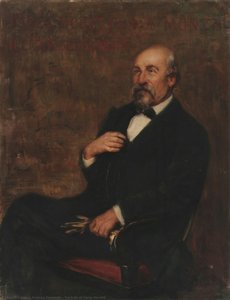
The Early Years in Lombardy
Born into humble circumstances in Montichiari, Antonio Pasinetti found his way to the brush through the guidance of Luigi Campini. This early apprenticeship in Brescia laid the foundation for a life defined by a restless search for artistic truth. At only twelve years of age, he entered the Moretto school, absorbing the local traditions before moving toward the larger lights of Milan in 1880. There, at the Brera Academy, he earned his diploma in drawing, yet the rigid structures of academic teaching could not hold him for long.
Seeking a more naturalistic approach, he traveled to Verona to study under Napoleone Nani. This period of wandering through northern Italy allowed him to refine his eye for the world around him. He spent time in various cities, including Padua, Genoa, and Venice, gathering the visual language that would later define his mature style. By 1889, he had settled permanently in Milan, a city that would become the stage for his professional triumphs and personal struggles.
A Life of Portraits and Landscapes
In the bustling studios of Milan, Pasinetti established himself among the middle-class clientele of the Lombard bourgeoisie. He shared a workspace on via Solferino with the sculptor Paolo Troubetzkoy, placing himself at the heart of a significant artistic circle. His hand was particularly skilled at capturing the human face, as seen in his portraits of figures such as Agostino Bertani and the composer Ruggero Leoncavallo. These works often favored a detailed physiognomic truth over elaborate settings, focusing instead on the character of the sitter.
Beyond the studio walls, his interests expanded into the natural world. He found deep inspiration in the light of Venice and the rugged beauty of the Alpine valleys. His landscapes were not merely scenery but reflections of daily life, often painted with a lively colorism and a bold use of the palette knife. In some instances, he even turned his attention to social themes, using his art to address the difficult conditions faced by women in the Lombard countryside.
Artistic Evolution and Legacy
The trajectory of Pasinetti's career was marked by a continuous openness to new movements. He moved through the influences of Scapigliatura, Symbolism, and Divisionism, eventually finding a connection with the Novecento Italiano movement around 1925. This evolution showed an artist who refused to remain stagnant, always willing to adapt his technique to the changing currents of his era. His work even touched upon the permanence of fresco, decorating the interior of the edicola Bocconi in Milan.
His life was also marked by personal loss and resilience. After the death of his first wife, Teresina Marchetto, he continued his prolific output, eventually finding companionship again with Tina Cini. Though he passed away in Milan, his presence remains felt through the collections that house his work. His legacy is preserved in various institutions, including:
- The Galleria d’Arte Moderna in Milano
- The Pinacoteca Tosio Martinengo in Brescia
- The Museo Teatrale alla Scala in Milano
- The Pasinetti Art Gallery in Montichiari
Pytania i odpowiedzi
W jakim mieście i kraju urodził(a) się Antonio Pasinetti?
Antonio Pasinetti urodził się w Montichiari w Italy.
Gdzie można znaleźć dzieła Antonio Pasinetti pogrupowane według nurtów artystycznych?
Dzieła artysty Antonio Pasinetti można przeglądać według nurtów na stronie Wszystkie nurty artystyczne.
Czy mogę przeglądać dzieła Antonio Pasinetti według nastroju?
Strona Sztuka według nastroju artysty prezentuje dzieła Antonio Pasinetti pogrupowane według ich nastroju.
Czy mogę odwiedzić wirtualne muzeum dzieł Antonio Pasinetti?
Zapraszamy na wirtualny spacer: strona Wirtualna Galeria 3D artysty Antonio Pasinetti prezentuje jego dzieła w galerii trójwymiarowej.