Podgląd w skali 1:1 Podgląd AR Przełącz na wydania drukowane Przejdź do wersji cyfrowej Wyślij jako kartkę
Szczegóły dzieła Przewodnik Dodaj do ulubionych Pobierz obraz Podobne obiekty RTG Pokaz slajdów Statystyki

Waiting

Admire Winslow Homer's evocative 'Waiting,' capturing poignant emotion and rural tranquility. Explore this iconic American Realist masterpiece – available as stunning reproductions at WahooArt.com!

Winslow Homer (1836-1910): Ikoniczny amerykański realistyczny malarz słynący z obrazów morskich i krajobrazów XIX wieku. Odkryj arcydzieła takie jak "The Gulf Stream" i "Breezing Up".

Ręcznie malowana reprodukcja olejowa

Ręcznie malowany obraz olejny na płótnie, wykonany na zamówienie przez naszych artystów w wybranym przez Ciebie wymiarze i oprawie. ( Przełącz na wydania drukowane Przejdź do wersji cyfrowej)

Corner sample of the P118B picture frame: polistyren formowany, 5 cm wide and 3 cm thick
P118B zł10
Corner sample of the P118H picture frame: polistyren formowany, 5 cm wide and 3 cm thick
P118H zł10
Corner sample of the P118W picture frame: polistyren formowany, 5 cm wide and 3 cm thick
P118W zł10
Corner sample of the P438Z picture frame: polistyren formowany, 5.5 cm wide and 3.5 cm thick
P438Z zł10
Corner sample of the P508JH picture frame: polistyren formowany, 7 cm wide and 3.5 cm thick
P508JH zł12
Corner sample of the P508YH picture frame: polistyren formowany, 7 cm wide and 3.5 cm thick
P508YH zł12
Corner sample of the P805H picture frame: polistyren formowany, 5 cm wide and 3.5 cm thick
P805H zł10
Corner sample of the P805Z picture frame: polistyren formowany, 5 cm wide and 3.5 cm thick
P805Z zł10
Corner sample of the P919BZ picture frame: polistyren formowany, 7 cm wide and 3.5 cm thick
P919BZ zł10
Corner sample of the P919G picture frame: polistyren formowany, 7 cm wide and 3.5 cm thick
P919G zł10
Corner sample of the P919XJ picture frame: polistyren formowany, 7 cm wide and 3.5 cm thick
P919XJ zł10
Corner sample of the P959ZH picture frame: polistyren formowany, 5 cm wide and 3 cm thick
P959ZH zł10
Corner sample of the P968JZ picture frame: polistyren formowany, 6 cm wide and 4 cm thick
P968JZ zł12
Corner sample of the W106C picture frame: lite drewno, 5 cm wide and 3 cm thick
W106C zł8
Corner sample of the W218G picture frame: lite drewno, 5 cm wide and 3 cm thick
W218G zł10
Corner sample of the W218JH picture frame: lite drewno, 5 cm wide and 3 cm thick
W218JH zł8
Corner sample of the W218Y picture frame: lite drewno, 5 cm wide and 3 cm thick
W218Y zł10
Corner sample of the W307PJ picture frame: lite drewno, 6 cm wide and 3 cm thick
W307PJ zł10
Corner sample of the W316G picture frame: lite drewno, 6 cm wide and 3 cm thick
W316G zł10
Corner sample of the W316PJ picture frame: lite drewno, 6 cm wide and 3 cm thick
W316PJ zł8
Corner sample of the W316Y picture frame: lite drewno, 6 cm wide and 3 cm thick
W316Y zł10
Corner sample of the W398PJ picture frame: lite drewno, 5 cm wide and 3 cm thick
W398PJ zł8
Corner sample of the W4111J picture frame: lite drewno, 6.5 cm wide and 3.5 cm thick
W4111J zł10
Corner sample of the W500HY picture frame: lite drewno, 7 cm wide and 5 cm thick
W500HY zł15
Corner sample of the W500JH picture frame: lite drewno, 7 cm wide and 5 cm thick
W500JH zł15
Corner sample of the W692G picture frame: lite drewno, 8 cm wide and 4 cm thick
W692G zł12
Corner sample of the W849H picture frame: lite drewno, 5 cm wide and 3 cm thick
W849H zł8
Corner sample of the W940BG picture frame: lite drewno, 7.5 cm wide and 4.5 cm thick
W940BG zł15
Corner sample of the W953PJ picture frame: lite drewno, 6 cm wide and 3.5 cm thick
W953PJ zł8

Standardowy format
personalizowane
CM
INCH

Wybierz spośród naszych standardowych rozmiarów, które zachowują oryginalne proporcje dzieła sztuki.

szerokość
wysokość

Wpisz wymaganą szerokość i wysokość, aby obraz pasował do Twojej ramy lub ściany. Ponieważ jest to dzieło malowane ręcznie, w przypadku rozmiaru o innych proporcjach artysta może domalować nieco więcej wokół obrazu lub przyciąć jego fragmenty — wybór należy do Ciebie. Przed rozpoczęciem pracy prześlemy Ci cyfrową wizualizację do zatwierdzenia. Obraz widoczny na tej stronie nie przedstawia rzeczywistego efektu — jedynie wizualizacja oddaje realny rezultat.

Przykłady możliwych zmian: Zamień twarz na zdjęcie klienta; Dodaj zwierzę domowe (np. zamień kota na psa); Ukryj wiadomość w tle; Zmień krajobraz lub elementy tła.
Po złożeniu zamówienia zespół WahooArt.com skontaktuje się z klientem drogą mailową w celu uzyskania instrukcji i prześle wizualizację projektu

Dostawa na całym świecie () w ciągu 3–4 tygodni zamiast standardowych 5 tygodni. (26 Październik). Bez kompromisów w kwestii jakości.

Bezpłatna ekspresowa wysyłka na cały świat
Wysokiej jakości płótno lniane
Pełne ubezpieczenie przesyłki
Gwarancja zwrotu należności celnych i podatków importowych
Gwarancja wiernego odwzorowania kolorów
100-dniowa polityka zwrotów (tylko w przypadku wad)
Gwarancja 100% zwrotu pieniędzy
Zniżka przy zakupie wielu sztuk

Suma całkowita

zł 1045

Waiting

Technika reprodukcji

Wymiary reprodukcji

-

Cena całkowita

zł 1045

Najważniejsze informacje

  • Medium: Watercolor painting
  • Dimensions: 30.5 × 21 U174728
  • Influences: Hudson River School
  • Year: 1880
  • Subject or theme: Domestic tranquility; Anticipation
  • Artistic style: Romantic Realism

Quiz o sztuce

Do każdego pytania dotyczy tylko jedna poprawna odpowiedź.

Pytanie 1:
What is Winslow Homer known for?
Pytanie 2:
The painting depicts a woman sitting on the grass. What emotion does this pose convey?
Pytanie 3:
What is prominent in the background of 'Waiting'?
Pytanie 4:
Which artistic movement does Winslow Homer's style align with?
Pytanie 5:
What is the primary medium used in this artwork?

Winslow Homer’s “Waiting”: A Study in Quiet Observation

Winslow Homer (1836–1910) wasn't sculpted by the formal academies of Europe; he emerged from an American experience defined by practicality and a profound connection to the natural world. His artistic journey began not with grand historical canvases—a path favored by many contemporaries—but with commercial illustration for Harper’s Weekly at just twelve years old. This early apprenticeship instilled in him an exceptional ability to capture scenes with remarkable clarity and detail – skills that would become cornerstones of his mature oeuvre. He wasn't absorbing perspective from Parisian studios; he was learning to *see* America, its people, and the unfolding narrative of its time, a perspective that profoundly shaped his artistic vision. The bustling streets of Boston, the serene dignity of rural New England life—these were his initial subjects, rendered with a precision born of necessity for the demands of print media, establishing a foundational understanding of observation that would permeate his later paintings.
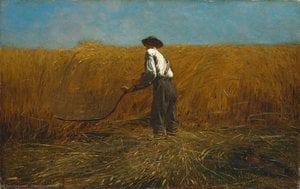
  • Subject Matter: Homer’s “Waiting” depicts a woman seated on grass, her hat resting in her hand, radiating an aura of contemplative stillness. Two figures flank her—one positioned at the upper right corner and another near the lower left—adding to the scene's complexity without disrupting its central focus. A handbag rests beside her, subtly hinting at preparation or anticipation.
  • Style: The painting embodies Homer’s signature Realism, prioritizing accurate representation of form and texture over idealized beauty. It eschews dramatic flourishes, favoring instead a restrained palette and meticulous attention to detail—characteristics that align perfectly with the aesthetic sensibilities of his era.
  • Technique: Executed in watercolor on paper, “Waiting” exemplifies Homer’s masterful control over medium. Watercolor allows for luminous washes and subtle gradations of color, capturing the diffused light characteristic of outdoor landscapes. The artist's brushstrokes are deliberate yet understated, conveying a sense of immediacy and capturing the ephemeral qualities of the moment.

Historical Context: Impressionism’s Shadow

“Waiting” emerged during the twilight years of Impressionism, though Homer consciously resisted its stylistic conventions. While Impressionists sought to capture fleeting impressions of light and color—often prioritizing subjective experience over objective accuracy—Homer remained steadfast in his commitment to portraying reality with unflinching honesty. This distinction reflects a broader trend within American art at the time: a preference for depicting familiar subjects—such as rural life and maritime scenes—with meticulous detail, rather than attempting to emulate European artistic trends. Homer’s approach can be seen as a reaction against the perceived artificiality of Parisian salons and a celebration of America's distinctive visual culture.

Symbolism: Anticipation and Vulnerability

Despite its apparent simplicity, “Waiting” is laden with symbolic resonance. The woman’s posture—seated calmly yet poised—suggests vulnerability and anticipation; she embodies the human condition grappling with uncertainty. The presence of the two figures adds to this sense of unease, hinting at external forces shaping her experience. Furthermore, the setting—a tranquil meadow bathed in dappled sunlight—contrasts sharply with the implied tension within the scene, creating a powerful visual dialogue between stillness and movement. Homer skillfully utilizes these elements to convey not merely what is seen but also what is felt—a profound meditation on human emotion and resilience.

Emotional Impact: A Moment Frozen in Time

“Waiting” transcends mere depiction; it evokes a palpable emotional atmosphere. The painting’s muted color palette contributes to its contemplative mood, fostering a feeling of quiet introspection. Homer's meticulous rendering of texture—the grass blades swaying gently in the breeze, the folds of the woman’s dress—grounds the viewer in the physicality of the scene, enhancing its immersive quality. Ultimately, “Waiting” succeeds in capturing a fleeting moment of human experience—a pause before an unknown future—resonating with viewers long after they have gazed upon it. It stands as a testament to Homer's ability to transform observation into artful expression and to imbue his canvases with enduring emotional power.

Pytania i odpowiedzi

Z czego wynika obecny status praw autorskich dzieła "Waiting"?

„Waiting” – Winslow Homer jest należy do domeny publicznej – autorskie prawa majątkowe wygasły. Okres ochrony praw autorskich liczony jest od śmierci artysty, która nastąpiła w 1910.

Jaki rozmiar wydruku "Waiting" będzie odpowiedni do mojego pokoju?

Zalecane zestawienie dla „Waiting” – Winslow Homer: wydruk w formacie Large do Living Room.

Gdzie mogę znaleźć statystyki dotyczące „Waiting” – Winslow Homer?

Statystyki dotyczące „Waiting” – Winslow Homer znajdują się na stronie Statystyki wyświetleń dzieła: obejmują one miesięczną liczbę odwiedzin danego dzieła, wizyty przy pracach artysty oraz podział ostatnich odwiedzających według krajów i języków.


Biografia artysty

Winslow Homer (1836-1910): A Brush With the American Spirit

Winslow Homer, born in Boston in 1836, wasn’t sculpted by the traditional European art academies that shaped so many of his contemporaries. Instead, he emerged from a distinctly American experience, one rooted in practicality and observation. His journey began not with grand historical canvases, but as a commercial illustrator at the tender age of twelve for Harper's Weekly. This early apprenticeship was formative, honing an exceptional ability to capture scenes with clarity and detail – skills that would become hallmarks of his mature work. He wasn’t learning perspective in Paris; he was learning to *see* America, its people, and its unfolding story. The bustling streets of Boston, the quiet dignity of rural New England life, these were his first subjects, rendered with a precision born of necessity for the demands of print media. This foundation allowed him to transition into painting, initially in watercolor, before fully embracing the expressive potential of oil paints.

Early Life and Artistic Beginnings

Homer’s childhood was marked by a close relationship between his parents—Charles Savage Homer, a merchant with restless tendencies, and Henrietta Maria Benson Homer, a gifted amateur watercolorist who instilled in him a lifelong appreciation for artistic expression. His brother, Charles S. Homer Jr., pursued a successful career as a chemist, providing a contrasting perspective on the family’s ambitions. From a young age, Homer demonstrated an innate talent for drawing, sketching landscapes and portraits with remarkable accuracy. He began his formal artistic training at fourteen, studying briefly in Paris under Jean-Baptiste Camille Corot—a pivotal experience that exposed him to the Impressionist movement but ultimately solidified his commitment to a distinctly American aesthetic. This Parisian sojourn instilled in Homer a fascination with light and color, influencing his later paintings and establishing a foundation for his distinctive style.

The Civil War Years: Witnessing History Through Art

The outbreak of the Civil War profoundly impacted Homer’s artistic vision. Recognizing the opportunity to document the realities of conflict—rather than glorifying heroic battles—he accepted a commission from Harper's Weekly to chronicle life on the Union front lines. Unlike many artists of his time who idealized warfare, Homer eschewed grand narratives and focused instead on portraying the everyday experiences of soldiers and civilians—the quiet moments of grief, resilience, and camaraderie amidst devastation. His sketches and lithographs captured the grim beauty of battlefields—the mud, the smoke, the exhausted faces of men—offering a visceral portrayal of the human cost of war. This experience instilled in him an unwavering commitment to portraying truthfulness and compassion—values that would permeate his subsequent works. Homer’s Civil War drawings stand as unparalleled examples of journalistic art, demonstrating his ability to transform observation into powerful visual storytelling.

From Watercolor Landscapes to Monumental Oil Paintings

Initially experimenting with watercolor, Homer quickly mastered the medium's fluidity and luminosity, creating a prolific oeuvre of serene landscapes—primarily set in Maine—that celebrated the majesty of nature and captured the subtle nuances of light and atmosphere. His watercolors are characterized by delicate brushstrokes and vibrant colors—a testament to his meticulous attention to detail and his profound understanding of visual perception. However, Homer’s artistic ambition extended beyond watercolor; he sought to convey emotion and drama through larger canvases painted in oil. He achieved this goal with remarkable success, producing monumental paintings that commanded attention and evoked powerful responses from viewers. Works like *The Gulf Stream*—a dramatic depiction of a lone sailor battling the fury of the ocean—and *Breezing Up (A Fair Wind)*—a celebration of maritime life—demonstrate Homer’s mastery of technique and his ability to capture the sublime beauty of nature alongside its inherent dangers.

Legacy and Influence: An American Icon

Winslow Homer's enduring legacy rests on his unwavering commitment to portraying America with honesty and authenticity—rejecting romantic idealism in favor of a direct engagement with reality. He established himself as one of America’s foremost painters, influencing generations of artists who followed him—particularly those committed to realism and landscape painting. His distinctive style—characterized by solidity, texture, and masterful use of light—continues to inspire contemporary artists today. Homer's paintings remain treasured for their emotional depth and visual power—testaments to his profound understanding of the human condition and his ability to convey complex ideas through simple yet evocative imagery. He is remembered not merely as a painter but as a chronicler of American life, capturing its spirit and beauty with unwavering conviction.

Winslow Homer

Winslow Homer

1836 - 1910 , Stany Zjednoczone

Krótka nota

  • Artistic Movement Or Style: Realizm amerykański
  • Artists Or Movements Influenced By This Artist: ['Amerykańskie malarstwo']
  • Artists Who Influenced This Artist:
    • École de Barbizon
    • Courbet
    • Millet
  • Date Of Birth: 24 lutego 1836
  • Date Of Death: 29 września 1910
  • Full Name: Winslow Homer
  • Nationality: Amerykański
  • Notable Artworks:
    • Breezing Up
    • The Gulf Stream
    • Innocence
  • Place Of Birth: Boston, USA
Odkryj dzieła sztuki uporządkowane według tematów, stylów i cech charakterystycznych.