x
Podgląd w skaliPodgląd w skali Podgląd ARPodgląd AR Zamów ręcznie malowaną reprodukcję Zamów ręcznie malowaną reprodukcjęKup obraz wysokiej rozdzielczości Kup obraz wysokiej rozdzielczości Wyślij jako kartkęWyślij jako kartkę
Szczegóły dziełaSzczegóły dzieła Dodaj do ulubionych Dodaj do ulubionych PobierzPobierz Podobne obiektyPodobne obiekty RTGRTG Pokaz slajdówPokaz slajdów

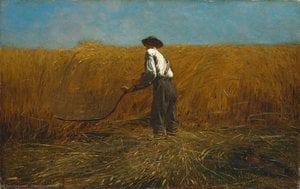
Mending the nets

Winslow Homer’s "Mending the Nets" (1881) captures rural life with realism & gouache texture. A poignant scene of two women working together, housed at the National Gallery of Art.

Winslow Homer (1836-1910): Ikoniczny amerykański realistyczny malarz słynący z obrazów morskich i krajobrazów XIX wieku. Odkryj arcydzieła takie jak "The Gulf Stream" i "Breezing Up".

Giclée / Wydruk artystyczny

Druk giclée lub płótno o jakości muzealnej, szybka realizacja i szeroki wybór opcji wykończenia. (Zamów ręcznie malowaną reprodukcję Zamów ręcznie malowaną reprodukcjęKup obraz wysokiej rozdzielczości Kup obraz wysokiej rozdzielczości)

P118B $10
P118H $10
P118W $10
P438Z $10
P508JH $12
P508YH $12
P805H $10
P805Z $10
P919BZ $10
P919G $10
P919XJ $10
P959ZH $10
P968JZ $12
W106C $8
W218G $10
W218JH $8
W218Y $10
W307PJ $10
W316G $10
W316PJ $8
W316Y $10
W398PJ $8
W4111J $10
W500HY $15
W500JH $15
W692G $12
W849H $8
W940BG $15
W953PJ $8

Standardowy rozmiar
na wymiar
CM
INCH

Wybierz spośród naszych standardowych rozmiarów, które zachowują oryginalne proporcje dzieła sztuki.

szerokość
wysokość

Możesz wprowadzić własne wymiary, aby dopasować dzieło do konkretnej ramy lub przestrzeni. Jeśli wybrany rozmiar nie będzie odpowiadał proporcjom oryginalnego obrazu, przytniecie dzieło lub rozszerzymy obraz za pomocą odbicia lustrzanego lub jednolitego wypełnienia krawędzi. Przed rozpoczęciem produkcji prześlemy cyfrową wizualizację do Twojej akceptacji.
Prosimy pamiętać, że podgląd na ekranie nie odzwierciedla faktycznego przycinania ani rozszerzania. Tylko wizualizacja dokładnie pokaże końcową kompozycję.
Mimo dostępności niestandardowych rozmiarów, zalecamy wybór wymiaru z listy zdefiniowanej, aby zachować oryginalne proporcje.

Dostawa na cały świat () w ciągu 2 tygodni zamiast standardowych 4/5 tygodni. (30 Sierpień)

why_choose_icon
Bezpłatna ekspresowa wysyłka na cały świat
why_choose_icon
Wysokiej jakości płótno lniane
why_choose_icon
Pełne ubezpieczenie przesyłki
why_choose_icon
Gwarancja zwrotu należności celnych i podatków importowych
why_choose_icon
Gwarancja wiernego odwzorowania kolorów
why_choose_icon
Polityka 60-dniowego zwrotu (tylko w przypadku wad)
why_choose_icon
Gwarancja 100% zwrotu kosztów
why_choose_icon
Zniżka przy zamówieniu wielu produktów

Suma całkowita

$ 68

reproduction

Mending the nets

Giclée / Wydruk artystyczny

Wymiary reprodukcji

-

Cena całkowita

$ 68

Szybki podgląd

  • Influences: Homer's works
  • Artist: Winslow Homer
  • Title: Mending the Nets
  • Subject or theme: Women mending nets
  • Notable elements: Realist depiction
  • Year: 1881
  • Artistic style: Realism, Detailed

Quiz o sztuce

Do każdego pytania dotyczy tylko jedna poprawna odpowiedź.

Pytanie 1:
What artistic movement is most closely associated with Winslow Homer’s ‘Mending the Nets’?
Pytanie 2:
The painting primarily depicts:
Pytanie 3:
What medium was predominantly used by Winslow Homer to create ‘Mending the Nets’?
Pytanie 4:
Where is ‘Mending the Nets’ currently housed?
Pytanie 5:
What detail in the painting contributes to its sense of realism?

Winslow Homer’s “Mending the Nets”: A Study in Rural Resilience

Winslow Homer's "Mending the Nets," painted in 1881 and now residing within the esteemed National Gallery of Art in Washington, D.C., is more than just a depiction of two women at work; it’s a poignant meditation on labor, community, and the quiet dignity found in everyday life. Homer, a pivotal figure in American Realism, masterfully captures a fleeting moment of connection amidst the demanding rhythms of rural existence, utilizing the subtle yet powerful techniques of gouache over graphite to create an image brimming with both understated beauty and profound emotional resonance.

The scene unfolds outdoors, bathed in a soft, diffused light that suggests either early morning or late afternoon – a time often associated with reflection and routine. Two women, their faces partially obscured yet radiating a palpable sense of camaraderie, are diligently engaged in the painstaking task of mending fishing nets. Their postures, rendered with Homer’s characteristic attention to detail, reveal years of experience and a shared understanding of this essential craft. One woman, positioned slightly to the left, holds a piece of blue fabric – perhaps destined for a new net or repair – while her counterpart, situated more centrally, expertly wields a knife, deftly separating strands of twine. The inclusion of a simple wooden chair in the background subtly anchors the scene, providing a point of rest and reinforcing the idea of this labor as a sustained activity, not merely a hurried chore.

Homer’s choice to employ gouache—a watercolor-like medium known for its opacity and ability to build rich colors—is particularly noteworthy. Unlike the delicate washes often associated with watercolor, gouache offers a greater degree of control and allows Homer to create a textured surface that subtly emphasizes the roughness of the nets and the weathered hands of his subjects. The use of graphite underpainting provides an underlying structure and tonal depth, contributing to the painting’s overall sense of realism and solidity. This combination of techniques—the fluidity of gouache balanced by the precision of graphite—is a hallmark of Homer's style, allowing him to capture both the ephemeral beauty of light and shadow and the tangible quality of his subjects.

The Influence of Neo-Romanticism

“Mending the Nets” firmly resides within the broader context of Winslow Homer’s artistic journey. While initially associated with commercial illustration, Homer steadily evolved towards a more deeply personal and expressive style, heavily influenced by the burgeoning Neo-Romantic movement. This movement, which gained momentum in the latter half of the 19th century, rejected the idealized forms and grand narratives of earlier Romanticism in favor of a focus on the emotional experiences of ordinary people, often set against the backdrop of nature. Homer’s work—particularly his depictions of rural life—resonates with this sensibility, capturing not just the visual appearance of his subjects but also their inner lives and the challenges they face.

The painting's quiet dignity and focus on the simple tasks of daily existence align perfectly with Neo-Romantic ideals. Homer wasn’t interested in heroic narratives or dramatic landscapes; instead, he sought to reveal the beauty and resilience found within the commonplace—the shared labor, the unspoken connections, and the enduring spirit of those who worked the land.

Realism and the Representation of Everyday Life

At its core, “Mending the Nets” is a testament to Homer’s commitment to Realism. He eschewed romanticized depictions in favor of an honest and unvarnished portrayal of rural life in New England. The scene feels utterly authentic—not staged or contrived—as if captured directly from observation. This dedication to accuracy extends beyond the depiction of the women themselves, encompassing every detail of their surroundings: the worn nets, the simple chair, the cobblestone ground. Homer’s meticulous attention to these seemingly insignificant elements elevates the painting and imbues it with a sense of profound significance.

Furthermore, the painting's focus on ordinary people—women engaged in a routine task—was a deliberate departure from the prevailing artistic trends of the time. By centering his work on the lives of those often overlooked by mainstream art, Homer challenged conventional notions of beauty and elevated the dignity of everyday labor.

A Legacy Preserved: Reproductions and Artistic Significance

The National Gallery of Art’s collection stands as a testament to Winslow Homer's enduring legacy. “Mending the Nets,” in particular, offers a captivating glimpse into his artistic vision and provides a poignant reflection on the human condition. WahooArt.com is proud to offer meticulously crafted handmade oil painting reproductions of this iconic work, allowing art lovers worldwide to experience its beauty and emotional depth firsthand. These reproductions faithfully capture Homer’s masterful use of color, texture, and composition, ensuring that this timeless masterpiece remains accessible for generations to come.

Beyond their aesthetic appeal, these reproductions serve as a valuable connection to the past—a tangible reminder of Winslow Homer's profound contribution to American art. Exploring “Mending the Nets” through a reproduction allows us to appreciate not only its visual beauty but also the historical and cultural context in which it was created, deepening our understanding of this remarkable artist and his enduring legacy.


O artyście

Winslow Homer (1836-1910): A Brush With the American Spirit

Winslow Homer, born in Boston in 1836, wasn’t sculpted by the traditional European art academies that shaped so many of his contemporaries. Instead, he emerged from a distinctly American experience, one rooted in practicality and observation. His journey began not with grand historical canvases, but as a commercial illustrator at the tender age of twelve for Harper's Weekly. This early apprenticeship was formative, honing an exceptional ability to capture scenes with clarity and detail – skills that would become hallmarks of his mature work. He wasn’t learning perspective in Paris; he was learning to *see* America, its people, and its unfolding story. The bustling streets of Boston, the quiet dignity of rural New England life, these were his first subjects, rendered with a precision born of necessity for the demands of print media. This foundation allowed him to transition into painting, initially in watercolor, before fully embracing the expressive potential of oil paints.

Early Life and Artistic Beginnings

Homer’s childhood was marked by a close relationship between his parents—Charles Savage Homer, a merchant with restless tendencies, and Henrietta Maria Benson Homer, a gifted amateur watercolorist who instilled in him a lifelong appreciation for artistic expression. His brother, Charles S. Homer Jr., pursued a successful career as a chemist, providing a contrasting perspective on the family’s ambitions. From a young age, Homer demonstrated an innate talent for drawing, sketching landscapes and portraits with remarkable accuracy. He began his formal artistic training at fourteen, studying briefly in Paris under Jean-Baptiste Camille Corot—a pivotal experience that exposed him to the Impressionist movement but ultimately solidified his commitment to a distinctly American aesthetic. This Parisian sojourn instilled in Homer a fascination with light and color, influencing his later paintings and establishing a foundation for his distinctive style.

The Civil War Years: Witnessing History Through Art

The outbreak of the Civil War profoundly impacted Homer’s artistic vision. Recognizing the opportunity to document the realities of conflict—rather than glorifying heroic battles—he accepted a commission from Harper's Weekly to chronicle life on the Union front lines. Unlike many artists of his time who idealized warfare, Homer eschewed grand narratives and focused instead on portraying the everyday experiences of soldiers and civilians—the quiet moments of grief, resilience, and camaraderie amidst devastation. His sketches and lithographs captured the grim beauty of battlefields—the mud, the smoke, the exhausted faces of men—offering a visceral portrayal of the human cost of war. This experience instilled in him an unwavering commitment to portraying truthfulness and compassion—values that would permeate his subsequent works. Homer’s Civil War drawings stand as unparalleled examples of journalistic art, demonstrating his ability to transform observation into powerful visual storytelling.

From Watercolor Landscapes to Monumental Oil Paintings

Initially experimenting with watercolor, Homer quickly mastered the medium's fluidity and luminosity, creating a prolific oeuvre of serene landscapes—primarily set in Maine—that celebrated the majesty of nature and captured the subtle nuances of light and atmosphere. His watercolors are characterized by delicate brushstrokes and vibrant colors—a testament to his meticulous attention to detail and his profound understanding of visual perception. However, Homer’s artistic ambition extended beyond watercolor; he sought to convey emotion and drama through larger canvases painted in oil. He achieved this goal with remarkable success, producing monumental paintings that commanded attention and evoked powerful responses from viewers. Works like *The Gulf Stream*—a dramatic depiction of a lone sailor battling the fury of the ocean—and *Breezing Up (A Fair Wind)*—a celebration of maritime life—demonstrate Homer’s mastery of technique and his ability to capture the sublime beauty of nature alongside its inherent dangers.

Legacy and Influence: An American Icon

Winslow Homer's enduring legacy rests on his unwavering commitment to portraying America with honesty and authenticity—rejecting romantic idealism in favor of a direct engagement with reality. He established himself as one of America’s foremost painters, influencing generations of artists who followed him—particularly those committed to realism and landscape painting. His distinctive style—characterized by solidity, texture, and masterful use of light—continues to inspire contemporary artists today. Homer's paintings remain treasured for their emotional depth and visual power—testaments to his profound understanding of the human condition and his ability to convey complex ideas through simple yet evocative imagery. He is remembered not merely as a painter but as a chronicler of American life, capturing its spirit and beauty with unwavering conviction.
Winslow Homer

Winslow Homer

1836 - 1910 , Stany Zjednoczone

Krótka nota

  • Artistic Movement Or Style: Realizm amerykański
  • Artists Or Movements Influenced By This Artist: ['Amerykańskie malarstwo']
  • Artists Who Influenced This Artist:
    • École de Barbizon
    • Courbet
    • Millet
  • Date Of Birth: 24 lutego 1836
  • Date Of Death: 29 września 1910
  • Full Name: Winslow Homer
  • Nationality: Amerykański
  • Notable Artworks:
    • Breezing Up
    • The Gulf Stream
    • Innocence
  • Place Of Birth: Boston, USA
Odkryj dzieła sztuki uporządkowane według tematów, stylów i cech charakterystycznych.