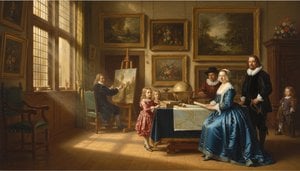
Willem Drost: A Shadow in Rembrandt’s Light – Rediscovering a Dutch Master
Willem Drost remains one of the most intriguing and elusive figures within the constellation of Dutch Golden Age painters. Born in Amsterdam in 1633, his life was tragically cut short at just twenty-six years old in 1659, leaving behind a remarkably small but increasingly recognized body of work. For centuries, Drost’s paintings were often mistakenly attributed to his immensely influential master, Rembrandt van Rijn – a testament to the profound impact Rembrandt had on the artistic landscape of the era. However, recent scholarship has painstakingly illuminated Drost's unique talent and established him as a compelling artist in his own right—a painter whose work offers a fascinating lens through which to examine the dynamics of artistic apprenticeship, attribution, and the subtle nuances of individual style during this pivotal period in art history. The story of Willem Drost is not merely one of rediscovery; it’s a testament to the complexities inherent in understanding artistic influence, the challenges of historical record-keeping, and the ongoing process of reevaluating our perceptions of the past.
Early Life and Apprenticeship with Rembrandt
Details surrounding Drost's early life remain shrouded in a certain mystery—a common characteristic for artists from this era. What is known centers around his relationship with Rembrandt, a connection that profoundly shaped his artistic development. Around 1650, he entered Rembrandt’s studio as a dedicated pupil, immersing himself in the master’s techniques and absorbing his distinctive approach to composition, color, and light. This was a period of intense influence, during which Drost honed his skills and began to develop his own artistic voice. Rembrandt's studio at this time was a vibrant hub of creative activity, attracting aspiring artists from across the Netherlands and beyond. It’s believed that Drost spent several years working alongside Rembrandt, observing him paint, studying his methods, and gradually developing his own style.
Early works attributed to Drost demonstrate a clear debt to Rembrandt's influence, particularly in their historical subjects and dramatic lighting. However, even within these early paintings, subtle hints of Drost’s individual vision begin to emerge. For instance, his 1654 interpretation of “Bathsheba,” undertaken while still under Rembrandt’s tutelage, showcases a distinct approach to the same subject matter explored by his mentor. Both paintings—the Rembrandt and the Drost version—are housed in the Louvre Museum in Paris, offering a compelling side-by-side comparison of two artists grappling with a shared theme but expressing it through uniquely personal visions. The Rembrandt’s rendition is characterized by its emotional intensity and dramatic chiaroscuro, while Drost's painting possesses a greater sense of restraint and psychological depth.
Italian Sojourn and Artistic Influences
Around 1655, Drost embarked on a significant journey—a common practice for Dutch artists seeking further training and exposure to the artistic traditions of Italy. This period in Rome proved transformative, exposing him to the vibrant colors, dynamic compositions, and dramatic lighting of Caravaggisti – Italian painters who favored tenebrism (extreme contrast between light and dark). Artists like Johann Karl Loth and Jan van der Meer, both prominent figures in the Utrecht Caravaggist circle, became close associates during this time. Drost’s exposure to these influences is evident in his later works, which display a greater emphasis on dramatic lighting, bold colors, and dynamic movement.
The Italian experience also broadened Drost's artistic horizons, introducing him to new compositional techniques and subject matter. He began to incorporate elements of classical mythology and allegory into his paintings, reflecting the influence of the Roman art scene. However, despite this exposure to diverse artistic traditions, Drost never fully abandoned his Dutch roots or his connection to Rembrandt’s style. His work remains firmly rooted in the conventions of Dutch Golden Age painting while incorporating subtle influences from Italian Caravaggism.
Key Works and Characteristics
- “Bathsheba” (1654): Perhaps Drost’s most celebrated work, this painting exemplifies his distinctive style—characterized by a sense of psychological depth, restrained emotion, and masterful use of light.
- “Portrait of a Young Man on Horseback” (“The Polish Rider”) : Initially attributed to Rembrandt, this iconic portrait is now increasingly recognized as the work of Drost, showcasing his skill in capturing character and conveying a sense of dynamism.
- “Portrait of a Young Woman with her Hands Folded on a Book”: Another significant painting that has undergone reattribution, highlighting Drost’s ability to create intimate and psychologically revealing portraits.
- Historical Scenes & Biblical Narratives: Drost excelled in depicting historical events and biblical stories, often imbuing them with a sense of drama and emotional intensity.
Drost's paintings are characterized by their meticulous attention to detail, skillful use of color, and masterful rendering of form. He possessed a remarkable ability to capture the nuances of human expression—both physical and psychological—creating portraits that are both visually striking and emotionally resonant.
Historical Significance and Legacy
For many years, numerous paintings were confidently ascribed to Rembrandt based on stylistic similarities – a reflection of the immense influence Rembrandt held over his contemporaries. However, as art historical scholarship advanced, particularly through the meticulous work of the Rembrandt Research Project, a critical reassessment began. This project systematically examined countless works previously attributed to Rembrandt, leading to a gradual but significant reattribution process. Drost emerged as a central figure in this scholarly shift. Paintings such as “Portrait of a Young Man on Horseback” – famously known as "The Polish Rider" – and “Portrait of a Young Woman with her Hands Folded on a Book,” once considered masterpieces by Rembrandt, are now increasingly recognized as the work of Drost.
The reattribution of these key works has not only shed light on Drost’s artistic talent but also provided valuable insights into the dynamics of workshop practices and collaborative art production during the Dutch Golden Age. While he may never achieve the widespread recognition enjoyed by Rembrandt, Willem Drost is increasingly acknowledged as a gifted artist deserving greater attention for his evocative portraits, compelling historical scenes, and contributions to the rich tapestry of 17th-century Dutch art. His story serves as a potent reminder that art history is an ongoing process—a continuous cycle of discovery, reevaluation, and the unveiling of hidden narratives.



 Podgląd w skali
 Zamów ręcznie malowaną reprodukcję
 Wyślij jako kartkę
 Udostępnij
 Szczegóły dzieła

 Pobierz
 Podobne obiekty
 RTG
RTG Pokaz slajdów


 Rozwiń treść






































 Opcja ze szkłem jest dostępna wyłącznie w rozmiarach poniżej 110 cm