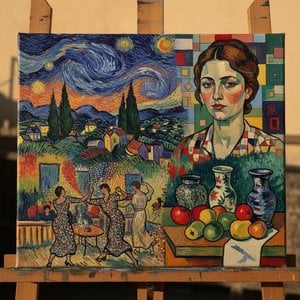
A Life Painted in Emotion: The World of Vincent van Gogh
Vincent Willem van Gogh, a name synonymous with artistic passion and turbulent genius, remains one of the most recognizable and beloved figures in Western art history. Born on March 30, 1853, in Groot-Zundert, Netherlands, his journey was not one of immediate acclaim but rather a slow burn of dedication, struggle, and ultimately, profound influence. The eldest of six children born to a Protestant minister, Theodorus van Gogh, Vincent’s early life was steeped in religious contemplation, a sensibility that would subtly permeate much of his later work. Though he displayed an inclination towards drawing from a young age, his path wasn't immediately clear; he explored various vocations – art dealer, teacher, and missionary – before fully embracing the artist’s life. These experiences, though seemingly disparate, proved formative, instilling in him a deep empathy for the working class and a profound sense of spiritual seeking that would become hallmarks of his artistic vision. Early influences included the Dutch Masters like Rembrandt van Rijn and Frans Hals, whose masterful use of light and shadow resonated with young Vincent, as well as contemporary French painters Jean-François Millet and Camille Corot, who depicted scenes of rural life with a poignant realism.
From Darkness to Light: Artistic Development and Style
Van Gogh’s serious engagement with painting began around 1880, largely self-taught, driven by an inner compulsion to express the world as he perceived it. His initial works reflected his compassion for the marginalized, focusing on the lives of peasants and laborers – exemplified in pieces like
The Potato Eaters. These early paintings are characterized by dark, earthy tones and a raw, almost brutal honesty that sought to capture the hardship and dignity of rural existence. The figures in *The Potato Eaters* aren’t idealized; they're depicted with unflinching realism, their faces etched with weariness and toil. This wasn’t simply a documentary record; it was an attempt to convey the profound respect Van Gogh held for these individuals, highlighting their resilience and humanity. A pivotal moment arrived with his move to Paris in 1886, where he was exposed to the vibrant world of Impressionism and Post-Impressionism. This encounter proved transformative, injecting brighter colors into his palette and encouraging experimentation with new techniques. He absorbed the lessons of artists like Monet, Renoir, and Pissarro, but never fully adopted their style; instead, he forged a path uniquely his own. His distinctive style rapidly evolved, becoming instantly recognizable for its bold colors, expressive brushwork, and emotional intensity. Van Gogh didn’t merely *represent* reality; he sought to convey the feeling of being within it, utilizing impasto – thick layers of paint – to create texture and imbue his canvases with a palpable energy. This technique wasn't simply aesthetic; it was an integral part of his expressive language, allowing him to translate inner turmoil and ecstatic joy onto the canvas.
Periods of Intensity: Key Works and Artistic Phases
Van Gogh’s artistic journey can be broadly divided into distinct periods, each marked by unique characteristics and significant works. The
Dutch Period (1880-1886), as mentioned, was defined by somber tones and depictions of peasant life. These early paintings, often characterized by a limited palette and meticulous detail, reflect his initial attempts to capture the essence of rural existence. The subsequent
Parisian Period (1886-1888) saw a dramatic shift towards brighter colors and experimentation with Impressionist techniques. He studied the works of artists like Monet and Pissarro, learning how to capture fleeting moments of light and color. However, it was during the
Arles Period (1888-1889), in the south of France, that Van Gogh reached a peak of creative intensity. Surrounded by the radiant light and vibrant landscapes of Provence, he produced some of his most iconic works:
Sunflowers, *The Night Café*, and *Starry Night Over the Rhône*. These paintings are not merely depictions of scenes; they are emotional landscapes, pulsating with life and imbued with a sense of longing. The swirling brushstrokes in *Starry Night* aren’t simply representing stars; they're conveying a feeling of awe and wonder, perhaps even a hint of anxiety. His use of color became increasingly expressive, employing vibrant yellows, blues, and greens to evoke specific moods and emotions. His final years, spent in Saint-Rémy and Auvers-sur-Oise (1889-1890), were marked by continued artistic output despite increasing mental distress. Confined to an asylum at Saint-Rémy following a breakdown, he found solace in painting the surrounding countryside, resulting in masterpieces like
The Starry Night, a swirling vortex of color and emotion that continues to captivate viewers today. Even during this period of profound suffering, his portraits – particularly those of Dr. Gachet – reveal an extraordinary sensitivity and psychological depth.
A Legacy Forged in Suffering: Achievements and Historical Significance
Despite facing rejection and struggling with mental illness throughout his life, Van Gogh created over 2,100 artworks in just over a decade—approximately 860 oil paintings, 150 watercolors, and over 1000 drawings and sketches. This astonishing output is testament to his unwavering dedication and relentless creative drive. Remarkably, during his lifetime, only one painting – *The Red Vineyard* – was sold. Recognition came posthumously, slowly at first, then with increasing momentum in the early 20th century. His work profoundly influenced the development of modern art, particularly Expressionism and Fauvism, inspiring artists to prioritize emotional expression over realistic representation. His bold use of color, distorted forms, and expressive brushwork paved the way for new artistic possibilities. Today, Van Gogh’s paintings are among the most recognizable and valuable artworks in the world, commanding record prices at auction and drawing millions of visitors to museums worldwide. But his legacy extends far beyond monetary value; he remains a cultural icon, representing the archetype of the “tortured artist” – though this narrative often overshadows his skill, dedication, and artistic vision. The Van Gogh Museum in Amsterdam stands as a testament to his enduring influence, showcasing his work and celebrating his life for generations to come. His art continues to resonate with audiences because it speaks to universal human experiences—love, loss, hope, despair—with an honesty and vulnerability that transcends time and culture.
- Major Influences: Dutch Masters (Rembrandt, Hals), Millet, Corot.
- Key Periods: Dutch, Parisian, Arles, Saint-Rémy/Auvers-sur-Oise.
- Notable Works: The Potato Eaters, Sunflowers, Starry Night, The Night Café.



 Zobacz w skali 1:1
 Kup ręcznie malowany obraz
 Wyślij
 Udostępnij
 Szczegóły
 Przewodnik

 Pobierz plik obrazu
 Podobne obiekty
 RTG
RTG Pokaz slajdów
 Statystyki

 Czytaj więcej






































 Opcja ze szkłem jest dostępna wyłącznie w rozmiarach poniżej 110 cm