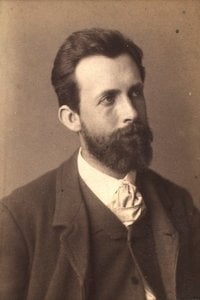
The Luminous Legacy of Viggo Pedersen
To wander through the canvases of Viggo Christian Frederik Vilhelm Pedersen is to embark on a sensory journey through the heart of the Danish landscape. Born in Copenhagen on March 11, 1854, into an environment steeped in artistic tradition, Pedersen was destined for a life defined by the brush and the palette. As the son of the esteemed artist and draftsman Vilhelm Pedersen, his earliest memories were likely colored by the meticulous strokes of his father’s hand. This foundational connection to art provided him with more than just technical instruction; it instilled a profound reverence for the natural world that would become the cornerstone of his life's work. His formal education at the Royal Danish Academy of Fine Arts, beginning in 1871, further refined this innate talent, placing him under the mentorship of luminaries such as P.C. Skovgaard and Janus la Cour, whose classical Romanticist influences provided the structural backbone for his burgeoning style.
As Pedersen matured, his artistic vision began to transcend the boundaries of his native Denmark. Between 1873 and 1881, a series of transformative travels through Germany, Paris, Switzerland, and Italy acted as a catalyst for a significant stylistic evolution. The vibrant energy of Paris, in particular, introduced him to the burgeoning ideals of Impressionism, teaching him to look beyond mere representation toward the ephemeral dance of light and atmosphere. This shift is masterfully captured in works such as “A Paved Road Under Old Trees” (1882), where the heavy shadows of tradition begin to yield to the flickering, transient moments of sunlight. His ability to blend the disciplined technique of his academic training with a newfound sensitivity to color and light allowed him to create landscapes that felt both timeless and vibrantly alive.
A Tapestry of Light and Domesticity
While Pedersen is celebrated as a master of the landscape, his oeuvre possesses a remarkable versatility that extends into the intimate realms of portraiture, religious art, and domestic scenes. He possessed a rare ability to imbue even the most quiet, interior moments with a sense of profound narrative weight. In paintings like “Sunshine in the Living Room” (1888), he captures the way light interacts with the textures of a home, turning a simple domestic space into a sanctuary of warmth and nostalgia. This mastery of atmospheric perspective allowed him to bridge the gap between the vast, sweeping vistas of the Danish countryside and the quiet, contemplative corners of human existence. His work often reflects a deep connection to the Danish Golden Age, yet he was never a prisoner of the past, constantly integrating modern European influences into his compositions.
The technical brilliance of Pedersen’s work is most evident in his use of color and texture. He utilized a rich, emotive palette that could shift from the somber, moody tones of “At the Approach of Night” (1890) to the bright, pastoral joy found in “Picking Poppies, Sora.” His compositions are characterized by:
- A sophisticated use of atmospheric perspective to create depth and a sense of infinite space.
- An expert command of natural light, capturing its movement across landscapes and through windows.
- A delicate balance between Romantic realism and the fleeting impressions of modernism.
Through these elements, he achieved a level of emotional resonance that allowed his viewers to feel the breeze of the Danish coast and the warmth of a summer afternoon.
Recognition and Enduring Influence
Throughout his prolific career, Pedersen’s contributions to the Danish art scene were met with significant acclaim. His dedication to the craft was formally recognized through prestigious honors, including the Sødring Prize in 1877 and the Annual Medal in 1890. His influence within the institutional fabric of the art world was equally profound; his election to the Academy's Plenary Assembly in 1904 and his service on the Academic Council from 1908 to 1911 cemented his status as a pillar of the artistic community. Beyond his individual accolades, his legacy lived on through his family, notably his son, William Pedersen, who continued the tradition of artistic excellence.
Today, the works of Viggo Pedersen remain vital touchstones for understanding the transition of Scandinavian art from the structured traditions of the 19th century to the more fluid, light-driven sensibilities of the early 20th century. He remains a painter of profound empathy, whose canvases serve as enduring windows into a world where nature and humanity exist in a state of beautiful, luminous harmony. His ability to capture the soul of the Danish landscape ensures that his name continues to resonate with anyone moved by the quiet majesty of the natural world.



 Zobacz w skali 1:1
 Przełącz na wersję drukowaną
 Wyślij
 Udostępnij
 Szczegóły
 Przewodnik

 Pobierz plik obrazu
 Podobne obiekty
 RTG
RTG Pokaz slajdów
 Statystyki
 Czytaj więcej