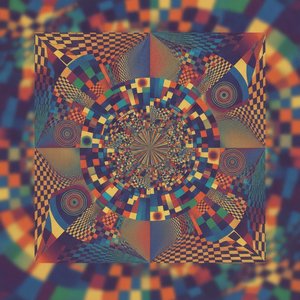
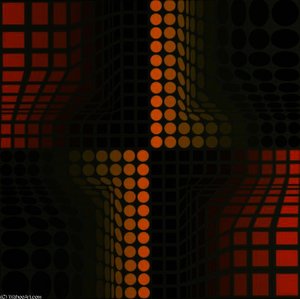
Variációk: A Kaleidoscope of Geometric Harmony by Victor Vasarely
Victor Vasarely’s "Variációk" (Variations), created in 1989, is more than just an arrangement of circles; it's a vibrant exploration of perception and the underlying mathematical order that governs our visual world. This piece, born from the mind of the Op Art pioneer, exemplifies his lifelong dedication to creating art accessible to all, transcending traditional boundaries between fine art and design. The artwork pulsates with energy, drawing the viewer into a dynamic interplay of color and form—a testament to Vasarely’s belief in the power of geometric abstraction to evoke profound emotional responses.
The Genesis of Op Art and Vasarely's Unique Vision
To truly appreciate "Variációk," one must understand its place within the broader context of the Op Art movement. Emerging in the 1960s, Op Art (Optical Art) sought to challenge traditional artistic conventions by exploiting visual illusions—creating a sense of movement, depth, and vibration on a flat surface. While other artists explored these effects through subtle shifts in color or line, Vasarely approached the genre with a distinctly systematic methodology. He wasn't interested in spontaneous expression; instead, he meticulously employed grids, mathematical principles, and precise geometric forms to generate patterns that actively engaged the viewer’s perception. His background in graphic design and advertising honed his ability to manipulate visual elements for maximum impact, resulting in works like "Variációk" that are both intellectually stimulating and emotionally captivating.
A Symphony of Circles: Technique and Composition
"Variációk" showcases Vasarely’s signature style—a carefully orchestrated arrangement of circles in a variety of colors including vibrant reds, calming blues, rich purples, energetic oranges, and grounding grays. These circles are strategically positioned within a grid-like structure, with some overlapping to create layers of visual complexity. The varying sizes of the circles contribute to the overall dynamism, drawing the eye across the canvas and creating an illusion of depth. The technique employed likely involved screenprinting, allowing for precise replication of these geometric forms and ensuring consistency in color application—a hallmark of Vasarely’s commitment to reproducibility and mass appeal. It's a testament to his belief that art shouldn't be confined to galleries but should permeate everyday life.
Symbolism and Emotional Resonance
While seemingly abstract, "Variációk" carries layers of symbolic meaning. The circles themselves can be interpreted as representations of wholeness, unity, and cyclical patterns—reflecting the interconnectedness of all things. The vibrant color palette evokes a range of emotions, from joy and excitement to tranquility and contemplation. The overall effect is one of harmonious balance—a visual representation of order emerging from apparent chaos. Vasarely aimed not just to create visually striking images but also to stimulate intellectual curiosity and evoke emotional responses in the viewer. "Variációk" succeeds brilliantly on both fronts, offering a captivating glimpse into the artist’s unique vision and his profound understanding of human perception.
Pytania i odpowiedzi
Jaka paleta i dominujący kolor definiują "Variációk"?
Kolorystyka dzieła „Variációk” – Wiktór Wasaryli: paleta Neutrals, w której dominuje Rosy Brown (#9f8da9).
Gdzie najlepiej eksponować dzieło „Variációk” w formacie Square?
Format (Square) oraz rekomendowana przestrzeń (Living Room) to dwa parametry dotyczące rozmieszczenia dzieła „Variációk” – Wiktór Wasaryli.
Jaki nastrój emocjonalny budzi „Variációk” – Wiktór Wasaryli?
Emocjonalny ton przypisany do „Variációk” – Wiktór Wasaryli to Calm. Oddaje on emocje, jakie wyraża to dzieło.



 Podgląd w skali 1:1
 Przełącz na wydania drukowane
 Wyślij jako kartkę
 Udostępnij
 Szczegóły dzieła
 Przewodnik

 Pobierz obraz
 Podobne obiekty
 RTG
RTG Pokaz slajdów
 Statystyki
 Rozwiń treść






































 Opcja ze szkłem jest dostępna wyłącznie w rozmiarach poniżej 110 cm