Dzieło sztuki prezentowane na tej stronie podlega ochronie prawem autorskim, co oznacza, że nie mamy prawa do tworzenia ani sprzedaży jego identycznej reprodukcji. Ochrona ta jest egzekwowana na mocy umów międzynarodowych, takich jak Konwencja berneńska oraz przez przepisy prawa krajowego, w tym te określone w Prawo autorskie USA – Tytuł 17.
Metoda ta jest w pełni zgodna z przepisami prawa autorskiego, ponieważ nie polega na kopiowaniu ani powielaniu chronionego dzieła. Stanowi ona kreatywną reinterpretację – nowy obraz, który czerpie inspirację z oryginału, ale nie jest z nim tożsamy.
Wydruki giclée lub płótna o jakości muzealnej, szybka realizacja i szeroki wybór opcji wykończenia. ( Zamów ręcznie malowaną reprodukcję Przejdź do wersji cyfrowej)





























Wybierz spośród naszych standardowych rozmiarów, które zachowują oryginalne proporcje dzieła sztuki.

Wpisz wymaganą szerokość i wysokość, aby dopasować grafikę do ramy lub ściany. Wydruk można jedynie przyciąć, nigdy nie powiększając go poza oryginalny obraz, dlatego format o innych proporcjach spowoduje utratę części kompozycji. Przed rozpoczęciem druku prześlemy Ci cyfrowy podgląd do zatwierdzenia. Obraz wyświetlany na tej stronie nie pokazuje rzeczywistego przycięcia — jedynie podgląd oddaje ten efekt.
Dostawa na cały świat () w ciągu 2 tygodni zamiast standardowych 4/5 tygodni. (10 Listopad)
Untitled1
Wymiary reprodukcji
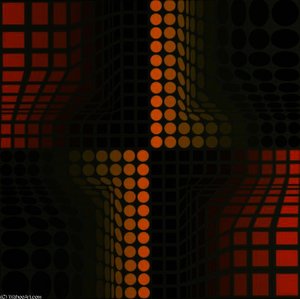
Victor Vasarely's "Untitled1" is more than just an abstract composition; it’s a meticulously crafted illusion, a testament to the pioneering work of Op Art and a profound exploration of how our eyes perceive reality. Created by one of the movement’s key figures – born Károly Vaszary in 1906 in Pécs, Croatia – this artwork embodies his lifelong fascination with geometry and its power to manipulate visual experience. Initially drawn to medicine, Vasarely's destiny shifted dramatically when he embraced painting, a path forged through rigorous training at the Podolini-Volkmann Academy and, crucially, within the influential workshop of Sándor Bortnyik, where the principles of functional design and geometric abstraction were rigorously honed – directly echoing the Bauhaus movement’s emphasis on form and function. “Untitled1” stands as a potent distillation of these influences, a vibrant embodiment of Vasarely's artistic vision.
At first glance, "Untitled1" appears to be a chaotic jumble of shapes – interlocking circles and squares arranged in a seemingly random fashion. However, a closer examination reveals an astonishing level of control and precision. The artwork’s core is dominated by a large square, subtly differentiated from the surrounding areas, creating a dynamic tension that draws the eye across the canvas. This grid-like structure, punctuated by variations in density and placement, isn't merely decorative; it’s a deliberate orchestration designed to trigger optical illusions. The high contrast between the vibrant red/orange and black hues amplifies this effect, forcing the viewer’s eye to constantly adjust its focus, creating a mesmerizing sense of movement and depth despite the artwork’s fundamentally flat surface. Vasarely masterfully exploits our visual system, challenging our assumptions about space and perspective.
The creation of “Untitled1” speaks to a remarkable technical skill. Executed with likely acrylics on canvas or board, the artist’s control is evident in the clean lines defining each shape and the consistent repetition throughout the composition. The smooth texture, a product of careful application and precise geometric patterns, suggests a deliberate avoidance of impasto – textural variation – prioritizing clarity and optical impact above all else. This meticulous approach aligns with Vasarely's broader philosophy: to reduce art to its purest visual elements, focusing on the fundamental principles of perception rather than representational accuracy. The artwork’s enduring quality is a testament to the robustness of this technique.
While undeniably abstract, “Untitled1” invites contemplation about its potential symbolic meanings. The repetitive patterns could be interpreted as representing order, infinity, or even a deliberate disorientation – mirroring the unsettling yet captivating effect that Op Art generates. Vasarely himself was interested in exploring the relationship between art and science, viewing his work as a visual investigation into the nature of perception itself. Beyond this intellectual engagement, however, lies an undeniable emotional resonance. The dynamic interplay of color and form evokes a sense of excitement, energy, and perhaps even a subtle feeling of unease – a reminder that our perceptions are not always reliable guides to reality. This piece is a powerful demonstration of how art can profoundly affect our psychological state.
„Untitled1” figuruje w katalogu jako dzieło o Recognized wśród prac należących do nurtu Op Art.
Statystyki dotyczące „Untitled1” – Wiktór Wasaryli znajdują się na stronie Statystyki wyświetleń dzieła: obejmują one miesięczną liczbę odwiedzin danego dzieła, wizyty przy pracach artysty oraz podział ostatnich odwiedzających według krajów i języków.
W dorobku Wiktór Wasaryli, "Untitled1" wpisuje się w styl Op Art, nawiązując do tematów takich jak bauhaus, geometric abstraction, kinetic art exploration, visual perception studies, op art pioneer work, signature pattern development.

1906 - 1997 , Chorwacja

Embark on a visual journey through the mesmerizing world of Op Art. Discover the masters of optical illusion, explore geometric abstraction, and learn how to curate high-impact kinetic works for your private collection with expert guidance from art professionals.

Explore the mesmerizing world of Victor Vasarely. Discover how his Bauhaus-inspired Op Art masters the science of perception through geometric abstraction and vibrant color. A sophisticated guide for discerning art collectors seeking to understand the legacy of optical illusion.
 Podgląd w skali 1:1
 Wyślij jako kartkę
 Udostępnij
 Szczegóły dzieła
 Przewodnik

 Pobierz obraz
 Podobne obiekty
 RTG
RTG Pokaz slajdów
 Pytania i odpowiedzi
 Statystyki

 Rozwiń treść









 Opcja ze szkłem jest dostępna wyłącznie w rozmiarach poniżej 110 cm