A Symphony in Squares: Exploring Victor Vasarely’s “Sinpo”
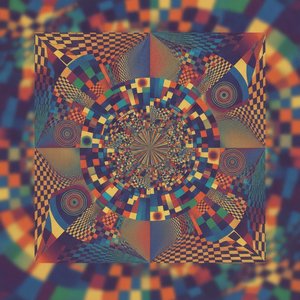
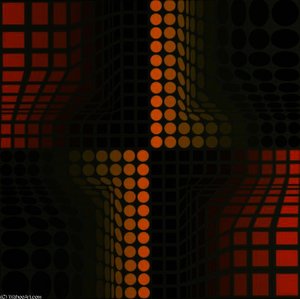
Victor Vasarely's "Sinpo" is more than just a painting; it’s an invitation into the heart of Op Art, a visual exploration of perception itself. Created by one of the movement’s founding fathers, this work embodies the core principles that captivated audiences in the mid-20th century – a fascination with optical illusions and the dynamic effects of geometric forms. The artwork's deceptively simple composition, dominated by pulsating purple and verdant green shapes, immediately draws the viewer into a world where reality seems to shift and shimmer. Vasarely’s meticulous construction, utilizing countless small squares arranged in complex patterns, creates an illusion of movement and depth that is both mesmerizing and intellectually stimulating.
The Genesis of Kinetic Art: Vasarely's Bauhaus Roots
Understanding "Sinpo" requires acknowledging the profound influence of its creator. Born Károly Vaszary in 1906, his journey began with aspirations for a medical career before he was drawn to the burgeoning world of visual art. His enrollment at the Podolini-Volkmann Academy and subsequent studies within Sándor Bortnyik’s “Műhely” – a workshop deeply connected to the Bauhaus movement – proved pivotal. The Bauhaus emphasized functional design, geometric abstraction, and the exploration of industrial materials, concepts that directly informed Vasarely's artistic practice. This background instilled in him a rigorous approach to composition, prioritizing mathematical precision and the manipulation of visual perception. “Sinpo” is therefore a direct descendant of this intellectual and aesthetic lineage, reflecting a desire to translate scientific principles into an accessible and engaging art form.
Decoding the Visual Language: Op Art and Geometric Abstraction
“Sinpo” exemplifies the core tenets of Op Art – Optical Art. This movement, flourishing in the 1960s, sought to create illusions through controlled visual effects, manipulating the viewer’s perception of space, depth, and movement. Vasarely's use of contrasting colors—the cool purple against the vibrant green—amplifies this effect, creating a sense of vibration and dynamism. The arrangement of the small squares isn’t merely decorative; it’s a deliberate strategy to disrupt our natural visual expectations. The artwork is firmly rooted in geometric abstraction, rejecting representational imagery in favor of pure form and pattern. This approach was revolutionary at the time, challenging traditional notions of artistic expression and paving the way for further experimentation with abstract art.
Symbolism and Emotional Resonance
While ostensibly a purely formal exercise, “Sinpo” subtly evokes feelings of energy, movement, and even anxiety – common themes explored within Op Art. The fragmented nature of the composition can be interpreted as reflecting the complexities of modern life, mirroring the fractured perceptions that arise from an increasingly fast-paced world. The repetition of squares, a fundamental element in Vasarely’s work, suggests order amidst chaos, inviting contemplation on the underlying structures of reality. This piece is not simply about seeing; it's about *experiencing* – a visceral engagement with the very nature of visual perception.
Pytania i odpowiedzi
Do którego okresu twórczości Wiktór Wasaryli należy dzieło "Sinpo"?
„Sinpo” pochodzi z okresu Op Art w twórczości Wiktór Wasaryli. Klasyfikacja ta wiąże dzieło z rozwojem artysty.
Jak technika i ruch łączą się w "Sinpo"?
"Sinpo" powstało przy użyciu Acrylic On Canvas, w stylu Op Art.
Jak można wykorzystać „Sinpo” – Wiktór Wasaryli w dekoracji wnętrz?
Zalecane zastosowanie (Accent) oraz przestrzeń (Living Room) to dwie rekomendacje dla dzieła „Sinpo” – Wiktór Wasaryli.



 Podgląd w skali 1:1
 Zamów ręcznie malowaną reprodukcję
 Wyślij jako kartkę
 Udostępnij
 Szczegóły dzieła
 Przewodnik

 Pobierz obraz
 Podobne obiekty
 RTG
RTG Pokaz slajdów
 Statystyki

 Rozwiń treść






































 Opcja ze szkłem jest dostępna wyłącznie w rozmiarach poniżej 110 cm