A Symphony of Perception: Unveiling Victor Vasarely’s *Sende C*
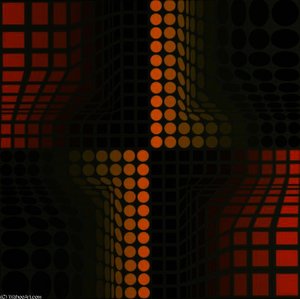
Victor Vasarely's *Sende C*, a captivating close-up study of vibrant blue and green, is more than just an image; it’s an invitation to explore the very nature of perception. This Op Art masterpiece, created by the Hungarian pioneer, embodies the core tenets of kinetic art – the manipulation of visual experience through geometric forms. The painting's deceptively simple composition immediately draws the eye into a dynamic interplay of color and shape, creating an illusion of movement and depth that shifts with every glance. Vasarely’s meticulous approach to translating mathematical principles onto canvas resulted in a work that is both intellectually stimulating and profoundly visually arresting.
The Genesis of Op Art: Vasarely's Bauhaus Roots
Born in 1906 in Pécs, Croatia, Károly Vaszary – later Victor Vasarely – initially pursued a medical career before embracing his artistic destiny. His formative years were deeply influenced by the Bauhaus movement and Sándor Bortnyik’s “Műhely” workshop, where he absorbed the principles of functional design and geometric abstraction. This training instilled in him a rigorous approach to composition, utilizing precise mathematical ratios and optical illusions to generate his signature style. *Sende C* exemplifies this legacy – a direct descendant of the Bauhaus emphasis on clarity, order, and the exploration of visual phenomena.
Decoding the Visual Language: Technique and Style
*Sende C* showcases Vasarely’s mastery of “stabék,” a technique he developed to create precisely defined, isolated shapes. The painting is constructed from numerous small, overlapping circles in varying shades of blue and green, meticulously arranged to generate an illusion of three-dimensionality. This method, combined with the deliberate use of contrasting colors, amplifies the visual impact and creates a mesmerizing sense of movement. The seemingly random distribution of dots actually adheres to a carefully calculated system, reflecting Vasarely’s belief that art could be both aesthetically pleasing and scientifically grounded.
Symbolism and Emotional Resonance
While ostensibly abstract, *Sende C* resonates with deeper symbolic meanings related to the exploration of consciousness and perception. Vasarely sought to represent the subjective experience of reality – how our brains actively construct our understanding of the world. The dynamic interplay of color and form evokes a sense of excitement, disorientation, and ultimately, wonder. This piece invites viewers to question their own perceptions and consider the complex relationship between art and the human mind. Its enduring appeal lies in its ability to tap into fundamental aspects of our visual experience.
Pytania i odpowiedzi
Jaki dominujący odcień przenika „Sende C” autorstwa Wiktór Wasaryli?
„Sende C” skłania się ku Green to Violet Spectrum tonacji.
Czy mogę użyć rozszerzonej rzeczywistości, aby zobaczyć „Sende C” autorstwa Wiktór Wasaryli w swoim pokoju?
Dzieło „Sende C” autorstwa Wiktór Wasaryli można przymierzyć na własnej ścianie dzięki stronie Podgląd AR, wykorzystując rozszerzoną rzeczywistość na kompatybilnym urządzeniu.
Jakie emocje przekazuje dzieło "Sende C" należące do nurtu Op Art?
W ramach nurtu Op Art, dzieło „Sende C” zostało utrwalone w Calm tonie.



 Zobacz w skali 1:1
 Kup ręcznie malowany obraz
 Wyślij
 Udostępnij
 Szczegóły
 Przewodnik

 Pobierz plik obrazu
 Podobne obiekty
 RTG
RTG Pokaz slajdów
 Statystyki

 Czytaj więcej






































 Opcja ze szkłem jest dostępna wyłącznie w rozmiarach poniżej 110 cm