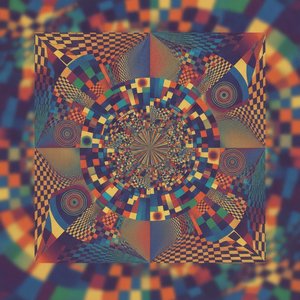
Victor Vasarely’s “Reech”: A Vortex of Geometric Perception
Victor Vasarely's "Reech," dating from an unknown period but undeniably rooted in the vibrant heart of Op Art, is more than just a visually arresting composition; it’s a meticulously crafted exploration of perception itself. Created by one of the movement’s founding fathers – born Károly Vaszary in 1906 in Pécs, Croatia – this artwork embodies his lifelong fascination with geometry and its power to manipulate our visual experience. The piece immediately commands attention with its intensely saturated palette, a riot of reds, greens, and purples that coalesce into concentric layers of diamond-shaped forms. These aren’t merely decorative elements; they are the building blocks of a carefully orchestrated illusion, drawing the viewer inexorably towards the artwork's central vortex.
Decoding the Geometric Language
Vasarely’s approach was profoundly influenced by his early training within Sándor Bortnyik’s “Műhely” workshop, a space deeply connected to the principles of functional design and the radical abstraction championed by the Bauhaus movement. This background instilled in him a rigorous understanding of geometric forms – particularly the diamond – as tools for creating optical illusions. "Reech" exemplifies this mastery; the repetition and layering of these shapes aren’t haphazard; they are precisely calculated to generate a sense of depth, movement, and even slight disorientation. The smooth texture, achieved through digital rendering, belies the intricate complexity beneath, suggesting a deliberate control over the illusionary space. The manipulation of perspective, with brighter colors indicating forward movement, further enhances this dynamic effect.
Op Art’s Legacy and Symbolic Resonance
As a key figure in Op Art, Vasarely sought to translate scientific theories about visual perception into artistic expression. “Reech” aligns perfectly with the movement's core tenets – its focus on creating optical illusions through precise geometric patterns. While devoid of representational imagery, the vortex-like structure subtly evokes notions of transformation, infinite space, and perhaps even a controlled chaos. The artwork’s dynamism isn’t simply aesthetic; it speaks to a deeper exploration of how we interpret the world around us. It's a testament to Vasarely's belief that art could be both intellectually stimulating and profoundly engaging.
Technique and Materiality
The creation of "Reech" likely involved sophisticated digital painting techniques, utilizing software to generate the intricate patterns and gradients with remarkable precision. The artwork’s material is fundamentally pixel-based – a testament to the evolving nature of artistic practice in the 20th century. This digital rendering allows for an unparalleled level of control over color, form, and texture, resulting in a piece that feels both intensely vibrant and meticulously crafted.
Pytania i odpowiedzi
Czy mogę zobaczyć „Reech” – Wiktór Wasaryli w różnym oświetleniu?
Widok rentgenowski dzieła „Reech” – Wiktór Wasaryli jest dostępny na stronie Analiza rentgenowska: to interaktywna analiza obrazu obejmująca jedenaście warstw optycznych.
Czy kolory dzieła "Reech" są intensywne czy stonowane?
Kolory dzieła „Reech” – Wiktór Wasaryli charakteryzują się Clear Color Presence nasyceniem oraz Balanced intensywnością.
Do jakiego nurtu i epoki zalicza się „Reech” – Wiktór Wasaryli?
„Reech” – Wiktór Wasaryli reprezentuje nurt Op Art, powstały w epoce Nowoczesność swojego twórcy.



 Zamów ręcznie malowaną reprodukcję
 Wyślij jako kartkę
 Udostępnij
 Szczegóły dzieła
 Przewodnik

 Pobierz obraz
 Podobne obiekty
 Pokaz slajdów
 Statystyki

 Rozwiń treść






































 Opcja ze szkłem jest dostępna wyłącznie w rozmiarach poniżej 110 cm