A Symphony in Red: Exploring the Geometric Vision of Victor Vasarely’s *Pyross-c*
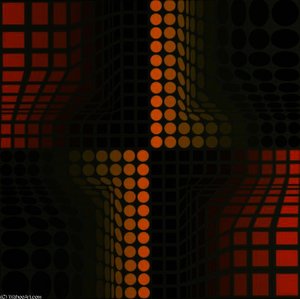
Victor Vasarely's Pyross-c is not merely a painting; it’s an invitation to experience reality through the lens of perception itself. This striking work, dominated by a vibrant red background, immediately draws the viewer into a world meticulously constructed from geometric forms – a testament to Vasarely’s pioneering role in Op Art and his profound engagement with kinetic principles. The image captures a moment frozen within a dynamic illusion, a visual trick that plays on our innate ability to interpret movement and depth. The artist's meticulous attention to detail, particularly the varying sizes of the circles, creates a captivating sense of spatial complexity, inviting prolonged contemplation and rewarding repeated viewing.
The Genesis of Optical Illusions: Vasarely and the Bauhaus Legacy
Born in 1906 in Pécs, Croatia – then part of Austria-Hungary – Károly Vaszary, as he was initially known, embarked on a remarkable artistic journey. His early studies in medicine hinted at a conventional path, but his passion for visual expression led him to the Podolini-Volkmann Academy and ultimately, to Sándor Bortnyik’s influential “Műhely” workshop. This environment, deeply rooted in the principles of Bauhaus functional design and geometric abstraction, provided the fertile ground for Vasarely's unique vision to take root. The influence is palpable here – the deliberate arrangement of shapes, the exploration of optical effects, and the rejection of traditional representational art all echo the core tenets of this revolutionary movement.
Decoding the Visual Language: Circles, Rhythm, and Movement
The composition of *Pyross-c* is a carefully orchestrated dance of circles. These aren’t simply decorative elements; they are fundamental building blocks used to create rhythm, depth, and an illusion of movement. Vasarely was fascinated by how the eye perceives these shapes – how they appear to vibrate and shift depending on the angle of observation. The clock subtly integrated into the design adds another layer of complexity, suggesting a temporal dimension within this static image, further reinforcing the artwork's exploration of perception and time. The use of color is equally crucial; the bold red background amplifies the impact of the shapes, creating a visually arresting experience.
A Legacy of Illusion: Vasarely’s Impact on Art and Design
Victor Vasarely (1906-1997) fundamentally altered our understanding of art. His work, alongside that of artists like Bridget Riley and Josef Albers, helped usher in the era of Op Art – a movement dedicated to creating optical illusions through precise geometric arrangements. *Pyross-c* stands as a powerful example of this legacy, demonstrating Vasarely’s mastery of color, form, and perception. Today, reproductions like this offer an accessible entry point into his groundbreaking work, allowing collectors and interior designers alike to bring the dynamism and intellectual rigor of Vasarely's vision into their spaces.
Pytania i odpowiedzi
Gdzie można kupić ręcznie malowane reprodukcje dzieła „Pyross-c” – Wiktór Wasaryli?
Ręcznie malowaną reprodukcję dzieła „Pyross-c” – Wiktór Wasaryli można zamówić bezpośrednio na stronie Ręcznie malowana reprodukcja: ręcznie malowana reprodukcja olejowa na płótnie lnianym, tworzoną na specjalne zamówienie.
Jaki dominujący odcień przenika „Pyross-c” – Wiktór Wasaryli?
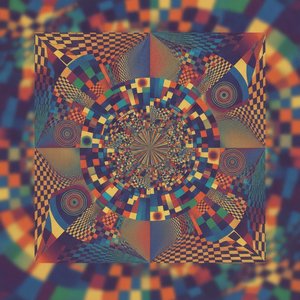
„Pyross-c” skłania się ku Green to Violet Spectrum tonacji.
Jakie miejsce w dorobku twórczym Wiktór Wasaryli zajmuje dzieło "Pyross-c"?
"Pyross-c" wpisuje się w nurt Op Art w twórczości Wiktór Wasaryli, której charakterystyczne motywy obejmują op art influence, geometric abstraction, vasarely's vision, visual perception, modern design ethos, color theory exploration, abstract expressionism, cold.



 Podgląd w skali 1:1
 Zamów ręcznie malowaną reprodukcję
 Wyślij jako kartkę
 Udostępnij
 Szczegóły dzieła
 Przewodnik

 Pobierz obraz
 Podobne obiekty
 RTG
RTG Pokaz slajdów
 Q&A
Q&A Statystyki

 Rozwiń treść






































 Opcja ze szkłem jest dostępna wyłącznie w rozmiarach poniżej 110 cm