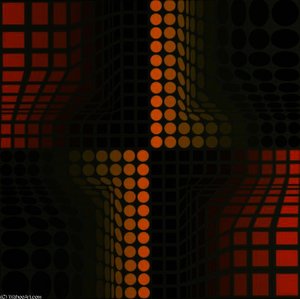
Victor Vasarely: The Architect of Illusion
Victor Vasarely (1906 – 1997), Hungarian-French artist, stands as an undisputed titan of Op Art—a movement that revolutionized visual perception in the mid-20th century. More than just a painter, Vasarely was a conceptual sculptor who meticulously crafted geometric abstractions designed to destabilize our senses and challenge conventional notions of reality. His enduring legacy resides not merely in his aesthetic achievements but also in his profound influence on subsequent generations of artists.
Early Influences & Bauhaus Roots
Born Győző Vásárhelyi in Pécs, Hungary, Vasarely’s artistic trajectory began with a formal education in medicine. However, he swiftly abandoned scientific pursuits for the vibrant world of visual art, enrolling at Sándor Bortnyik’s Műhely workshop—a school deeply rooted in the Bauhaus principles. This formative experience instilled within him a conviction that art should serve functionality and prioritize geometric abstraction as a pathway to exploring fundamental visual concepts. The Bauhaus ethos championed clean lines, modular design, and an uncompromising commitment to rationalism – ideals that would become inseparable from Vasarely’s artistic vision.
The Birth of Op Art: Zebra & Beyond
Vasarely's breakthrough came in 1937 with “Zebra,” a pioneering work that cemented his place as one of the progenitors of Op Art. This mesmerizing piece utilizes precisely calibrated black squares superimposed on a luminous yellow background, creating an illusion of movement and depth—a visual paradox achieved through optical illusions. Unlike traditional painting techniques focused on representing external reality, Vasarely deliberately sought to manipulate perception itself, harnessing principles derived from Gestalt psychology to generate captivating visual effects.
Geometric Abstraction & Kinetic Sculpture
Vasarely’s artistic practice extended far beyond canvas; he embraced kinetic sculpture—creating monumental installations that responded to movement and light. These sculptures, often composed of interlocking cubes and spheres, further amplified the illusionistic qualities inherent in his paintings. He meticulously calculated angles and proportions to generate dynamic visual patterns, transforming static forms into instruments of perceptual exploration. His approach was revolutionary, anticipating developments in computer graphics and digital art decades before their widespread adoption.
Symbolism & Emotional Resonance
While Vasarely’s works appear initially devoid of narrative content—pure geometric forms presented against a monochrome backdrop—they are imbued with a subtle yet powerful symbolic dimension. The repetition of shapes, the interplay of colors, and the manipulation of perspective serve to convey concepts related to order, chaos, and transformation. More than just aesthetically pleasing images, Vasarely’s creations invite contemplation on the nature of perception and the relationship between art and science. They evoke a feeling of wonder—a reminder that reality itself is often more complex and captivating than our conscious minds might readily acknowledge.



 Podgląd w skali
 Zamów ręcznie malowaną reprodukcję
 Wyślij jako kartkę
 Udostępnij
 Szczegóły dzieła

 Pobierz
 Podobne obiekty
 RTG
RTG Pokaz slajdów
 Stats
Stats
 Rozwiń treść






































 Opcja ze szkłem jest dostępna wyłącznie w rozmiarach poniżej 110 cm